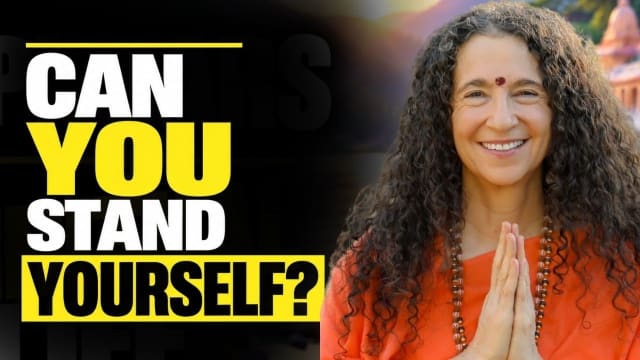
Every serious chanter eventually hits the same question. You have a mantra that moves you, but you also love Hanuman, you feel the pull of Shiva, you bow to Ganesh before you begin your day, and you have a guru whose name you cannot stop saying. Do you keep all of that devotion in one bowl, or do you spread it across a week of different mantras? In a short teaching posted to her YouTube channel in early November 2026, Sadhvi Bhagawati Saraswati, known as Sadhviji, gives a clear answer. Her answer is not "pick the one correct mantra forever." It is a distinction between two practices that often get blurred together: japa, the focused repetition of a single mantra, and puja, the open-hearted honoring of the many forms of the Divine that touch us. The video runs under six minutes and answers one question, but the logic inside it is worth slowing down for.
Her starting point is practical. Asked whether a person should chant one mantra every day or different mantras for different forms of the Divine, she begins with japa itself and makes her recommendation plain: "Just with the mantra japa, I would recommend one mantra because of that power of what happens as it starts to actually resonate in you." The phrase that carries the weight is "resonate in you." She is describing a process that unfolds over time, not a single session. A mantra repeated once is a sound. The same mantra repeated across many sessions becomes something you have lived with.
The reasoning is about focus. In her words: "The issue is you want to be focused. And it's hard to focus if I'm chanting, you know, five different mantras." Anyone who has tried to hold a rhythm while switching songs every four bars knows the problem. The mind has to re-learn the shape of each phrase, re-find its breath, and re-establish its devotional tone. Japa asks the opposite of novelty. It asks you to return to the same syllables, again and again, until the returning is the point. [0:00]
She states the mechanism directly: "The power of japa works in a repetition sort of way." Repetition is not a warm-up for the real practice in this view. It is the practice. The count, whether you use a mala or simply keep track of rounds, gives the mind a container. The sameness of the sound gives it somewhere to settle.
The most striking line in the teaching describes the point where repetition stops feeling like effort. "You chant it so much, so many times, over and over and over and over and over again in a deep meditative devotional state," she says, "and eventually you see it's almost like that mantra that I just chant itself." She laughs briefly at the end of that thought, and it is one of the most human moments in the video. The mantra no longer feels like something you are doing. It begins to run, quietly, underneath whatever else you are doing.
"The power of mantra though, especially with regard to mantra japa, is much more powerful when it is just one mantra because then what happens is it actually starts chanting itself within you." (Sadhviji, YouTube, 1:41)
This is a claim about depth, not about correctness. She is not saying other mantras are wrong or weaker. She is saying that depth accumulates in one channel, and that the accumulation is what gives japa its force. Spread the same hours across five mantras and each one stays at the surface.
Yes, and she says so without hedging. "Now, it may be that I do different mantras on different days. Absolutely possible. I do a Hanuman Ji mantra on Tuesdays. I do a Shankar Bhagwan mantra on Mondays. You can absolutely do that." [1:22] The rotation she describes is not a failure of commitment. It is a choice about how a devotional life is arranged across a week.
Her middle path is a layered one. Keep a single mantra as the core of your japa, the thread you return to, and then let other devotions sit alongside it. She gives an example of how that layering can look: "You do a few rounds or a few malas of your mantra every day, and then okay, so Tuesday you add some Hanuman Chalisas or Hanuman Japa, no problem at all, it's beautiful." The core stays fixed. The additions are offerings on top of it.
This is where the teaching becomes subtle, and where many chanters go wrong. She separates the discipline of japa from the wide, emotional field of puja, prayer, celebration, and devotion. For puja, the field is open. "If you feel deeply touched by many different forms of the divine, do it. Absolutely. Do a different aspect of the divine's puja every day, why not?"
But she adds a warning about the inner stance behind that openness. The worry is not that you honor many deities. The worry is a particular bargaining psychology. "Just make sure that your mind understands that it's not I'm making Shankar Bhagwan happy today. I'm making Hanuman Bhagwan happy the next day. I'm making Ganesh Bhagwan happy the next day. Like I've got all my ducks in a row. It's not that." [0:22]
That line is worth sitting with. A devotional calendar can quietly turn into a ledger, where each deity is a box to tick and the aim is to keep everyone satisfied. Sadhviji rejects that frame. Her Hindi phrase, "kis sab ko khush karu taki," roughly asks how one could keep everyone pleased, and she dismisses the idea outright. Devotion, in her account, is not a balancing act among gods. It is a single current that takes different shapes.
Her answer rests on the goal that sits above both practices. "Ultimately the goal is to see the divine in all." [2:51] If that is the aim, then multiplicity is not a betrayal of focus. It is an expression of the same recognition appearing in many faces.
She offers her own life as an example, and it is the most personal passage in the video. "I am a deep devotee of Hanuman Ji. I'm a deep devotee of Bhagwan Krishna. I'm a deep devotee of Ganga. I'm a deep devotee of my guru. And I have been known to burst into ecstatic sobs of spiritual oneness hugging trees." [3:57] The sentence is funny, and it is also a demonstration. She does not manage her devotion like a portfolio. She lets it overflow in every direction, including toward a tree.
"So there's there's an incredible spectrum of ways of being touched by the presence of the divine. So let it all touch you. Open your heart, open your devotion, do puja of it all, whatever touches you." (Sadhviji, YouTube, 4:35)
The structure she describes can be summed up in three lines. One mantra anchors the japa, where repetition does its slow work. Many deities receive the puja, where the heart opens without a checklist. And the inner intention is unified, so that honoring any form is honoring the whole.
Her own example shows how flexible the rule is outside the japa itself. She has a guru mantra, given to her by her guru, which she chants along with other mantras in ceremony. "I sit in heaven. I chant all the heaven mantras along with, you know, the rishikumars. We come to aarti, chant all the aarti mantras. Sit in some function, they're chanting mantras. I chant along with all of the ones I know." [4:57] She is clear that a mantra you were not personally assigned is not off limits in a communal setting. "It's not like, 'Oh, wait, that's not my mantra. I'm not going to chant it.'"
The boundary is drawn at the japa. "As far as what you're actually doing on your japa with that japa practice, try to stay with one mantra for that." [5:32] Outside the private repetition, you can sing with the room. Inside it, you stay with the thread.
The video does not give a method for selection, and it would be inventing to pretend otherwise. What it gives is a criterion: the mantra should be one you can return to over the long run, because the benefit she describes depends on accumulated repetition. A mantra you abandon after a month never gets the chance to begin "chanting itself." Practically, that suggests picking something you can commit to for the long haul, counting your rounds consistently, and resisting the urge to swap when the practice feels dry. Dryness is often the stage before the resonance she describes.
The teaching is short, but it holds a complete position. Keep one mantra for your japa so the repetition has room to deepen. Let your devotion to Hanuman, Shiva, Krishna, Ganesha, your guru, or the Ganga flow outward in puja, prayer, and celebration, and let it be whatever touches you. Keep the inner stance clear: you are not paying off gods in rotation, you are recognizing the Divine in many faces. Watch the full video on Sadhviji's channel to hear her own phrasing, especially the lines on repetition and the mantra that begins chanting itself. Then try it for a month with a single mantra and notice what changes in the sixth week, not the first.