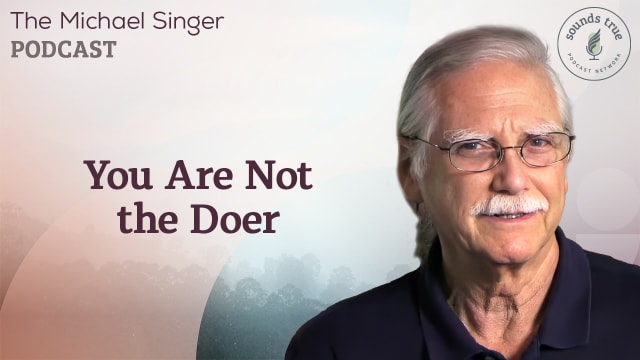
Six hours a day on the meditation cushion, and still not getting out. That is the starting point of a short conversation between Tami Simon and Michael Singer about his new book, Wisdom Untethered: A Time for Questions, and it explains why a volume of 200 questions can, in his telling, reduce to one. The question is "are you willing to let go?" It sounds like a slogan until he describes what letting go is not, where it happens, and what he says follows when it works. What follows is a walk through those ideas for readers who haven't heard the exchange, because the instruction is more exact than the phrase suggests.
Simon sets up the book before Singer says a word. The volume was built from 1,200 questions that people wrote in about the issues raised in his earlier books, along with questions put to him when he gave talks at the Temple of the Universe. Those were cut down to 200 and sorted into categories: ego and self-concept, desires and preferences, dealing with fear, engaging with the world, relationships, and more. (0:23 to 0:57)
Then Simon reads a line from the preface, where Singer writes that "ultimately, life is asking you a single question." Her follow-up is the one that matters: why distill all of it into that one? Singer answers from his own life, and the answer is what gives the rest of the conversation its shape. (1:23)
Singer places the question at the start of his path. He says he began around 1971 by dropping out and meditating six hours a day, with a clear aim: getting out. What life seemed to tell him was not to abandon that effort but to add a second question to it. Yes, try to get out. And also find out why you aren't.
"What's the anchor? What's holding you down? Otherwise, you're stretching yourself to try and go up, but there's something holding you down. And that's where I learned to let go." (1:53 to 2:17)
— Michael Singer, in conversation with Tami Simon
The image is physical, and it's worth taking literally. An effort that only pushes upward is a body straining against a weight it hasn't identified. Singer's move is to stop treating the strain as a failure of effort and start treating it as information. Before you can rise, you have to find what is pulling you down, and that search is where letting go begins.
This is the misreading Singer returns to most insistently, and he ties it to The Surrender Experiment. People, he says, take the teachings to mean "Don't deal with anything. Don't argue with anybody. I mean, don't disagree with anybody. Don't have a political view, right?" (2:31) His correction is structural. Letting go is something you do inside, and it is not renunciation of the outer world.
He calls it a form of meditation, and then gives it a shape you can carry through an ordinary day: "walking meditation. It's constant." (2:42) The practice doesn't pause for a retreat or wait for a quiet room. It runs while you are doing things, arguing or not, working or not, in the middle of the traffic of other people's views.
Singer is candid that life doesn't fit neatly. Things happen, and each one stirs something: fear, desire, insecurity, defensiveness. He lists them as they arrive, the way a practitioner notices the next thing in a sequence rather than being surprised by it. (2:51)
"Things happen that cause fear to come up. Things happen that cause desire to come up. Things happen that cause insecurity to come up. Things happen that you feel defensive and so on." (2:51)
— Michael Singer, in conversation with Tami Simon
The move that follows is the heart of the teaching. Singer doesn't ask you to suppress the reaction. He asks you to notice that it has been in there a long time, and to refuse to let its tenure count as a reason to keep it. Defensiveness, for example, often traces back to having been hurt before, or to having said nothing when someone spoke against you and regretting it later. The old wound feels like it has earned a seat. Singer's answer is that it hasn't.
His phrasing for that refusal is the most quotable thing in the conversation, and it's worth reading slowly:
"I don't want it in there. I love myself. I love everybody, but I don't need that garbage in there from my past. So, when it comes up, are you willing to let it go? And I've learned that that's the entire path." (3:35 to 3:48)
— Michael Singer, in conversation with Tami Simon
Notice the sequence. The statement of self-love comes first, and it is not a rejection of the self. It is what makes the release possible: you can be fully affectionate toward yourself and still decline to keep the debris of old hurts running your reactions. Self-acceptance and letting go are not opposites here.
Singer's distinction between ego and identification is the key that resolves the apparent paradox. "I have an ego, but I don't have to buy into it," he says. "I don't have to own it. I'm a witness conscious, and I see that there's these things in here." (4:01) Witness consciousness is the stance of seeing the ego's material arise without becoming it. You can hold a political position, disagree in a conversation, and still not be possessed by the fear that wants you to win.
This is why the teaching does not reduce to passivity. The inside work changes what you do outside, but the change comes from clarity, not from withdrawal. The practice is not "don't have views." It is "don't let the unexamined material make your views for you."
Singer describes the payoff in terms of felt energy, which he calls shakti. As fears, anxieties, jealousies, insecurities, needs and wants are released, he says, "all of a sudden there's less of that," and the relationship between the two is direct: "literally one to one, whatever degree there's less of that stuff in there, you start feeling this beautiful upward flow." (4:34 to 4:38)
The proportionality matters. He is not promising a dramatic conversion. He is describing a ratio. Each unit of inner weight released makes room for an equal measure of upward flow, which means the practice shows its results in increments you can actually feel. That is a more usable claim than most spiritual promises, because it can be checked against your own experience over a week.
He also sets a standard that prevents the practice from turning into self-judgment:
"You will not be perfect, believe me, right? But if it comes up, I'm going to take the position, 'I don't need this in here.' Then I'll deal with it. You don't not deal with things. The first you let go." (4:46 to 4:58)
— Michael Singer, in conversation with Tami Simon
The final sentence carries the order of operations. Letting go comes first, and dealing with the situation follows. You are not asked to skip the practical response to a real problem. You are asked to make sure the reaction isn't the thing steering it.
The conversation is short, but it gives a complete working method. Start with the question Singer returns to, asking what is holding you down, and treat your recurring defensiveness, fear, and desire as evidence rather than verdicts. When one arises, notice how long it has been in there, state plainly that you don't need it, and then act on the situation in front of you. Repeat that all day, because by Singer's account the practice is constant, not occasional.
For a fuller treatment, Singer's previous books are the natural next step: The Untethered Soul, The Surrender Experiment, and Living Untethered. Wisdom Untethered: A Time for Questions works as a companion, since its 200 questions are organized around the same inner territory this conversation maps: ego, desire, fear, the world, and relationships. Read a single chapter at a time and test each question against a week of your own reactions. The book's premise, and Singer's own, is that the answers come from that testing.