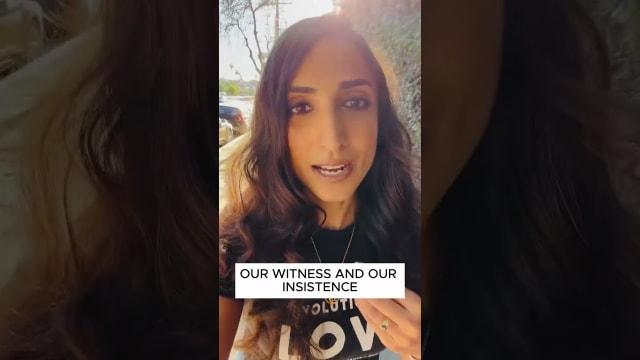
One week after what she calls the most historic election of our lifetimes, Valarie Kaur stands before her community—energized, reflective, and urgent about what comes next. The election is won. Democracy has held. But for Kaur, this moment is not the finish line; it is an opening. The real work, she suggests, has only begun: how do we transform the grief, rage, and exhaustion of resistance into a sustained vision of the world we actually want to build?
Kaur begins not with celebration but with acknowledgment. She speaks directly to what her community has endured—not the language of politicians, but the lived reality of ordinary people. "We have witnessed profound destruction and damage, cruelty, and suffering," she says. For months or years, these communities marched, organized vigils to mourn the dead, held courageous conversations in their homes and teams. They "wove threads of care and protection around each other as our neighbors were being kidnapped and disappeared." In quiet moments, they made art, picked up pens, held space for each other's grief.
This is not the triumphalism of electoral politics. It is the voice of a spiritual teacher who understands that victory comes at a cost—not just to the winners, but particularly to those who held the line when retreat seemed easier. Kaur invokes her grandfather's wisdom: "Do not abandon your post." Her community did not abandon theirs. That refusal, she argues, is why this changed reality exists at all.
But here is where Kaur pivots. Victory, she insists, is not the end—it is the chance to change the question entirely.
"It is a chance to turn our gaze from what we are fighting against to the world that we are fighting for," she says. This distinction is both practical and spiritual. For years, energy has flowed toward opposition: stopping harm, protecting borders, resisting cruelty. That work was necessary and sacred. But opposition, by definition, is reactive. It defines itself against something else.
Now, with what she calls "the most fertile conditions for pro-democracy organizing that we have seen in our lifetime," Kaur proposes a reorientation. The next phase is not about defending ground gained. It is about articulating a moral vision so compelling, so whole, that people organize toward it rather than away from fear.
"It is our sacred task to lift up a moral vision of what the whole world could be," she says. Not a policy platform. Not a damage-control agenda. A moral vision.
She offers a sketch: "A world that is safe and free, green and whole, where you see my child as yours and I see your child as mine." These are not abstractions. They are concrete images—safety, freedom, ecological health, kinship. They answer the question that haunts organizing work: What are we building this for? What will it feel like? Who will we become in the process?
This is where Kaur introduces the concept that anchors her entire framework: revolutionary love.
"Revolutionary love is a choice to see no stranger, to leave no one outside of our circle of care," she defines it. It is both intimate and systemic—a practice that begins in the heart but extends into how communities organize, how movements structure themselves, how power is shared and wielded.
For Kaur, love is not sentiment. It is strategy. It is a choice repeated daily, consciously, to include those society has designated as "other"—to actively resist the instinct toward tribalism, fear, or in-group protection. In a moment of historic polarization, this is radical. Not because it is soft, but because it is the hardest possible stance: to expand the circle of care even toward those who opposed you, to build a world where everyone belongs.
"Now more than ever, I believe revolutionary love is the call of our times," she concludes.
For those moved by this vision but uncertain where to begin: the work Kaur is organizing around is detailed at revolutionarylove.org, where updates and opportunities to participate are available. More fundamentally, though, the invitation is internal. Begin by asking yourself what world you are fighting for—not what you are fighting against. Then ask: how can love be part of your strategy, not separate from it? How can your organizing reflect the world you want to build?