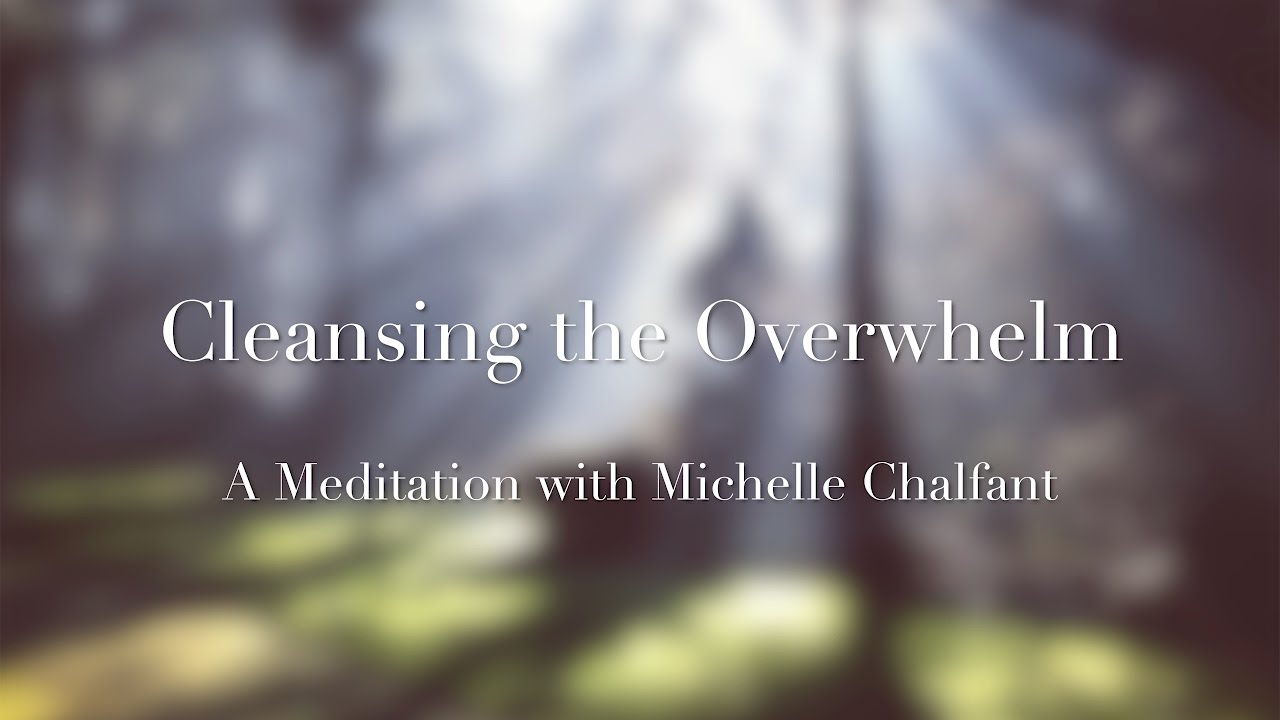
Close your eyes and picture someone standing a few feet in front of you: a former partner, a parent, a friend who stopped returning your calls. In Michelle Chalfant's guided meditation "A Meditation: Cleansing Relationships & Cutting Cords," that person is the starting point. Over roughly eight minutes, Chalfant leads the listener through breathing, a mental ticker tape for the words that rise up unbidden, a visualization of the energetic cords that bind two people together, a act of cutting those cords with whatever tool feels right, and a flow of healing light that moves first through the listener's body and then out to the other person. The practice is framed in energetic terms, and its stated purpose is not to sever a bond but to clear what is unhealthy from it so that whatever comes next can be built on clean ground. The video has drawn more than half a million views since it was posted in August 2017, which suggests how many people are carrying a relationship they want to change but do not know how to hold.
The practice opens with a premise that frames everything after it. "When a relationship ends, becomes hurtful or unhealthy, we must clean the energy between us and the other person," Chalfant says at the 0:31 mark. She then names the aim directly: cutting cords "so a new healthy relationship can form if it's in our highest good to do so." The phrase "if it's in our highest good" appears repeatedly, and it does real work. The meditation does not presume that reconciliation is the goal. A clean ending and a renewed connection are both presented as legitimate outcomes, and the practitioner is asked to hold the question open rather than decide the answer in advance.
This is the first thing worth understanding about the form. It is not a ritual of forgiveness, and it is not a demand that you feel warmly toward someone who hurt you. It is closer to a clearing exercise: a way of acknowledging that a relationship leaves residue, and that residue can keep operating long after the conversation, the breakup, or the silence has ended.
Chalfant asks the listener to settle first, to "sink into the surface where you are resting" and let the breath find "a nice rhythmic pattern all on its own" (around 0:53 and 1:10). Only then does she introduce the other person. The instruction at 1:25 is specific: picture someone "that was or is in your life that you are having issues with, having trouble communicating with." She offers a few entry points, including "perhaps you don't feel seen or heard," "perhaps you were hurt," or "maybe this relationship is ending or even over."
The choice of a comfortable distance matters. You are not asked to merge with the person or to stand inside the conflict. You stand a few steps away and observe. That spacing gives the practice a witnessing quality: you are looking at the relationship rather than being swallowed by it. The meditation keeps returning to that stance of observation, and it is the reason the later steps can feel like something you do rather than something that happens to you.
This is the most concrete and memorable device in the video. Chalfant anticipates that the moment you picture this person, feelings or sentences will surface. Rather than suppress them, she says: "It's okay. Allow them to rise up." Then she offers an image: "see the words that are coming up for you and put them on a ticker tape machine like the one in the stock market. When these words move to the right, just like on the ticker tape machine or on the television, they are gone. And there's an ending to these words" (around 2:25).
The ticker tape does two things at once. It gives unspoken material a place to go, so the things you have wanted to say for months are not left circulating in your head. And it imposes a visual rule: the words scroll off to the right and disappear. Anyone who has tried to write an unsent letter to an ex knows the problem this addresses. The unsaid sentence tends to loop. Chalfant's image gives it a trajectory and an end. Whether or not the listener thinks of this in energetic terms, the mechanism is familiar to anyone who has used a journal, a walk, or a conversation with a friend to get something out of the head and onto the table.
With the emotions moving across the tape, the listener is asked to soften their gaze and notice the cords. Chalfant describes them openly: "They may be small, large, thick, thin, connecting back to front or front to back, head to heart or all of it. There is no right way to see the cords" (around 3:11). That last sentence is worth taking seriously. A lot of guided imagery quietly tells you what you ought to experience. Here the instruction is to notice what is actually there, whatever form it takes.
The cords are the image for the bond itself, specifically the parts of it that are patterned, habitual, and unhealthy. The practice treats connection as something that can be visualized as a set of lines running between two people. Some lines are thin and easy to overlook. Others are thick, heavy, and run from the heart of one person to the head of the other. The meditation does not ask you to judge which cords are good or bad at the moment you see them. It asks you to see them, and to keep breathing while you do.
This is the question the description and the script both take care to answer, and the answer is no. "We remember that by cutting these cords, you are not ending the relationship with this person," Chalfant says at roughly 4:05. "You are simply cutting away the unhealthy parts and patterns of this relationship so you both can have a clean slate if you should choose to do so and it's in the highest good for you both."
The video's own description puts the same point in plainer language: cutting cords "releases the dysfunctional cords that are binding you with someone so new healthy cords can form and connect you from a healthy place." The distinction is the heart of the practice. A relationship can be ended, changed, or repaired, and the meditation is agnostic about which of those is right for you. What it targets is the dysfunction that persists regardless of the outcome, the patterns that keep pulling you back into old reactions even when the relationship has formally changed shape.
Here the meditation becomes vivid. "Now, with a tool of your choice, cut these cords," Chalfant says at about 4:28. "You can use scissors, an axe, a blowtorch, anything you want. Use multiple tools if you need them. Watch the cords disconnect, drop, or recoil away from you both."
The range of tools is intentional, and it reflects the video's broader permission structure. A pair of scissors and a blowtorch are not equivalent in intensity, and the listener is free to choose what fits the strength of the attachment and the anger involved. Some people will reach for something gentle; others will need something forceful. The instruction to "use multiple tools if you need them" acknowledges that a single cut may not be enough, and that the work can take more than one pass. She returns to the breath during this stage ("staying mindful of your breath as you do this") and advises continuing "until you feel done." The end point is a felt sense of completion rather than a fixed count.
For a reader approaching this practice for the first time, the most useful thing to notice is that the cutting is performed by you, on purpose, in imagination. The meditation puts agency in the listener's hands at the exact moment many people feel most powerless in a relationship.
After the cords fall away, Chalfant shifts the practice from cutting to healing. "Now take a nice slow deep breath from the center of your being. Notice the light deep within you. Expand this light now through every part of your being" (around 5:18). She asks the listener to "drink this light in," and describes what it does: "This healing light cleanses away any remnants from the cords, any roots to the cords, and any unhealthiness left behind from the relationship with this person."
The sequence is deliberate. You are not asked to heal the other person first. The light starts inside you, bathes your own body, and clears whatever the cords left behind. Only then does it expand outward. At about 6:25, Chalfant instructs: "see the circle of light expand and envelope the other person standing in front of you, bathing them as well, cleansing them in this healing love energy." The intention she states is mutual: "to cleanse you both and allow you to move on and reconnect in a healthy way if it's in the highest good."
This ordering matters for anyone who has felt pressure to forgive before they are ready. The meditation builds the sense of your own cleansing first, so that the wider gesture of including the other person grows out of a settled place rather than an obligation.
Chalfant's closing is careful and grounded. "Now bow to this person and release them back into their bodies," she says at about 7:15. The bow is a small, formal gesture of respect that also marks the end of the encounter. The release returns the other person to their own life, which is a useful reminder that the work was never about controlling them. Then she guides you back: "Feel yourself come back into your body, back into the room. Notice the surface you're sitting or lying on. And when you are ready, open your eyes" (around 7:38).
The re-grounding step is not a formality. Visualization practices can leave people slightly unmoored, and returning attention to the surface beneath you and the room around you is the ordinary way contemplative teachers close a session. Taking a moment before you stand up, reach for your phone, or respond to a message is a good way to let the practice settle.
If you want to try this meditation, the most practical approach is to start with a relationship that is painful but not the most charged one in your life. Give yourself a quiet room, a seat or a bed you can rest on, and enough time to get through the whole sequence without hurry. Keep a notebook nearby if you think the ticker tape will generate more than you can hold. Then follow Chalfant's arc: breathe, picture the person, let the words scroll off, see the cords, cut what is unhealthy, fill yourself with light, extend it outward, release, and return.
Pay attention to what you notice as much as what you are told to see. The meditation's own language, that there is "no right way to see the cords," is the best guide for a first attempt. And remember the distinction the video keeps returning to: this is a practice for clearing the energy between two people, not a decision about whether that relationship continues. You can finish the meditation and still choose to walk away, to stay, or to wait. The cords are cut so that whichever path you take starts from a cleaner place.
If you want to go further, watch the full video again slowly, and try it at different points in your life with different people. Many contemplative practices reveal their depth through repetition rather than a single session.
Michelle Chalfant's meditation "A Meditation: Cleansing Relationships & Cutting Cords" was published on YouTube on August 7, 2017. Quoted passages are taken from the video's spoken guidance; timestamps refer to the video's running time.