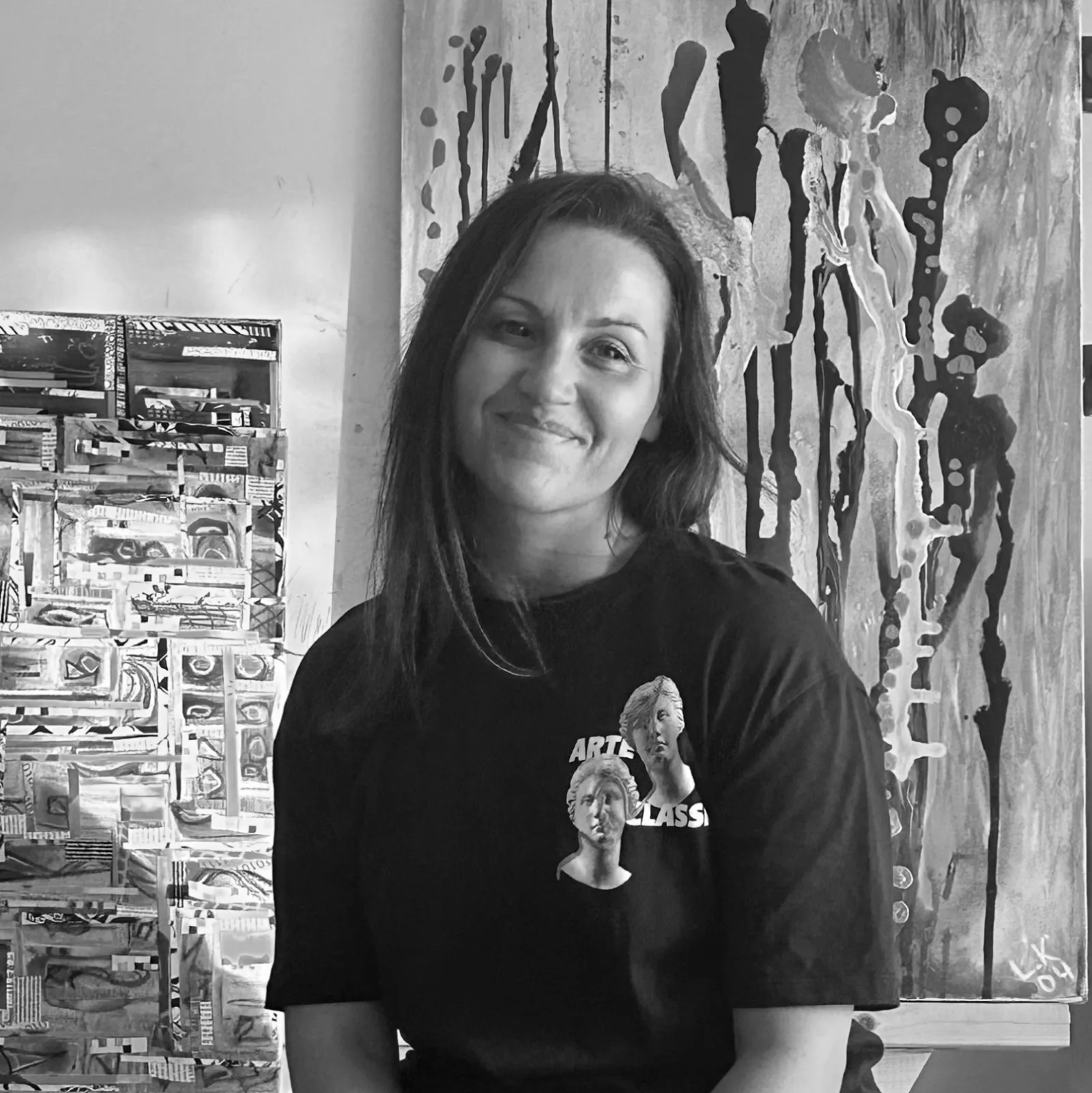

Lindsay Kokoska builds paintings the way sediment builds landscape—layer upon layer, with patience and intention. Her canvases are dense with history, both personal and collective, constructed from paint, found objects, archival photographs, and fragments of the built environment. To encounter her work is to stand before something that functions simultaneously as image and artifact, a surface where memory accumulates rather than simply being depicted.
Working primarily in painting and mixed media, Kokoska has carved out a distinctive position in contemporary art by treating the picture plane as an archaeological site. Where modernist abstraction sought to flatten and purify the canvas, and where much contemporary painting privileges surface and gesture, Kokoska's work insists on depth—not illusionistic depth, but the literal accumulation of time, material, and meaning. Her compositions exist in the productive tension between abstraction and representation, never fully committing to either mode, instead using both as tools to investigate how physical spaces hold and transmit the stories we embed in them.
Kokoska arrived at her current approach through what she describes as a sustained engagement with place and belonging. Her formal training in painting provided technical foundation, but it was a parallel fascination with vernacular architecture—the everyday structures that shape how we inhabit the world—that gave her work its conceptual anchor. This dual interest allowed her to develop a practice that honors both the formal traditions of American landscape painting and the experimental spirit of contemporary material investigation.
The turning point appears to have been recognizing that the places we move through are never neutral backdrops but active participants in forming identity. This insight shifted her practice from observation to excavation, from depicting landscapes to dissecting them, from painting about place to painting with place itself.
Kokoska's methodology is decidedly physical. She incorporates found objects and architectural ephemera directly into her canvases, creating surfaces that bear the marks of actual use and weathering. An archival photograph might emerge from beneath layers of paint. A fragment of wallpaper or flooring could anchor a composition. These aren't decorative additions but structural elements, chosen for their capacity to carry specific histories into new contexts.
Her palette reinforces this archaeological sensibility. She favors muted earth tones—ochres, grays, weathered greens—interrupted by unexpected moments of saturated color. These chromatic choices mirror the work's central concerns: the slow erosion of memory, the sudden flare of recollection, the way certain details persist while others fade. The result is work that demands extended viewing. What reads as abstraction from a distance reveals embedded narratives upon closer inspection, details and references that only emerge through patient attention.
This layering technique positions Kokoska within a lineage of artists interested in material as meaning. Yet where some practitioners use assemblage to fragment and disorient, Kokoska uses it to consolidate and preserve. Her compositions suggest that nothing is truly lost, only buried, waiting to be uncovered by the right kind of looking.
Kokoska has participated in residencies that emphasize site-specific investigation, opportunities that allow her to root bodies of work in particular geographies and their attendant histories. These immersive research periods prove crucial to her practice. Rather than working from imagination alone, she engages directly with place, absorbing its textures, stories, and material evidence before translating them into painted form.
This approach yields work that carries the weight of specificity while remaining open to broader interpretation. A painting might emerge from sustained attention to a particular building, landscape, or community, yet its layered complexity allows viewers to project their own experiences of place and memory onto its surface. The work becomes a meeting point between Kokoska's investigations and the viewer's recollections.
Her exhibitions have included solo and group shows at galleries and institutions across the United States, contexts that have allowed her work to reach audiences invested in both contemporary painting and the conceptual questions animating her practice.
In an era of digital ephemerality and accelerating displacement, Kokoska's commitment to the material traces of lived experience carries particular resonance. Her paintings insist that places matter, that the environments we inhabit leave marks on us just as we leave marks on them, and that attending to these reciprocal impressions is a form of cultural preservation.
She reaches audiences who sense that contemporary life's increasing abstraction from physical space comes at a cost. Her work offers a counterproposal: that we might slow down, look closer, and recognize the stories embedded in our surroundings before they're erased by renovation, development, or simple forgetting.
Kokoska's practice represents a sustained argument for painting as a medium capable of holding complexity—temporal, material, and emotional. In treating the canvas as a site where past and present coexist in visible tension, she demonstrates that the question of how we remember, and what we choose to preserve, remains among the most urgent concerns facing contemporary art.