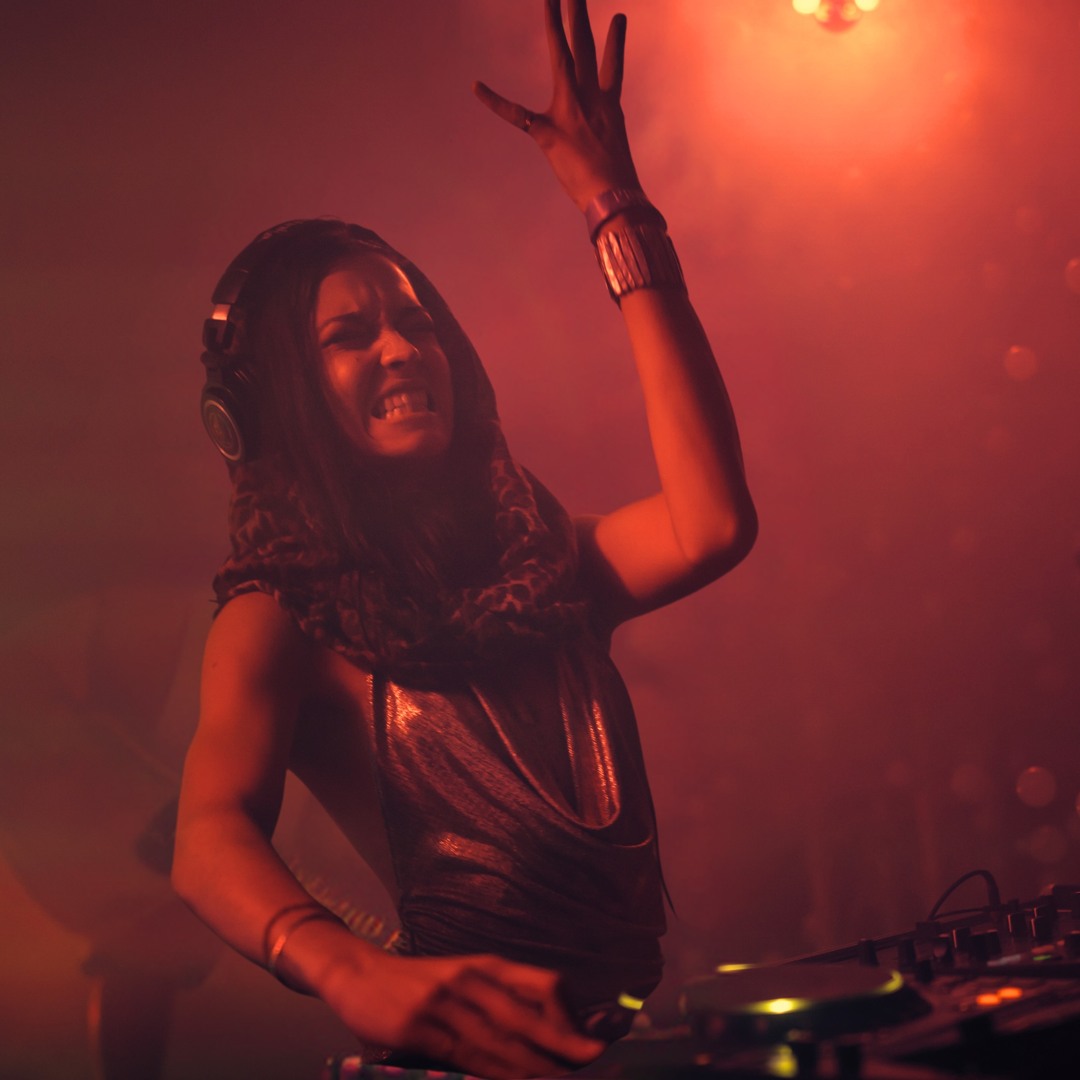

Start Here: Morph Festival Set
If you're coming to Leah Luna cold, your entry point is her Morph Festival performance. Recorded in New Zealand at an event built specifically around the intersection of conscious culture and dance music, this set captures exactly what makes her approach distinct. It's not a rave, and it's not a sound bath—it's the rare thing that refuses to choose between them.
The Morph set gives you 90 minutes of Luna threading bass house's body-rattling low end through tribal percussion patterns that lock into something cyclical and trance-inducing. You'll hear her use tempo not as a constant push but as a tool for moving between states: euphoric peak moments that dissolve into pockets of embodied stillness, then build again. The oriental textures she layers in aren't decorative—they shift the emotional temperature of the room without breaking the groove. This is Luna at full strength, working a crowd that came prepared for both sweat and presence.
After That: Ecstatic Boiler Room, Then the Berlin Circuit
Once the Morph set clicks, move to her Ecstatic Boiler Room concept. Luna took the format of the UK's influential live-stream platform and reimagined it for a different purpose: showcasing DJs who treat the booth as facilitation rather than performance. The camera work, crowd energy, and production values mirror the original, but the selection and intention are pointed toward collective experience over viral moments. Watch a few of these to understand Luna's curatorial instincts and see how her peers operate in the same overlap.
From there, track down recordings or footage from her Berlin club dates. Berlin is where the underground electronic orthodoxy lives, and Luna's ability to hold her approach in those rooms—spaces that can be skeptical of anything coded as "wellness"—shows how the work translates under pressure. The Berlin sets tend to be darker, heavier on the bass house foundation, but the cyclic structure and texture work remain.
What to Expect on First Encounter
Leah Luna will not sound like what you think "conscious dance music" means. If you're expecting crystal bowls and gentle build-ups, prepare to recalibrate. The bass will hit hard. The BPM will climb. But somewhere in the third or fourth track, you'll notice the floor hasn't lost its center. The energy isn't scattering outward—it's cycling.
Her sets ask your body to do two things at once: release into the tempo and drop into sensation. That combination can feel disorienting at first, especially if you're used to electronic music that chooses a lane and stays there. Give it 20 minutes. The structure reveals itself once you stop waiting for a breakdown that resolves into obvious catharsis.
Common Misunderstandings
Beginners often assume Luna is "healing music for dancers" or "party music for yogis." Both framings flatten the work. She's not trying to make bass house palatable to the wellness crowd or sneak spiritual content into the club. The coexistence of wildness and wellness isn't a compromise—it's the actual subject of the work.
Another misstep: treating the tribal elements as aesthetic borrowed from elsewhere. Luna's use of cyclic percussion isn't world music tourism. It's structural. Those patterns create the container that lets the set move between states without feeling like a playlist of moods.
When This Lands Hardest
Leah Luna's work tends to hit people in transition. If you're in a phase where the old categories—party versus practice, hedonism versus discipline—feel too rigid, this is when her sets make the most sense. It's music for people who've aged out of peak-time amnesia but aren't ready to trade the dance floor for something quieter.
It also lands during periods of return: coming back to your body after living in your head too long, or returning to rhythm after months of stillness.
The 1-Week Starter Plan
Day 1-2: Listen to the Morph Festival set twice. First time as background. Second time with attention on how tempo shifts guide your physical state.
Day 3-4: Watch two Ecstatic Boiler Room sessions. Note how different DJs use the format, and where Luna's approach diverges.
Day 5: Find a recording from her Berlin performances. Compare the energy and track selection to Morph.
Day 6: Movement day. Put on the Morph set and let your body respond without overthinking it.
Day 7: Rest. Then decide if you're curious enough to follow her circuit—Bali, New Zealand, wherever she's facilitating next.