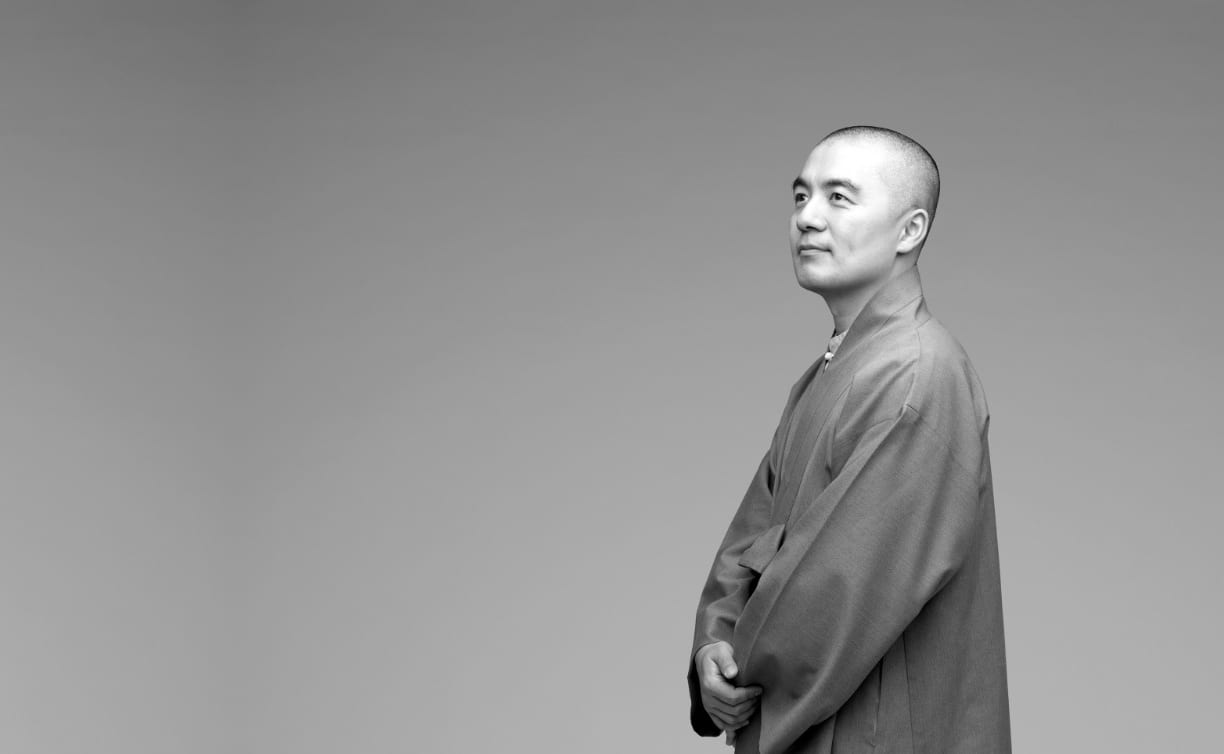

A retreat with Haemin Sunim is not built around silence. His retreat teaching, titled Joy of Enlightenment, combines guided contemplation, gentle movement, journaling, group dialogue, and Dharma talks. Instruction is explicit. He walks participants through methods, uses his voice to anchor attention, and explains practices without specialist vocabulary. The movement portions, which the sources describe as aimed at settling the nervous system and grounding attention in the body, break up the sitting. Journaling gives participants a way to put inner experience into words, and group dialogue means retreatants speak with one another and with him rather than keeping their experience private.
The result is a structured, conversational container, closer to a workshop with contemplative depth than to a traditional silent sesshin. He leads these programs across North America, Europe, and Asia, and the formats are described as ranging from day-long workshops to longer residential programs. Outside the retreat room, recorded talks and guided meditations are available through his website and podcast, so a newcomer can hear his manner before committing time or money.
The most repeated frame is his own question: "Is it the world that's busy, or is it my mind?" It places the source of strain in mental patterns rather than circumstances, and it makes mindfulness a matter of discernment rather than escape. Practice, in his telling, happens inside ordinary responsibilities, not apart from them.
Emotional well-being is treated as a legitimate spiritual subject. Anxiety, overwhelm, and relationship difficulty recur, and he approaches them through the Zen he trained in, joined with Positive Psychology. Compassion, toward others and toward oneself, is foundational: practice is presented as building a warmer relationship with one's own mind rather than reaching perfection or transcendence. Running through all of it is a tension between simplicity and depth. The teachings are plain, but they are meant to carry weight.
The busy-world question is the central one, and it is less rhetorical than it looks. It asks a student to check, in the middle of a crowded day, how much of the pressure is external and how much is manufactured by attention and expectation. Related questions follow from the same material: how to remain present within obligations rather than leaving them, how to meet difficult emotion without being run by it, and how to use awareness when making real choices in relationships. The journaling component exists to push these from abstraction into specifics.
The dominant register is warmth and clarity. The sources describe his voice as compassionate, clear, and free of jargon, and he is said to acknowledge that meditation is difficult rather than presenting it as an elite accomplishment. The materials provided do not document his use of humor, particular stories, or scriptural quotation, so I won't characterize them. What can be said is that the delivery favors plain explanation over theatrical depth, and that silence appears as one element within a guided structure rather than as the organizing principle. His books, which have sold over six million copies, carry the same orientation toward everyday difficulty.
No Buddhist background is needed. The teaching welcomes complete beginners and experienced practitioners, and the combination of instruction, movement, and dialogue tends to make meditation less intimidating. People managing stress, anxiety, or the sense of being overextended are the clearest fit. Readers with an academic interest may also find substance: he earned his doctorate at Princeton and taught Asian religions for seven years at Hampshire College.
The same features can turn others away. Those looking for traditional Zen austerity, long silent retreats, or teaching that withholds comfort may find his approach too accommodating. Anyone who regards Positive Psychology as a dilution of dharma will likely see the hybrid as compromised. Those who want ritual or devotional practice will not find it, and people drawn to Tibetan or Theravada traditions will want a teacher trained in those lineages. Skeptics of introspection are also unlikely to be won over by accessibility alone. Nor is it a teaching for spiritual bypassing: it asks for engagement with everyday reality as it is.
Haemin Sunim is a Zen teacher from South Korea who received monastic training there. His background combines that training with study of religion at the University of California, Berkeley, Harvard University, and Princeton. The bio names no specific teacher or lineage line, and none is assigned here. What it establishes is a Zen foundation, a monastic formation, and an academic career, joined to a deliberate integration of Buddhism with Positive Psychology. Whether that integration reads as a bridge for modern practitioners or as a softening of the tradition depends on the listener, and both reactions are reasonable. The record of sales and coverage, including a national longest-running nonfiction record in the Netherlands and recognition from The New York Times, The Guardian, NPR, and BBC Radio, shows that the approach reaches well beyond Buddhist circles. It does not settle the question of how it sits within Zen itself.