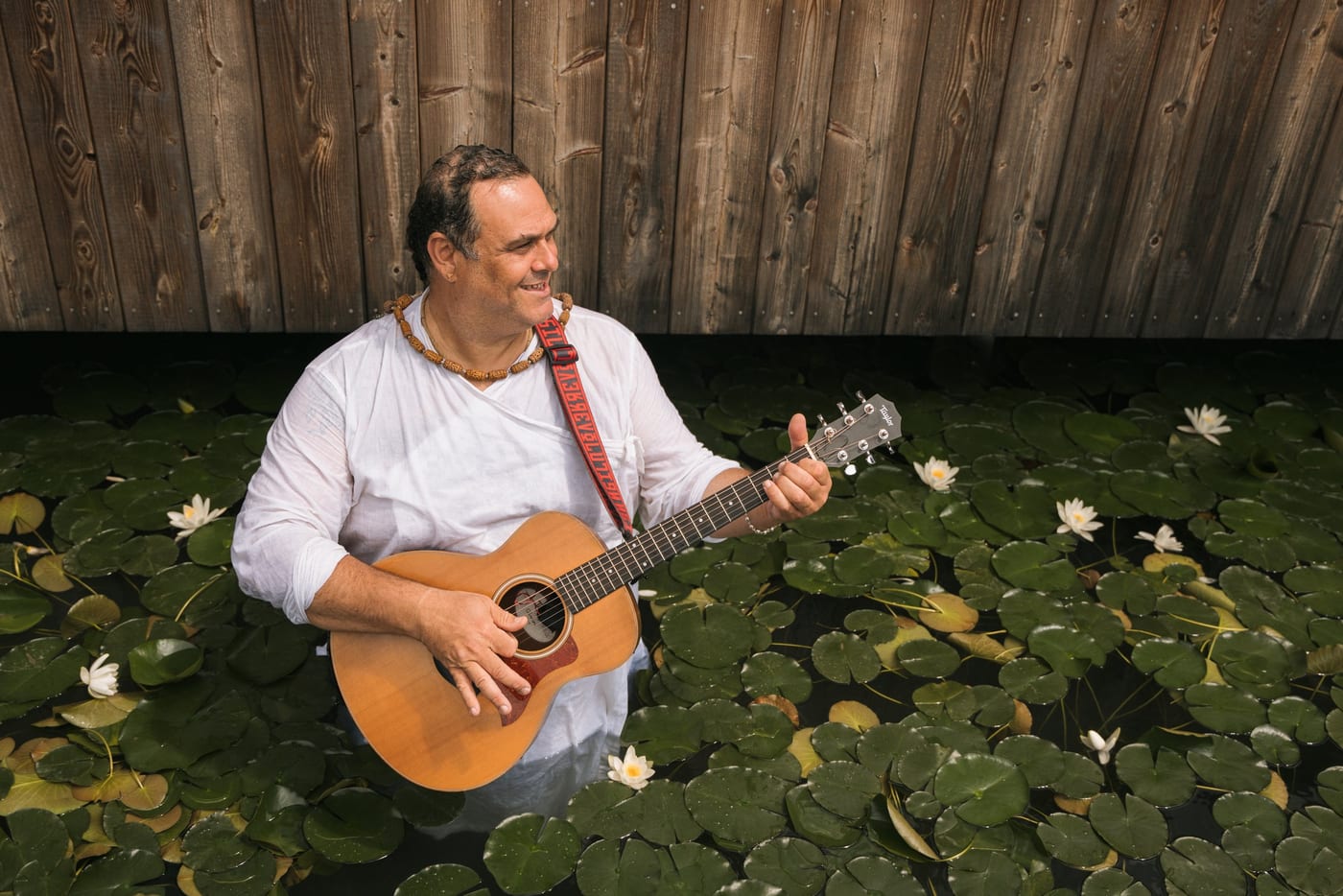

Meditation & Mantra arrived on February 14, 2023, as a nine-track album, and it occupies a particular place in Gaura Vani's catalog. His path is not a straight line. He was raised by monks in temples from the age of four, steeped in mantra and ritual as daily life, then rebelled in his teens and worked as an actor in Hollywood, appearing in films with Michelle Pfeiffer, Denzel Washington and Ethan Hawke. After roughly two decades of touring and recording, he has played Lollapalooza, Floyd Fest, Bhakti Fest, Omega Ecstatic Chant and Wanderlust, as well as temples, opera houses and yoga studios.
Within that range, this album is the quiet one. It follows Love (2022) among the studio records and is the most direct entry point for listeners who want mantra as a practice tool rather than concert spectacle. If the festival work is the public face of his music, this is the room with the door closed.
The core of the record is the human voice carrying Sanskrit mantra, with emphasis on repetition and the names of the divine rather than melodic showmanship. The pacing leans toward the sustained and meditative end of what he does, closer to his studio chant than to the call-and-response build of a kirtan session or the driving, percussive energy of The Juggernauts.
A note on instrumentation: the available record does not itemize which instruments appear on which track, so I won't guess at a harmonium here or a drum there. Credits on Spotify or the official site at gauravani.com are the place to confirm. What can be said is that the mood is built for sitting. The repetition is the design, not a flaw. Listeners who need constant variation may find the pace demanding, while those who let it work tend to find the sameness opening into something spacious.
I can't responsibly name individual tracks from this album, because the track list is not part of the information available to me, and inventing titles would do you a disservice. Open the album on Spotify (the nine tracks are listed there) and approach it differently than you would a singles collection.
Instead of hunting for a standout, notice three things as you move through it:
- The opening track. In a mantra-centered record, it sets the register. Notice how quickly the voice settles and how much it asks of your attention.
- The middle stretch. Repetition does its real work here, when the novelty fades and the phrase begins to carry you.
- The closing track. See whether the album lets you out gently, which is often where a devotional record shows its intent.
Those are listening prompts, not claims about specific songs.
Gaura Vani's work sits in the bhakti tradition, the devotional path within Hinduism centered on love for the divine expressed through song. Kirtan, the call-and-response chanting of names and mantras, and bhajan, the devotional song form, are his two working vocabularies, with Sanskrit as the default language rather than decoration. His formation came from inside temple life, so the practice predates any career decision.
The public record does not name a specific guru lineage or sampradaya, so it is best not to attach one. What can be said is that he stands in the modern chant and kirtan scene, having shared stages with Jai Uttal and Krishna Das. This album reads less as a fusion experiment, like his work in As Kindred Spirits, and more as a return to the devotional center those projects orbit.
This album suits the listener who is curious about bhakti and willing to hear chant as a sung, practiced thing rather than background texture. It lands hardest in a moment that needs steadiness: a stretch of restlessness, a morning routine you want to anchor, a period of grief or transition when repetition feels kinder than variety. It also suits anyone building a sitting or breathwork practice who wants a reliable sonic companion.
It is a poor fit for those wanting high-BPM electronic sound, club-style drops or remix-driven kirtan. Listeners unfamiliar with Hindu names will face a small learning curve, since the lyrics carry Sanskrit and named deities. And those who want the crowd-driven roar of festival kirtan should look to the live material instead.
Choose a time when the day has already loosened its grip: early morning or evening. Use headphones or a quiet room, and play the album through in order rather than shuffling, since the sequence is part of the experience. Let the first track feel slower than expected. Resist the urge to skip ahead, and if you are comfortable chanting, add your voice quietly.
For a ritual context, treat it as the length of a single sitting and let the nine tracks define the session. Return to it across several days. Repetition rewards repetition, and this album is built on that principle.