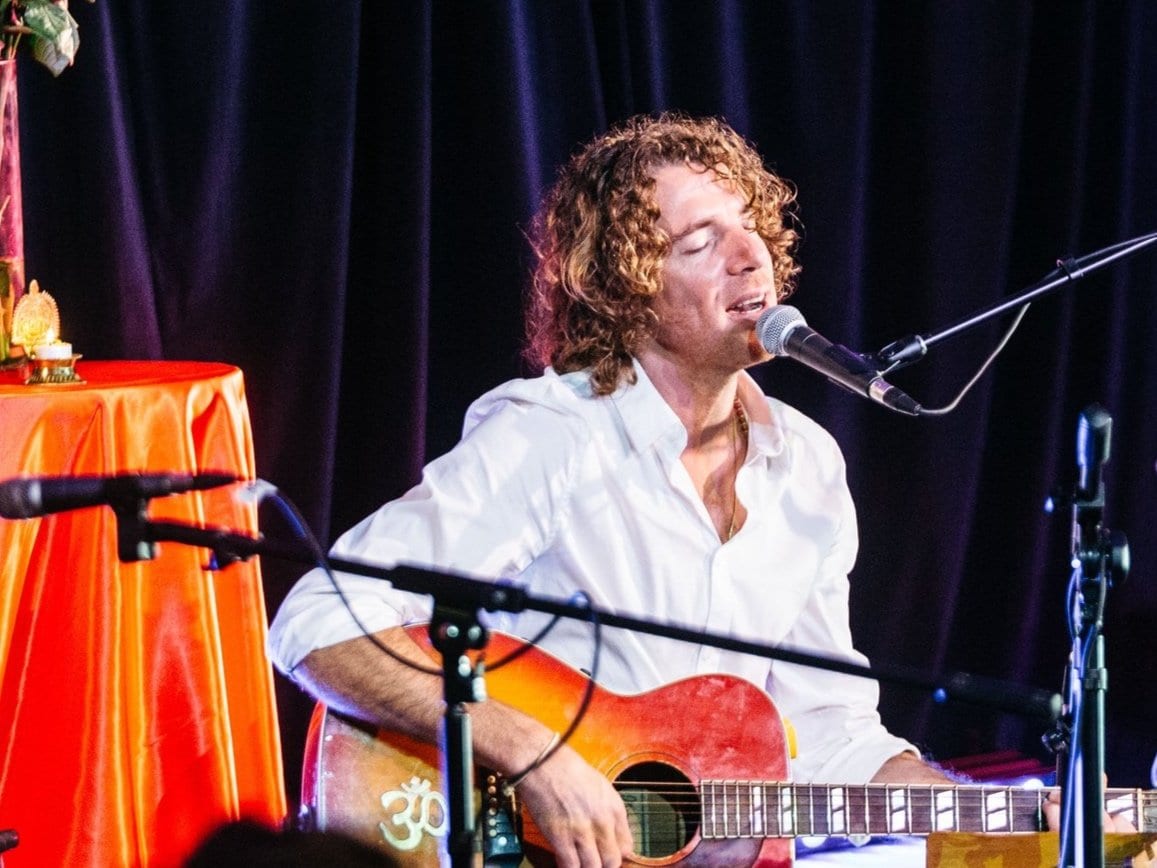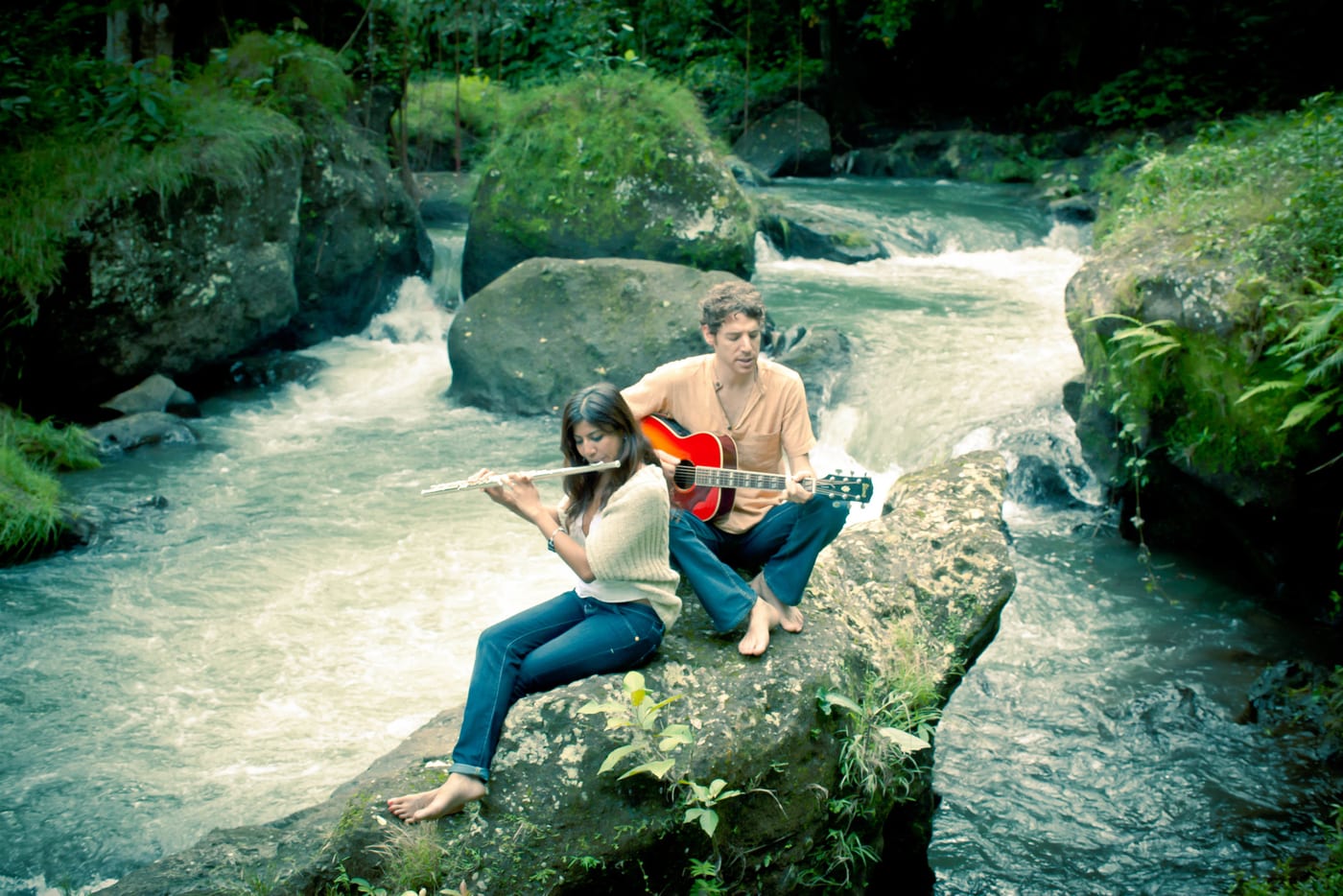

Edo & Jo were an Australian duo of singer-songwriters, mantra musicians and yogis. Between 2008 and 2015 they toured Australia, South-East Asia, India and America. Their teaching cannot be separated from their music, and it cannot be fully judged from the record alone. The profile that exists is thin on first-hand accounts of the room, so what follows rests on the structure of their offerings and on what their documented work says about intent. Jo Mall Kahn died in September 2015, shortly after a cancer diagnosis, so the teaching is now a closed body of work rather than a live practice.
Their workshops were built around Sound Yoga, which combines asana, mantra, chakra meditation and sound relaxation in a single session. The sequence implies a progression: the body is moved and prepared, the voice is brought in through chanting, and the session closes toward guided stillness. Chanting was participatory rather than performed, and that is the main difference between sitting in one of their sessions and attending a concert.
The setting varied. They led yoga retreats and workshops, played festivals such as Byron Spirit, Sydney Spirit, Bhakti Bliss, Bodhi and Bali Spirit, and held monthly residencies at Ubud Yoga Barn in Bali from 2012 to 2014. A residency over two years suggests a teaching relationship with a returning community, not only a string of one-off appearances. Beyond that, no account of the classroom atmosphere, pacing or group size is documented, and it would be dishonest to invent one.
Mantra as a meditative practice, not just a lyrical device, runs from the first album to the workshops. Bhakti, the devotional path of heart-centred repetition of divine names, gives the work its devotional character. Nada Yoga, the yoga of sound, treats vibration as a route into meditative absorption, and the third album draws on it directly. Chakra meditation recurs as a structuring framework, in both an album title and the workshop format. The fourth theme is the pairing of movement and sound: the duo treated asana and chant as complementary.
A fifth, practical theme is service. They co-founded A Sound Life, a charity that brings music and yoga free of charge to people in health care and underprivileged communities. It extends the same conviction, that these practices are for use, beyond those who can pay for retreats.
The bio and verified sources do not record specific questions the pair posed to students, and none should be attributed to them. What the structure of the work implies is a set of practical inquiries: what happens to attention when a single phrase is repeated long enough to stop being a phrase; whether the body, once moved, hears sound differently; whether devotion can be practised without first resolving what one believes. These are inferences from the format, not quotations, and a prospective student should treat them that way.
The strongest documented feature is musical. Their site describes the music as both soothing and uplifting, and the stated method is blending Eastern mantra with Western pop. Edo Kahn's background in rock, with Gelbison and Kahn Brothers, and an APRA award for songwriting, sits beside Jo's classical training and yoga qualification. The result keeps the mantra at the structural centre, in clean, song-based arrangements, rather than burying it under production. Restraint over spectacle is the fair summary.
Humor, story and scripture are another matter. The sources do not describe the pair's spoken style, use of anecdote, or quotation of texts, and the records suggest the work is practice-led rather than scholarly. Anyone expecting doctrinal study or close engagement with Sanskrit sources should look elsewhere.
It suits people who want a way into chanting without having sat in a kirtan circle, and who are comfortable with some physical yoga practice. It suits those seeking soothing, devotional material for practice, ceremony or quiet evenings. The call-and-response form is designed to be joined by newcomers.
It is a poorer fit for several groups. Purists who want long, unadorned kirtan with minimal production may find the pop framing too polished. Students of a purely physical yoga class may resist the chanting and extended sound work. Listeners who want driving, high-energy music will find little. People seeking intellectual rigour will find the themes practical rather than philosophical. The third album and its mantra practice are more demanding and best approached after some comfort with chant. And because touring ended around 2015, anyone hoping to study with them live cannot.
The bio states one named transmission: Edo & Jo were initiated into a mantra meditation practice by their teacher, Sakthi Amma, and the third album shares that practice. Their work sits within bhakti and draws on Sound Yoga, also called Nada Yoga. Beyond Sakthi Amma, no lineage, guru or institution is named in the bio, and none should be assumed. Bhakti and Nada Yoga are the traditions the work draws on, but the sources do not claim formal training in them beyond the stated initiation and Jo's yoga qualification.
This is a teaching of accessible entry and practical orientation, carried mostly by recordings now. Its strength is the translation of chant into a form newcomers can join. Its limit is the absence of detailed documentation about how the pair actually taught, which leaves the albums, the workshop format and the charity as the evidence.