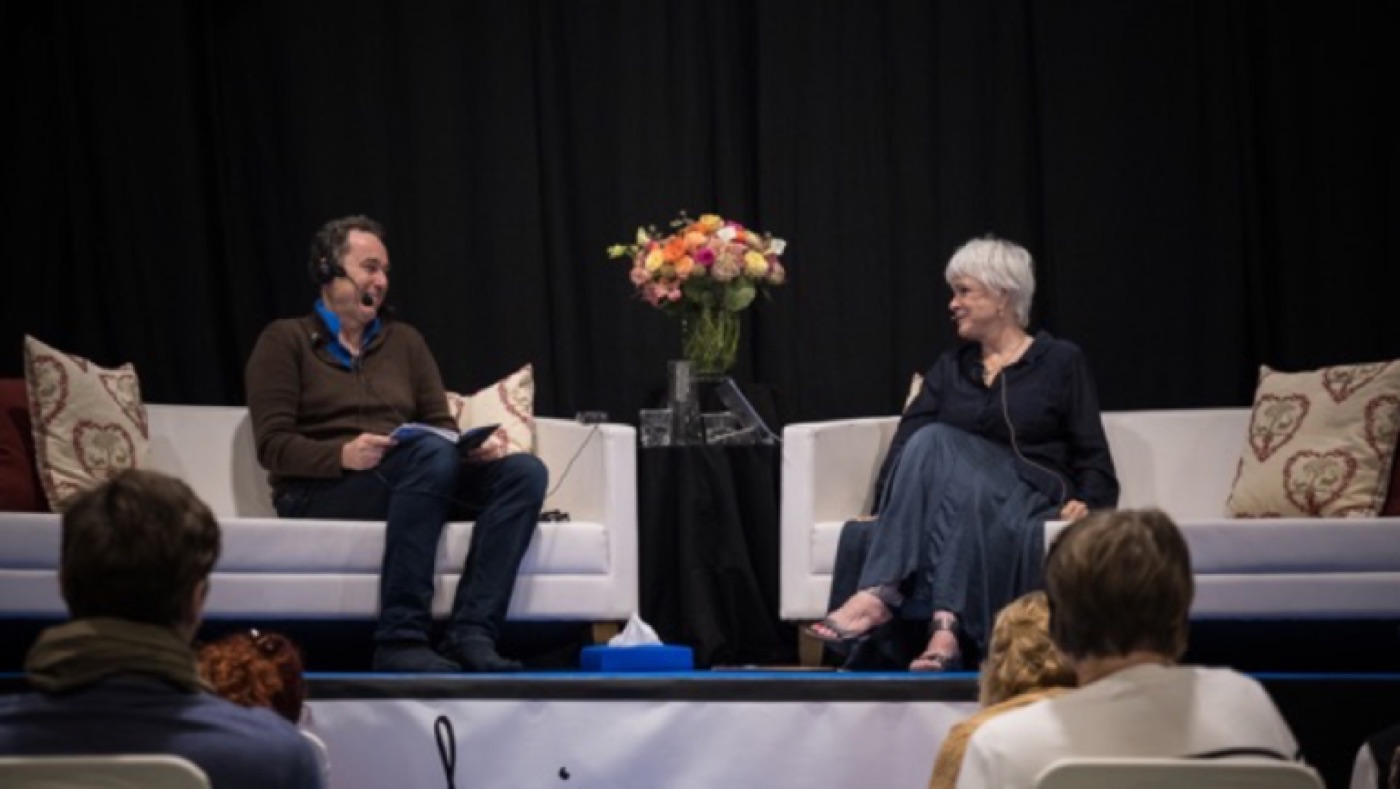

Byron Katie's teaching is built around a procedure rather than a philosophy. The Work, which she describes as meditation, consists of four questions followed by the turnaround, and nearly everything she does in public is an application of that structure. A session is conversational and direct. A student names a stressful belief, usually about another person or a situation, and speaks it aloud. The facilitator then takes that single belief through the questions, one at a time, and the student answers from their own experience.
What this feels like in the room is closer to a working session than a service. Sessions are organized around one specific story rather than a general lecture, which keeps the material concrete and sometimes uncomfortable. There is little theory. Much of the facilitator's attention goes to the exact wording of a belief, since small changes in phrasing change what the inquiry turns up. Retreats and workshops follow the same method, so the atmosphere is attentive and practical, not devotional. Specific attendance details are not in the available data, and thework.com is the place to confirm format and schedule before booking.
The central claim is stated in her own words: "I found that suffering is optional." She traces suffering to believing stressful thoughts, and ease to questioning them. This account comes from 1986, when, at the end of a ten-year spiral of depression and self-loathing, she woke one morning in a state of joy. She says what she saw is true for every human being, and she asks people not to believe her but to test it.
Related themes recur across her books. One is the mind's stories about how things should be, and the distress that follows when reality disagrees. Another is the need for other people to change before we can be at peace, which is the territory of I Need Your Love—Is That True?, co-written with Michael Katz. Relationships of every kind, including partners, family, and workplace, are a constant subject. The turnaround, a way of experiencing the opposite of what you believe and looking for real examples of it in your own life, threads through all of it. A Thousand Names for Joy and A Mind at Home with Itself carry these concerns toward questions of identity, freedom, and settled inner peace. Loving What Is, her bestseller, sets out the method alongside her account of the awakening.
The four questions are the core of the practice, and the turnaround is where the belief gets turned over. The point is not to replace a stressful thought with a pleasant one. The turnaround is not a substitute for the original thought, and students who skip the actual questioning often find the exercise collapses into affirmation. What she pushes people to sit with is the content of a specific conviction: whether it is true, what happens when it is believed, and what remains without it. She aims at what she calls reality, meaning what is actually the case rather than what the mind insists on.
This distinguishes her from many meditation teachers, who ask students to change how they sit, breathe, or attend. Katie asks them to examine a belief, often on paper with a worksheet, alone or with a facilitator.
The delivery is plain. The tone is unmystical, with few Sanskrit terms and no ritual gestures. Her authority rests on her personal story and an explicit invitation to verify, rather than on inherited standing. Her recorded facilitations, on YouTube and in a Spotify show, are the best window into how she works with real people, and they show how the questions are adjusted in practice. I can say little here about humor, silence, or scripture as features of her delivery, because the available record does not describe them, and I won't invent them. What the record does support is an economy of means: one belief, a fixed set of questions, and attention to what the student actually says.
It suits people who want a concrete method they can run on a page, who are willing to examine convictions about other people, and who are wary of devotional structures. No prior meditation experience or spiritual vocabulary is required. The Little Book, free worksheets, and instructions are available in many languages.
It will frustrate others. People who want ritual, chant, devotional music, mantra, visualization, or a teacher whose authority is institutional will find little of that. Those seeking gentle, open-ended awareness may find the method too structured. Some find the directness hard, since it asks them to question convictions they would rather defend, and the format can feel rigid after the first few sessions. It is also distinct from clinical treatment.
The bio names no lineage, teacher, or guru, and Katie frames The Work as arising from her own direct experience. Its central claim, that the wisdom a person needs is already within them and reachable by questioning belief, places it in the broader nondual and self-inquiry current. Any resemblance to other contemplative approaches is a family resemblance only, not a documented succession, and claims of formal lineage should be treated with caution. Her collaborators include the translator Stephen Mitchell, a partner in her work since 2000, and the illustrator Hans Wilhelm, with whom she has made children's books. She is based in Ojai, California.
A fair reading is that this is a method-first teaching. Its credibility depends less on the teacher than on whether the procedure holds up when a reader tests it, which is exactly the test she proposes. Independent accounts of her story and reception are not part of the record here, so readers should weigh her own account accordingly.