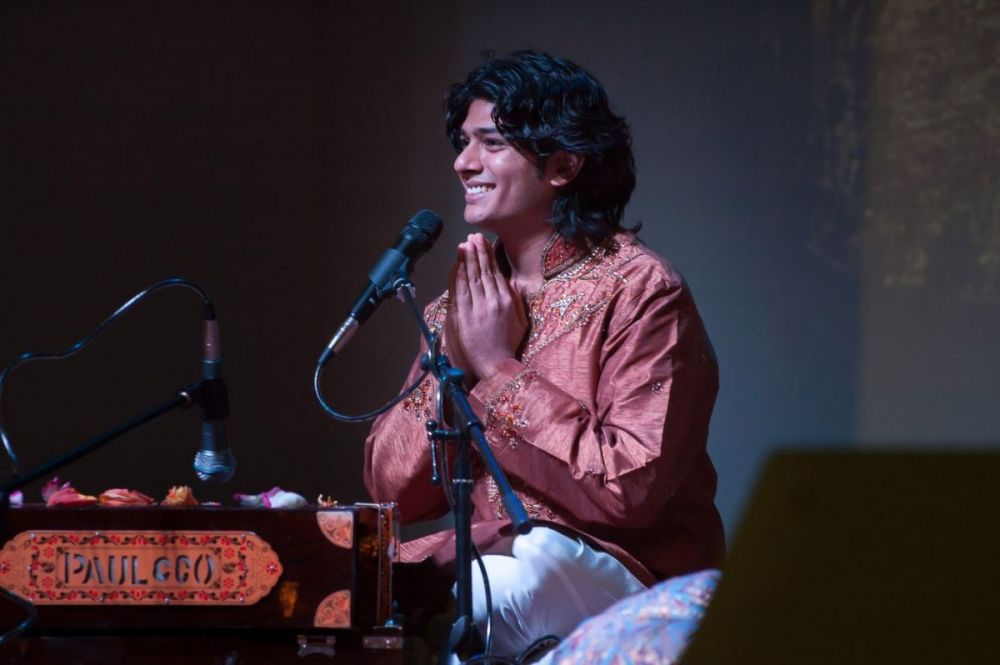

Bittu Mallick carries music in his blood—literally. As the thirteenth generation of a hereditary musical lineage in India, his path was determined long before his birth. Where most musicians choose their craft, Mallick inherited it, along with centuries of accumulated knowledge about technique, repertoire, and the spiritual possibilities of sound. This isn't merely background; it's the foundation of everything he does as a vocalist. From childhood, he was trained in the exacting discipline of Hindustani classical music, absorbing not just melodies and ragas but an entire philosophical framework that understands music as seva—selfless service.
This lineage-based training gives Mallick's work a particular quality of depth and precision. The ornamental vocal techniques of Hindustani classical singing—the meends (glides), gamaks (oscillations), and taans (rapid melodic runs)—are second nature to him, woven into muscle memory through years of rigorous practice. But unlike many classically trained singers who remain within the strict boundaries of raga performance, Mallick has taken this technical foundation in a different direction, one that honors tradition while speaking to contemporary spiritual seekers.
At the center of Mallick's artistic vision is a concept he calls "the power of the awakened voice." It's an idea that positions vocal practice not as entertainment or even art in the conventional sense, but as a technology for transformation—a way of accessing presence, dissolving the boundaries of self, and transmitting something beyond words. This isn't metaphor for Mallick; it's the organizing principle of his work.
This philosophy bridges the ancient and the modern. It draws on centuries-old understandings of sound as sacred force—the Sanskrit concept of nada brahma, the idea that sound itself is divine—while speaking to contemporary interest in mindfulness, embodiment, and altered states of consciousness. Mallick's vocal practice asks: what happens when the voice moves beyond performance, beyond the ego's desire to impress, and becomes instead a vehicle for something larger?
Mallick's music refuses easy categorization. He moves fluidly between mantra recitation, kirtan, Sufi devotional music, and what gets labeled ethno-fusion—a term that barely captures the sophisticated way he layers traditional melodic structures with contemporary instrumentation. Where many kirtan artists draw primarily on bhakti devotional repertoire, Mallick casts a wider net. Sanskrit mantras sit alongside Sufi poetry; the cyclical, trance-inducing structures of kirtan meet the ecstatic intensity of qawwali.
This isn't fusion for fusion's sake, the kind of shallow world-music pastiche that borrows aesthetics without understanding. Mallick's hereditary training gives him deep fluency in multiple Indian musical traditions, allowing him to move between them with authority. When he incorporates Sufi elements into his practice, it's not appropriation but recognition of the shared devotional impulse that runs through India's intertwined Hindu and Muslim musical histories. His ethno-fusion work extends these traditions into new contexts without betraying their essential character.
The technical precision of Hindustani classical music provides the backbone, but Mallick adapts it to serve the repetitive, hypnotic qualities that make mantra and kirtan effective as spiritual practice. The result is music that satisfies both the trained listener's ear for nuance and the devotional practitioner's need for sustained, immersive experience.
Mallick's primary medium is live performance. He appears in temples and concert venues, yoga studios and retreat centers, circulating through the global spiritual music circuit that has grown exponentially in recent decades. These performances happen across India and internationally, connecting him with communities of seekers, practitioners, and listeners hungry for music that offers more than passive consumption.
The venues matter. Unlike pop musicians who create a strict separation between performer and audience, Mallick often works in participatory contexts where the boundary dissolves. In kirtan, the audience becomes the chorus; the experience is communal rather than spectatorial. This aligns with his understanding of music as service rather than self-expression, as transmission rather than performance.
What makes Mallick significant isn't innovation for its own sake. He's not trying to revolutionize sacred music or create a signature sound that will dominate streaming platforms. Instead, he represents something increasingly rare: a living connection to hereditary musical knowledge, adapted thoughtfully for contemporary contexts without being diluted or commodified.
In an era when spiritual practice is often flattened into wellness content, when ancient traditions get repackaged as self-help, Mallick's work maintains a certain integrity. The thirteenth generation of his lineage isn't a marketing hook; it's a responsibility, a weight of transmission that shapes how he approaches his craft.
His audience spans continents and contexts—Indian listeners connected to these traditions by birth or choice, Western spiritual seekers exploring Eastern practices, yoga communities looking for music that supports practice rather than decorates it. What they find in Mallick's work is something increasingly difficult to locate: music that takes the spiritual seriously, that doesn't apologize for its devotional intensity, that trusts listeners to meet it on its own terms.
In this sense, Mallick occupies important cultural territory. He's a bridge figure, translating hereditary knowledge for global spiritual communities while maintaining the depth and rigor that makes that knowledge worth preserving. The awakened voice he speaks of isn't his alone—it's an inheritance, carefully tended and passed forward.