Where to Start with Alex Grey: A Beginner's Guide
Begin with the Sacred Mirrors Series
Your entry point into Alex Grey's universe is the Sacred Mirrors series he began in 1979. These large-scale paintings systematically reveal the human form from skeleton to energy body, each canvas peeling back another layer of what it means to inhabit a physical vessel. Don't approach them as gallery pieces to glance at—they're contemplative tools. Spend time with individual images. The paintings layer skeleton, musculature, organs, nervous system, and chakras in translucent anatomical precision, creating something between medical textbook and religious icon.
What strikes most newcomers is the uncanny recognition. Grey's technique renders you simultaneously strange and familiar to yourself—you're looking at the meat and electricity you've inhabited your entire life but rarely acknowledged.
After That: The Three Essential Follow-ups
Once the Sacred Mirrors crack open that initial awareness, move to Transfiguration (1993). This piece shows Grey's evolution beyond anatomical cataloging into depicting consciousness itself in transformation. The painting captures a human figure in metamorphosis, nervous system ablaze with light, dissolving boundaries between individual and universal.
Next, seek out any documentation of Grey's meditation practices. He doesn't separate his painting from his spiritual practice—the work emerges from sustained contemplative states. Understanding his process illuminates why the images function as portals rather than mere representations.
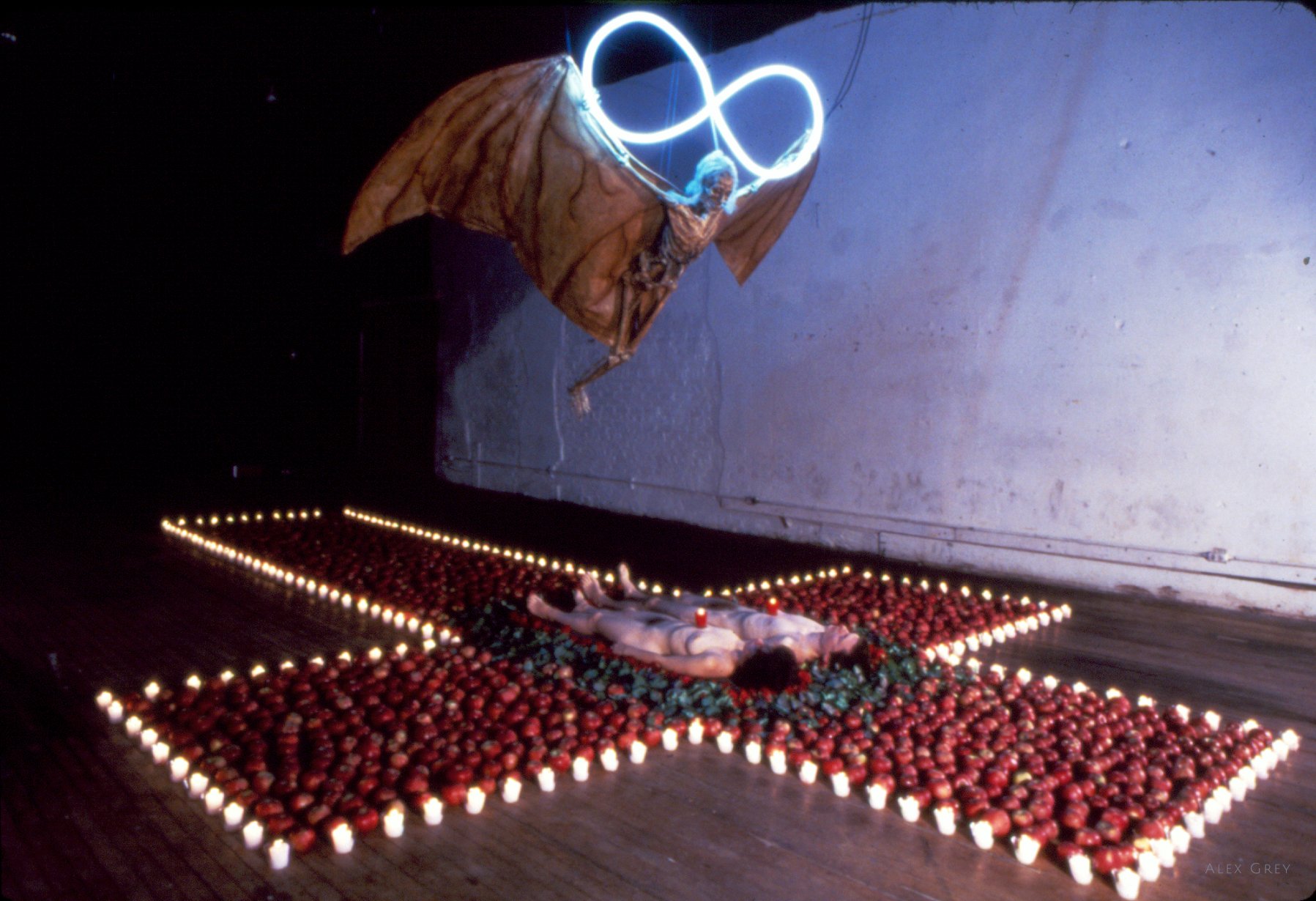
Finally, explore his installation work and sculptural pieces if you can access them. Grey builds three-dimensional environments where viewers physically enter the visions. The difference between seeing a Sacred Mirror reproduced on a screen and standing before the actual canvas matters enormously.
What to Expect on First Encounter
The work will likely provoke one of three responses: profound recognition, aesthetic overwhelm, or immediate dismissal. Grey's paintings operate at maximum intensity—there's no minimalism, no restraint, no ironic distance. Every nerve ending is rendered. Every energy center glows. This is either exactly what your consciousness has been searching for or it's too much.
Many first-timers report an almost psychedelic effect despite viewing the work completely sober. The images seem to move, to breathe, to look back. This isn't accidental. Grey paints from altered states and builds those states into the composition's architecture.
How Beginners Misunderstand the Work
The most common mistake: treating Grey as a psychedelic artist primarily interested in recreating drug experiences. While he doesn't hide his engagement with non-ordinary states, reducing his life's work to "trippy paintings" misses the disciplined spiritual practice underlying every piece. He's a mystic who uses paint instead of poetry.
Another misreading: approaching the Sacred Mirrors as science illustrations. Yes, the anatomy is precise. But Grey isn't illustrating anatomy textbooks—he's arguing that your nervous system is the divine made manifest. The medical accuracy serves contemplative ends.
When This Work Lands Hardest
Grey's paintings tend to hit with particular force during three life phases: when you're first questioning materialist explanations of consciousness (often late teens through twenties), during major transitions that strip away identity (illness, loss, ego death), and in middle age when spiritual questions resurface with urgency.
The work resonates most powerfully when you're already sensing there's more to embodiment than mechanical function but lack a visual language for what you're experiencing. Grey provides that language.
Your One-Week Starter Plan
Days 1-2: Spend 20 minutes each day with individual Sacred Mirrors images. One painting per session. Note which layers your attention catches on—skeleton, organs, energy meridians. Journal what surfaces.
Day 3: Research Grey's meditation practice and biographical background. Understand the contemplative ground the paintings emerge from.
Day 4: Study Transfiguration alongside the Sacred Mirrors. Notice how Grey moves from anatomical inventory to depicting consciousness in transformation.
Days 5-6: Find the highest quality reproductions available (ideally documentation of the actual large-scale canvases). Scale matters in Grey's work.
Day 7: Attempt to paint or draw your own anatomical self-portrait using his layering approach. The practice of looking inward to render what you contain changes how you inhabit your body.
The work asks you to recognize your own sacred architecture. Start looking.
