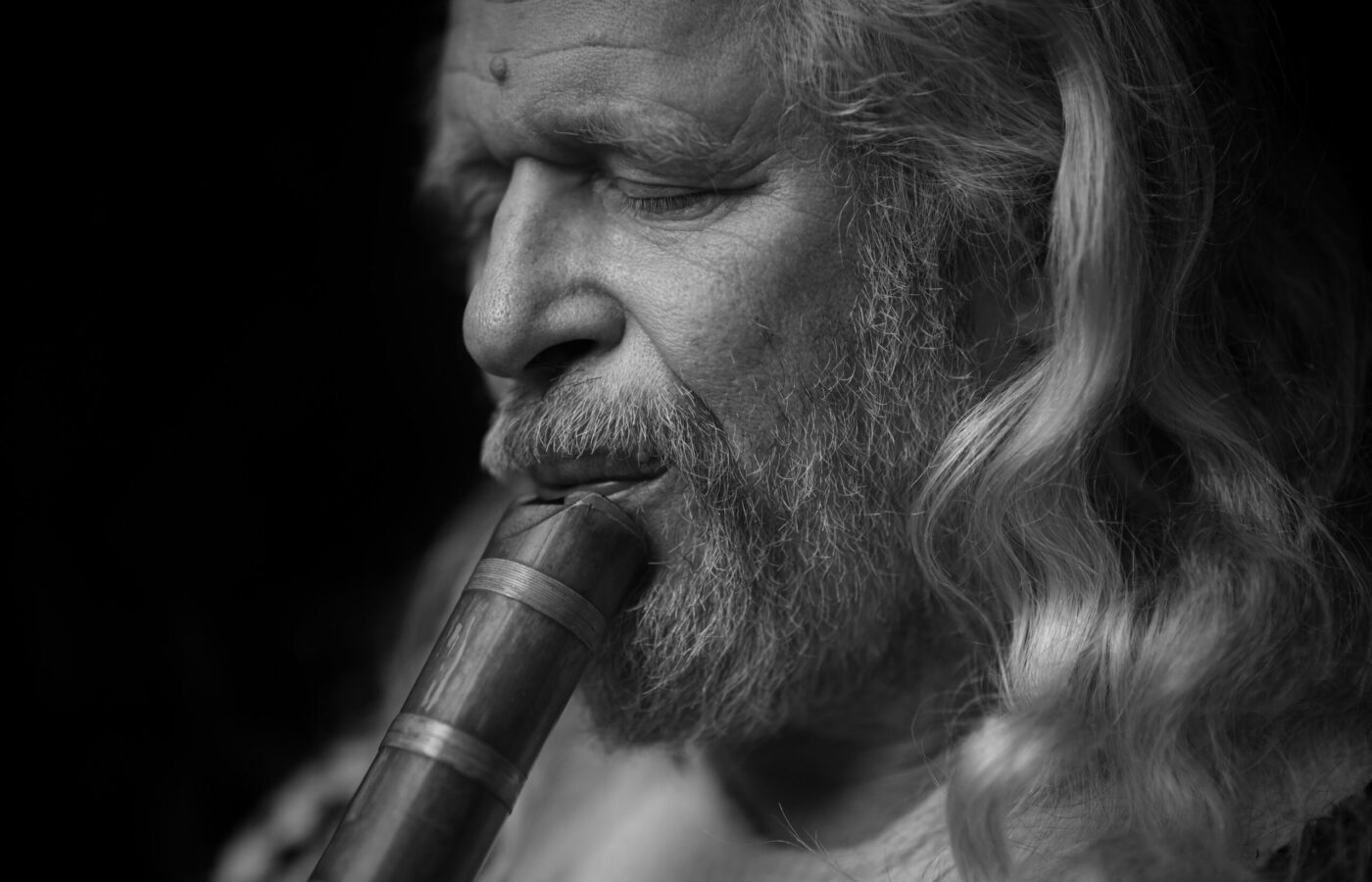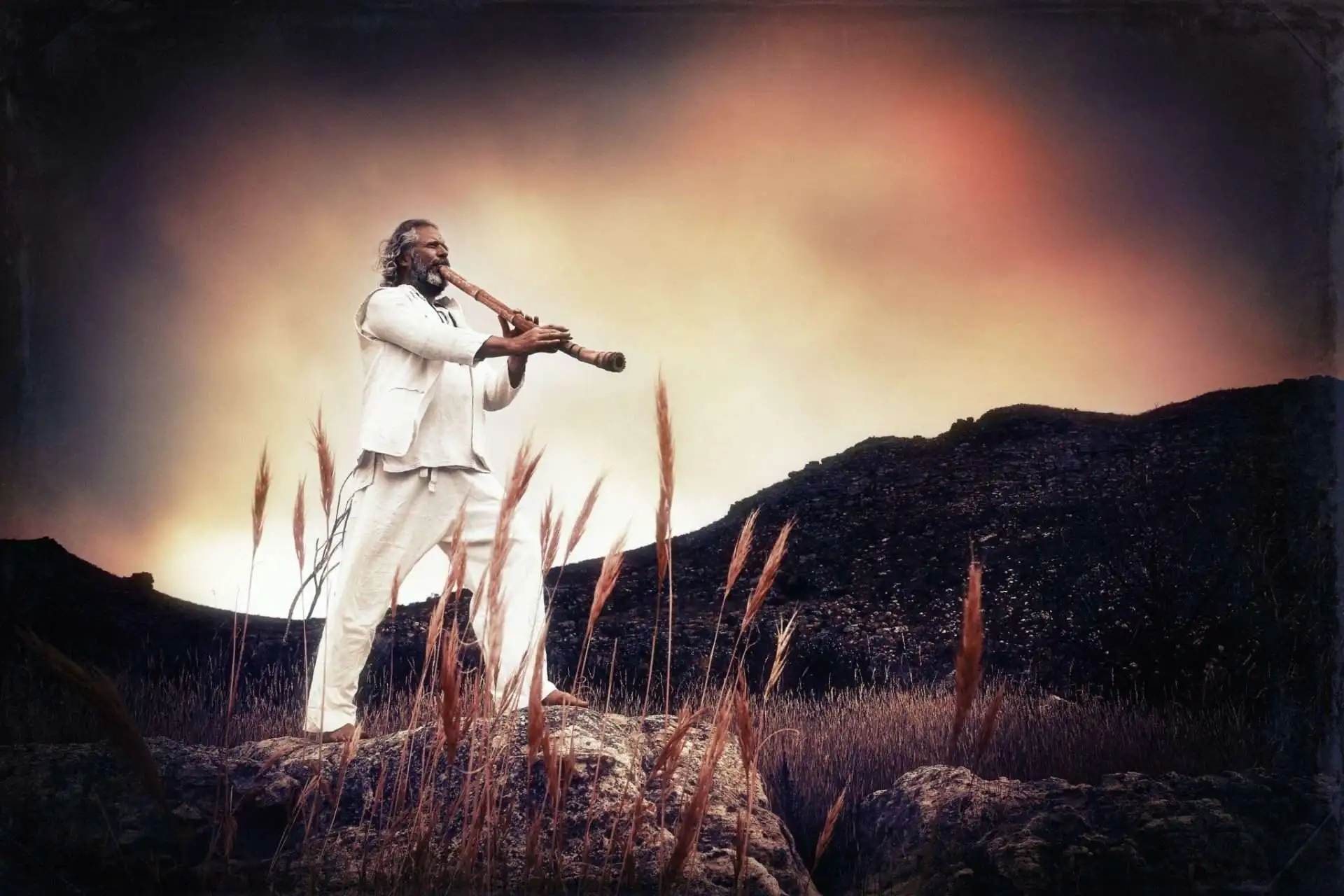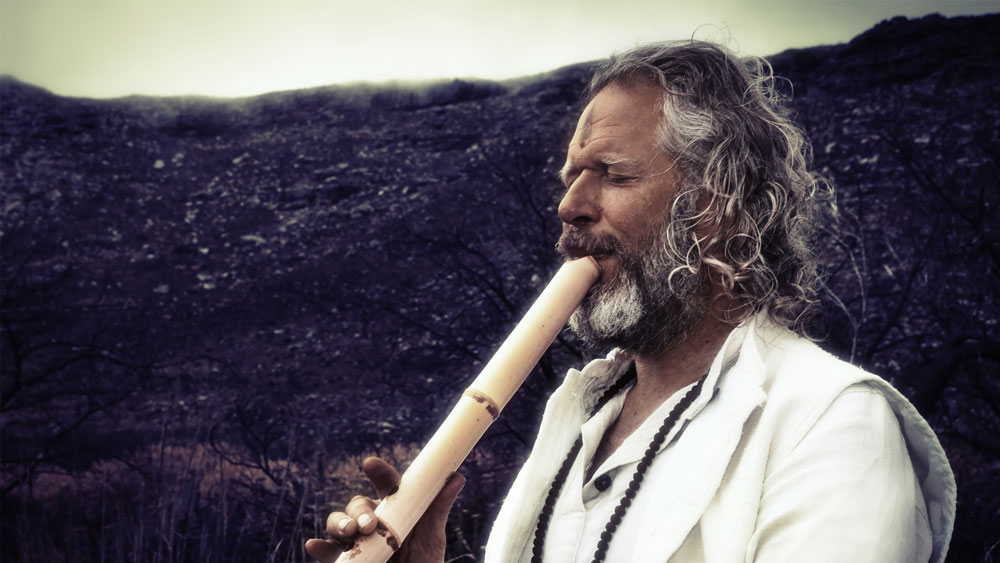

Adrian Freedman's music arrives as breath made audible—long, searching phrases that bend and wobble through microintervals, punctuated by silence that feels as intentional as the sound itself. At its core is the shakuhachi, the Japanese bamboo flute whose breathy, hollow timbre occupies a space somewhere between wind through canyon walls and human voice caught mid-prayer. This isn't background music for yoga studios. The shakuhachi's pitch wavers, its tone frays at the edges, and its melodic lines unfold with an unhurried patience that can feel alien to Western ears accustomed to harmonic resolution and steady pulse. Freedman's compositions often layer this ancient instrument with his own voice—chanting mantras, repeating syllables that emerge less as song and more as sonic ritual.
The texture is spare. Where many conscious-music artists build upward with harmonium, guitar, and percussion, Freedman works downward, stripping away until what remains is breath, bamboo, and the space between notes. Tempos are slow when they exist at all; many pieces operate outside metric time entirely, following instead the natural arc of a breath cycle or the duration of a meditative phrase. When rhythm does appear, it's often subtle—a frame drum's gentle pulse, the rustle of natural percussion—but never driving. This is music designed not to carry you along but to create an open field in which stillness can settle.
Freedman stands firmly within the honkyoku tradition, the repertoire of solo shakuhachi pieces historically played by Zen monks of the Fuke sect as a form of meditation—literally, "blowing Zen." He trained for seven years under Grand Master Yokoyama Katsuya in Japan, one of the twentieth century's most respected lineage holders. This apprenticeship matters: honkyoku isn't a genre you can learn from YouTube tutorials or weekend workshops. It's a transmission-based practice where the instrument serves as dharma vehicle, each piece a study in non-attachment, breath awareness, and the acceptance of impermanence audible in every note's decay.
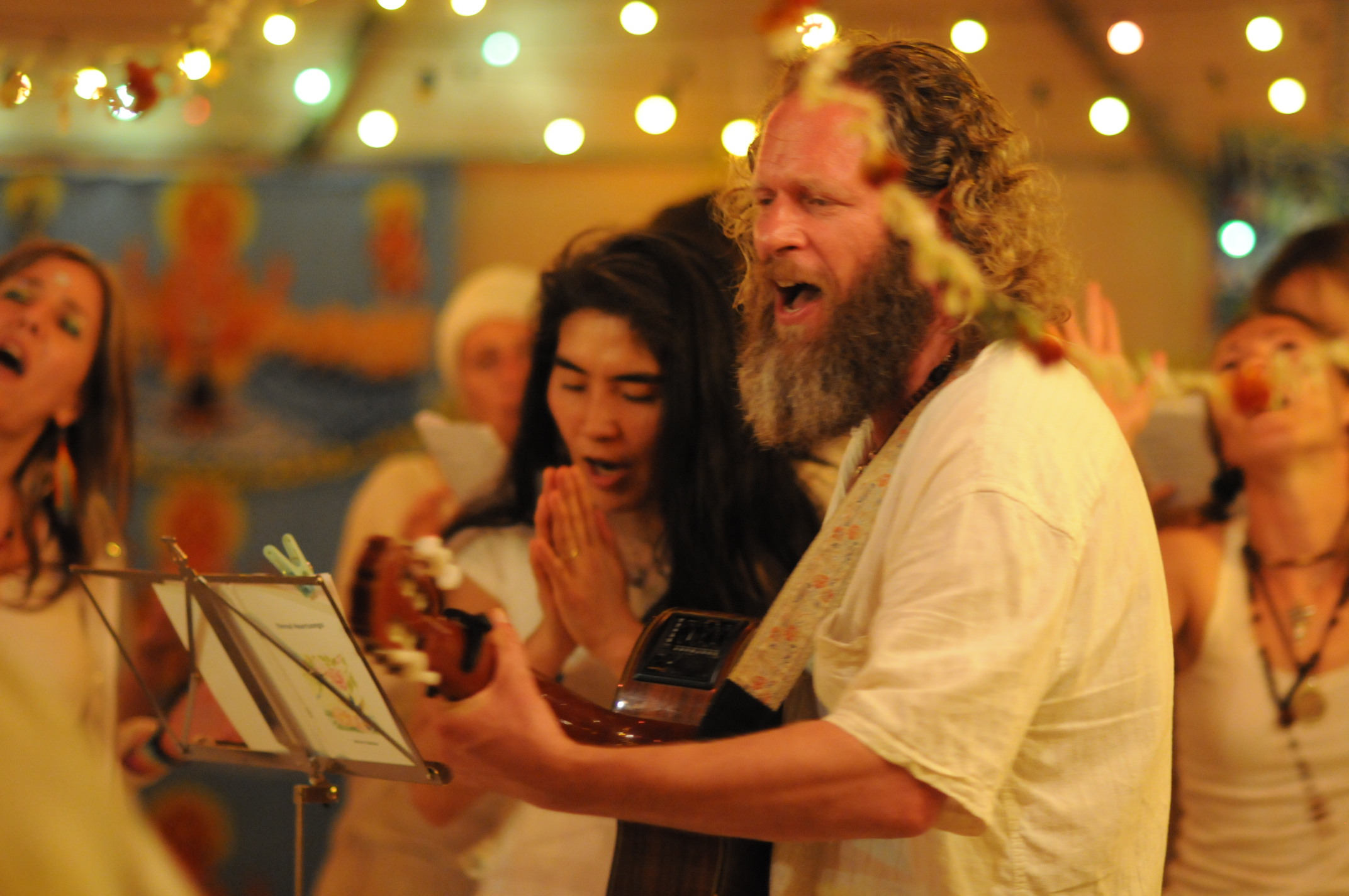
But Freedman doesn't remain within the Japanese temple aesthetic. His work crosses the honkyoku foundation with plant medicine ceremony and Buddhist devotional practice, creating what he terms "Zen Heart Medicine Music." This places him in conversation with—but distinct from—the bhakti kirtan wave that has dominated Western devotional music for the past two decades. Where kirtan emphasizes call-and-response, community singing, and the ecstatic repetition of Sanskrit mantras, Freedman's approach is more solitary, introspective, shamanic. His mantras emerge from multiple traditions, and the musical frame remains closer to the meditative austerity of Japanese aesthetics than to the warm, major-key embrace of kirtan.
Freedman's unique contribution is this synthesis itself: bringing the shakuhachi's meditative vocabulary into the medicine music context while maintaining its contemplative rigor. Many Western musicians who pick up world instruments treat them as texture or exotic color. Freedman's shakuhachi playing remains rooted in its lineage—the ma (negative space), the meri-kari pitch bends, the breath-centered phrasing—even as he composes new pieces for ceremonial contexts that would have been foreign to Fuke monks. He doesn't make the shakuhachi "accessible" by surrounding it with familiar Western instruments or pop structures. Instead, he invites listeners into its world, asking them to adjust their ears rather than adjusting the tradition.
Come prepared for slowness. Freedman's pieces can spend minutes exploring a single phrase, letting it breathe, return, transform incrementally. The shakuhachi's airy tone—often described as having "more breath than pitch"—takes getting used to. Its pitch isn't fixed and clean like a piano or guitar; it bends and warps, living in the spaces between Western scale degrees. This isn't imprecision—it's intentional microtonality, part of the instrument's expressive range.
Expect space. Silence isn't dead air here; it's structural. The gaps between phrases allow each sound to complete its full resonance before the next begins. When vocals appear, they're rarely melodic in a conventional sense—more like toned prayer, syllables repeated until they dissolve into pure vibration. This can feel meditative or challenging, depending on where you meet it.
Within conscious music's increasingly crowded terrain, Freedman occupies a distinct niche. He's not making the festival-ready, guitar-and-harmonium kirtan that Krishna Das popularized, nor the electronic-inflected world fusion of East Forest or Desert Dwellers. His work sits closer to the purist end of the spectrum, alongside practitioners like Riley Lee or other traditional shakuhachi players, but distinguished by his willingness to bridge that tradition with Western ceremony. For listeners seeking music that functions as genuine meditation technology rather than spiritual ambiance, Freedman offers an entry point that demands attention, patience, and a willingness to let the music work on its own terms.