Coming Up
What's Happening
Coming Up
Escuchar
Listening Journey
Sound Journey
Discography
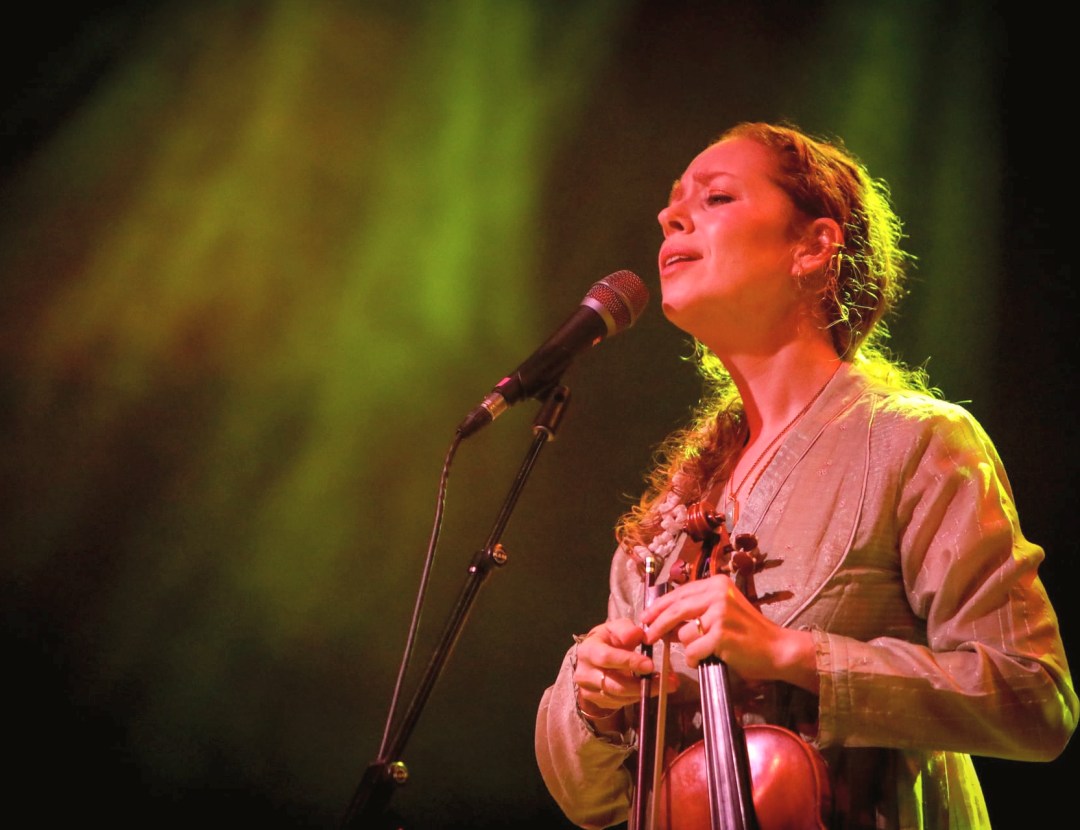

Kirtan Artist
Jahnavi Harrison is a musician, writer, artist and practitioner of bhakti-yoga. She spent her formative years at Bhaktivedanta Manor in England, in an environment where mantra chanting and sacred art were part of everyday life. With a background in Western and Eastern classical music and dance, she has sought a path of self-realisation and service through artistic expression.
Jahnavi Harrison is a musician, writer, artist and practitioner of bhakti-yoga. She spent her formative years at Bhaktivedanta Manor in England, in an environment where mantra chanting and sacred art were part of everyday life. With a background in Western and Eastern classical music and dance, she has sought a path of self-realisation and service through artistic expression.
For nearly 20 years she has offered her voice and violin in performances of original spiritual music and mantra kirtan, in venues around the world. Her work offers an experience of deep connection through sacred song and mantra, a reconnection to the sacred space within us all. She aspires to create art and facilitate experiences that heal, uplift and nourish the spirit.
Now based in California, Jahnavi regularly leads live gatherings, sound bath experiences, concerts and retreats. She is found at music festivals, yoga studios, corporate settings and landmark performance venues.
She has collaborated regularly with artists including Deva Premal and Miten, Jai Uttal, Krishna Das, Snatam Kaur and Gaura Vani. She also worked with Willow Smith on the EP 'Rise' (2020). Her album 'Into the Forest' was released in 2024.
What's Happening
Listening Journey
Discography
Worth Knowing
She's a multi-instrumentalist and bhakti-yoga practitioner based in California who has spent nearly two decades performing sacred mantra kirtan and original spiritual music on voice and violin. Her background straddles classical training—both Western and Eastern disciplines—and a formative spiritual upbringing at Bhaktivedanta Manor in England, where mantra chanting was woven into everyday practice. What distinguishes her in the contemporary kirtan scene is her willingness to blend lineage-rooted mantra work with contemporary production aesthetics, as evidenced by her 2020 collaboration with Willow Smith on the EP 'Rise', and her range across multiple disciplines: she leads intimate sound bath experiences, teaches yoga, performs at landmark venues, and records carefully arranged albums like 'Into The Forest' (2024) and 'The Heart Album (LIVE Kirtan)' (2026). Listeners are drawn to her because she doesn't treat kirtan as a historical artifact—she treats it as a living practice that can meet modern seekers where they are. Her BBC Radio appearances on 'Something Understood' and 'Pause for Thought' have also introduced her voice to audiences beyond yoga studios and devotional circles.
Jahnavi Harrison's work is rooted in bhakti-yoga, the path of devotion expressed through sacred song and mantra chanting. Her formative years at Bhaktivedanta Manor—a major center of Krishna consciousness in the UK—anchored her in the lineage of Hare Krishna practice, where mantra recitation is a primary sadhana (spiritual discipline). The Hare Krishna Mahamantra appears throughout her discography, including the live recording 'Hare Krishna Mahamantra (Mantra Lounge Live in London 2022)', which exemplifies her approach to this foundational mantra. What's notable is that while she's grounded in this lineage, she's not confined by it; collaborations with Deva Premal, Krishna Das, Snatam Kaur, and Gaura Vani show she operates within a broader interfaith bhakti ecosystem. The lineage emphasizes both the practice of kirtan—call-and-response devotional singing—and the personal transformation it invites, which aligns with her stated intention to create art that heals and nourishes the spirit. Her background in Western and Eastern classical music distinguishes her from many kirtan artists, bringing intellectual and compositional rigor to devotional work.
Start with 'The Heart Album (LIVE Kirtan)' (2026), her most recent full-length release, which captures the immediacy of a real kirtan gathering and gives new listeners a clear sense of how she approaches mantra—unhurried, grounded, with space for the Sanskrit to breathe. If you prefer studio production, 'Into The Forest' (2024) is more polished and showcases her violin and compositional voice alongside traditional mantras; it reads as accessible without being watered down. For shorter listening, the single 'Holy Madman Live!' (2024) or 'Govinda Jaya Jaya' from her Mantra Lounge London 2022 sessions offers a quick 4-5 minute window into her voice and the participatory energy of kirtan. Newcomers should understand that her work is devotional by design—this isn't background ambient music, nor is it chant-as-wellness content stripped of tradition. The practice of kirtan involves call-and-response participation (you're meant to sing along), so listening actively, rather than passively, completes the experience. Her Spotify catalogue (2,600+ followers) is a solid starting point, but her YouTube live recordings will show you what an actual kirtan gathering with her feels like, which is often more meaningful than studio listening alone.
Jahnavi's signature move is the integration of violin—a non-traditional instrument in classical kirtan—with Sanskrit mantra and her own compositional voice, bringing a chamber music sensibility shaped by classical training that prizes restraint over orchestral excess. While Krishna Das, Snatam Kaur, and others have brought kirtan to Western audiences, Jahnavi's clarity, spatial arrangement, and textural sophistication (audible on albums like 'Heartflow' (2024) and 'Mantraverse 2 (Immersive)' (2025)) set her apart. Her recent work suggests she's also experimenting with immersive sound design and production techniques that move beyond traditional live kirtan into more curated sonic experiences for meditation and ceremony. The Willow Smith collaboration on 'Rise' signals another distinction: she's comfortable co-creating across genre boundaries, bringing bhakti sensibility into contemporary music conversations without compromising authenticity or lineage integrity. Unlike some kirtan artists whose work remains primarily devotional within spiritual circles, Jahnavi explicitly frames herself as a "musician, writer, artist and practitioner"—suggesting her work is a deliberate synthesis of multiple disciplines. Her willingness to appear in yoga studios, corporate settings, music festivals, and landmark performance venues indicates an approach that doesn't gatekeep the experience to devotees alone.
Her music is not suited to listeners seeking high-energy, rhythmically propulsive dance or workout soundtracks; the pacing of kirtan is intentionally meditative, even in its more rhythmic moments, and lacks the acceleration and climactic builds those listeners expect. If you're drawn to contemporary pop, electronic music, or textured production like Bon Iver-meets-yoga, Jahnavi's work—rooted in Sanskrit mantra and devotional tradition—may feel slow, liturgical, and potentially obscure without significant cultural or spiritual background. Because her work is explicitly devotional rather than secular spirituality, listeners uncomfortable with Hindu theology, deity invocation, or the belief that mantra itself holds transformative power independent of literal meaning will find her work ideologically specific rather than universally "uplifting." Sound baths and live kirtan gatherings also require presence and a willingness to participate in group singing; they're not passive, background experiences, which rules them out for those seeking functional ambient music for working or unwinding in solitude. Finally, her work assumes some openness to Sanskrit pronunciation, repetition as spiritual practice, and the lineage framework of bhakti-yoga—thresholds not every seeker crosses. If you prefer spirituality stripped of religious language and tradition, Jahnavi's unabashedly devotional practice won't feel like home.
Visit her official website at jahnavimusic.com for the most current information on concerts, retreats, sound baths, and live gatherings from her California base; she maintains a regular schedule of performances at yoga studios, music festivals, and landmark performance venues. Her YouTube channel (UCDJVpt2p_KivFy4Bfms64Ew) archives live performances and sound bath sessions, offering direct access to her work even if attending in person isn't possible. Spotify and Apple Music are the primary platforms for following new releases and exploring her back-catalogue; as of mid-2026, she's actively releasing work, with recent singles like 'The Bee' and full albums like 'The Heart Album' showing consistent artistic output, so following her profile there ensures you catch new music as it drops. For the deepest engagement with tour and event announcements, check her website first—no major tour schedule is currently visible, but her pattern of appearing at corporate events, yoga studios, and festivals suggests opportunities emerge regularly through direct booking. Her Spotify artist page (5yFeIzipr0tcFe2TAU1vBz) also connects you to playlists featuring her and collaborators like Deva Premal, Krishna Das, and Snatam Kaur, which can signal upcoming projects and cross-artist events.
Her voice is a clean, centered alto that prioritizes clarity and emotional restraint over vibrato-heavy ornamentation; the Sanskrit mantras land with linguistic precision rather than melismatic flourish, allowing the syllables to carry their devotional meaning. Instrumentation typically centers on her violin—played with classical tone rather than folk or world-music idioms—and harmonium (the traditional keyboard in Sanskrit kirtan), creating a sparse, chamber-like texture that values silence and breathing room. Pacing is devotional rather than metronomic; the rhythm softens and expands, drawing influence from traditional kirtan's call-and-response structure but executed with contemporary production sensibility and compositional intention. On albums like 'Into The Forest' and 'Heartflow', you'll hear layered strings, subtle ambient textures, and thoughtful post-production, but the aesthetic remains one of restraint—this isn't maximalism, it's its opposite. 'The Heart Album (LIVE Kirtan)' strips back to what sounds like live voice, violin, and percussion, giving the clearest window into her unadorned sound without studio mediation. Her recent work 'Mantraverse 2 (Immersive)' hints at experimentation with spatial audio and textural depth, suggesting her sonic palette is evolving while maintaining the restrained, devotional core.
'Into The Forest' (2024) is her most cohesive recent album and the entry point for understanding her compositional voice—ten tracks that blend Sanskrit mantra with original arrangements and showcase her range as both interpreter and creator. 'The Heart Album (LIVE Kirtan)' (2026) is essential if you want to understand what a genuine kirtan gathering with her sounds like; seventeen tracks of live group singing that represents the truest expression of the kirtan tradition. 'Heartflow' (2024) is shorter but equally important for its intimacy—eight carefully arranged tracks that explore sacred song in a more produced setting than raw kirtan but without losing devotional authenticity. For those interested in her experimental edge, 'Mantraverse 2 (Immersive)' (2025) is worth exploring; its title suggests it's engineered for immersive listening and indicates she's pushing beyond traditional kirtan into textually complex, sonically sophisticated territory. The live album 'Into The Forest (Live)' (2023) offers a direct window into her performance approach if you want to compare studio and live versions side-by-side. Older live recordings like 'Hare Krishna Mahamantra (Mantra Lounge Live in London 2022)' and 'Om Namo Bhagavate Vasudevaya' show her working with foundational mantras in intimate community settings. Skip around on Spotify before committing to a full album; the sonic and devotional approach is consistent, but matching the right album to your listening intention matters.
Her core instruments are voice (alto register with classical clarity), violin (classical technique adapted to Sanskrit mantra), and harmonium (the traditional keyboard instrument in kirtan), though recent studio albums suggest she's expanding into synth, layered percussion, and ambient textures that push beyond traditional instrumentation. On the collaborator front, she's worked regularly with Deva Premal and Miten (who share her cross-genre Sanskrit approach), Jai Uttal (the American kirtan pioneer), Krishna Das (Western kirtan's most recognizable voice), Snatam Kaur (who bridges Kundalini yoga and mantra), and Gaura Vani (another contemporary female kirtan artist). Her 2020 collaboration with Willow Smith on the EP 'Rise' stands out as her most visible cross-genre work to date, indicating she's comfortable stepping outside the bhakti-yoga bubble to co-create with artists working in contemporary music. Production-wise, recent albums like 'Mantraverse 2 (Immersive)' and 'Into The Forest' show an evolving sonic palette likely shaped by producers invested in expanding how mantra and kirtan can sound in a modern recording context—moving beyond raw, live documentation into textured, intentionally arranged compositions. When she leads sound baths and live gatherings, she likely works with complementary musicians and facilitators, though specific ensemble arrangements aren't detailed in publicly available information. Her collaborations suggest a commitment to both lineage integrity and artistic experimentation.
'Into The Forest' (2024) as a complete album reads as a meditation sequence—the arc, pacing, and compositional choices suggest it was designed for extended listening rather than song-by-song consumption, making it suitable for yoga nidra (guided relaxation) or contemplative practice. 'Heartflow' (2024) feels similarly curated for intimate practice; its eight tracks flow naturally and could serve as a ceremony opener or backdrop for restorative yoga. For ceremony specifically—puja, ritual, or group kirtan gatherings—'The Heart Album (LIVE Kirtan)' (2026) is the obvious choice; these are mantras meant to be sung as part of devotional practice, not passively listened to, and the group energy is palpable. The live Mantra Lounge recordings ('Hare Krishna Mahamantra', 'Govinda Jaya Jaya', 'Om Namo Bhagavate Vasudevaya' from 2022) are particularly strong for ceremony because they capture the energetic quality and participatory momentum of group chanting. For focused meditation, shorter tracks like 'The Bee' (2026) or 'I Trust You' (2024) offer a contained entry point, while 'Mantraverse 2 (Immersive)' may be specifically engineered for meditation, given its title and immersive audio design. The distinction matters: traditional kirtan is participatory (you sing along), while her more produced albums invite contemplative listening. Know which experience you're seeking before choosing.
¿Eres tú? Reclamar esta página ›
Continue your journey
BrightStar is the global directory of artists, teachers, and healers in the wellness and spiritual movement. Find your next experience — or add yourself.
Browse 14,000+ curated profiles across kirtan, yoga, meditation, and beyond.
Explore directory →Kirtan, retreats, sound baths, breathwork, ceremonies — happening this week.
Browse events →Are you an artist, teacher, or healer? Get listed — free, AI-assisted, live in minutes.
Get started →


