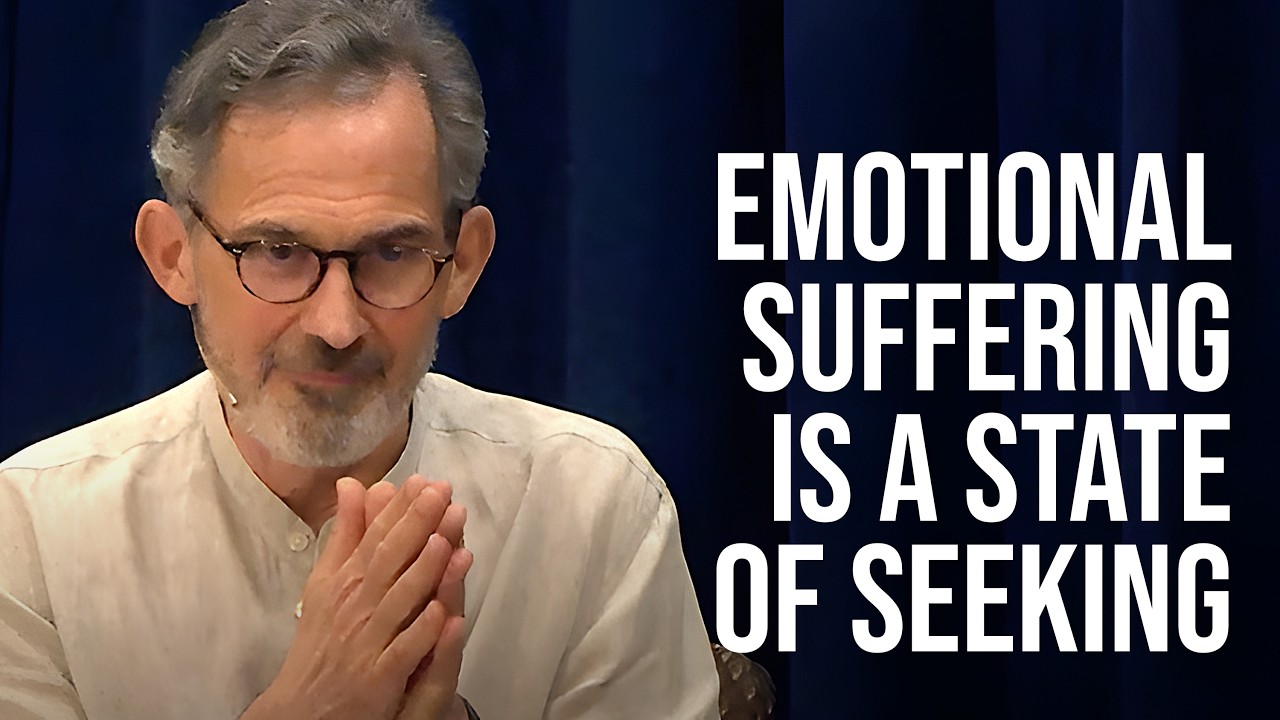
Suffering, in Rupert Spira's account, is not evidence that spiritual seeking has failed. It is evidence that seeking is already underway. In a 90-second YouTube video published in October 2026, the non-dual teacher argues that anyone who is suffering is, by definition, looking for something they feel is missing, and that the honest move is to admit it and then ask a better question: not whether to act, but where to look.
Spira's central move is to refuse a comfortable pretense. Plenty of unhappy people tell themselves they have stopped wanting anything, that they have made peace with their lot. He calls that a contradiction. "It would be much more honest if we are suffering to say yes, I'm suffering," he says in the video. "That means I'm searching for something. I'm resisting what is present and I'm seeking what is not present." (0:00)
The implication is practical. If we are already seeking, the real question is direction. Spira contrasts two strategies. The first tries to relieve distress through acquisition, what he lists as "objects, incense, and so on." (0:43) The second, which he recommends, is to relieve suffering "by investigating the one on whose behalf it arises." (0:47) This is the classic move of self-inquiry: instead of trying to fix the content of the distress, you look at who is experiencing it.
He describes where that investigation leads. Trace it back "to your true being," and, he says, "there is no sorrow in your being." (0:53) From there the sense of a separate self loosens, and what remains is "I am at peace." (1:04) Abiding in that peace is what he calls being "on the pathless path." (1:09) The phrase recurs across non-dual teaching to describe a way that is not a ladder of steps, because the thing sought is already what you are.
The clip closes with a caution that is easy to miss. Once there is peace, you do not need to insist that "there's nobody here and there's nothing to do." (1:15) The point is not to turn the absence of self into a new doctrine. You simply rest "in the peace of your being." That restraint is what keeps the teaching from becoming one more story of seeking, this time with a finish line.
This clip is a compressed statement of a teaching Spira develops at greater length in his longer videos on his YouTube channel, Rupert Spira. For fuller context on self-inquiry and non-duality, start there, and treat this short excerpt as an invitation to investigate your own suffering rather than as a conclusion to accept on trust.