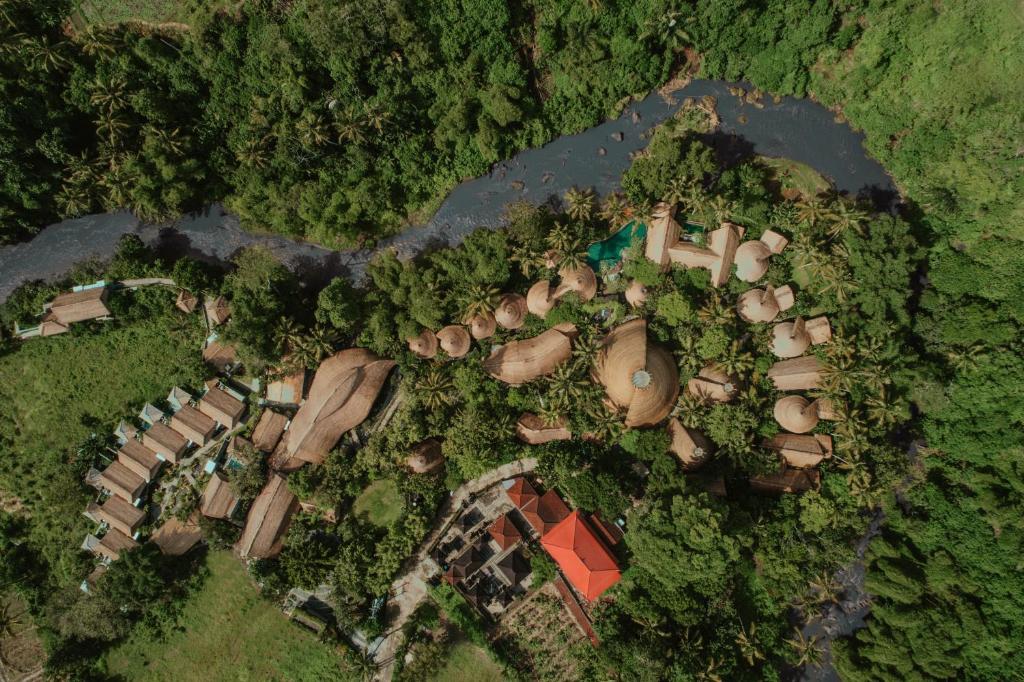
Deep in the rice terraces of Ubud, Bali, a retreat sanctuary has emerged from the ancient philosophy that guides an entire island—one rooted in the disciplines of pure thought, speech, and action. Fivelements Retreat represents not a modern wellness destination imposing Western spa culture onto Eastern tradition, but rather an operational embodiment of Balinese spiritual architecture itself. What distinguishes this approach is neither novelty nor marketing polish, but the integration of three verifiable healing disciplines that have shaped Balinese culture for centuries: ritual purification, plant-based medicine through nutrition, and the sacred arts as pathways to inner alignment.
What Is the Ancient Balinese Philosophy Behind This Approach?
Balinese spirituality rests on a foundation distinct from the Sanskrit-derived yoga traditions of mainland India or the Buddhist schools of Southeast Asia. The philosophy centers on three pillars: purity of thought, purity of speech, and purity of action. This is not asceticism imposed from above, but rather a practical framework for living that addresses the whole human being—mind, voice, and body in motion. The Balinese understanding recognizes that healing cannot occur in fragments. A mind aligned but a body toxic, or words spoken carelessly while the nervous system races—these create internal contradictions that perpetuate suffering.
Within this system, purification is not punishment or denial. It is regeneration. The Balinese see ritual not as superstition but as technology—precise interventions designed to shift the energetic and physical state. These rituals address what Western medicine would categorize as inflammation, stagnation, and imbalance, yet they operate through a different diagnostic language. A Balinese healer observes the whole person: the quality of presence, the relationship to the natural world, the accumulation of what they understand as blocked or heavy energy.
How Do Balinese Healing Rituals Function in a Modern Retreat Setting?
Fivelements operationalizes this philosophy through personalized work with a Wellness Liaison—a guide who serves less as a prescriptive therapist and more as a shepherd through the retreat experience. This is a crucial distinction. Rather than arriving to a fixed menu of treatments, each guest collaborates on their own arc of healing, informed by their specific constitution, presenting imbalance, and readiness for transformation.
The rituals themselves draw from Balinese ceremonial practice but are adapted for contemporary retreatants. Purification rituals might include water ceremonies, herbal preparations, and guided work with sacred spaces. Balancing practices address the restoration of harmony within the energetic body—what Balinese practitioners understand as the interplay between physical matter, subtle energy, and consciousness. Regeneration rituals mark transitions, completion, and renewal. Together, they create a container in which the nervous system can genuinely downregulate and the body's own intelligence can reassert itself.
The distinction between tourism and genuine healing work lies here: in the personalization, in the coherence between the philosophy stated and the practice offered, and in the understanding that three weeks cannot cure lifelong patterns, but the experience can catalyze genuine shifts in how one inhabits the body and relates to oneself.
What Role Does Plant-Based Cuisine Play in the Healing Process?
Balinese medicine has long recognized that food is not merely fuel but medicine—each plant carrying specific properties that either aggravate or pacify different constitutions and conditions. In the retreat context, plant-based cuisine becomes a daily practice of intentional detoxification and nutritional restoration.
This is distinct from dietary dogma or the Western "wellness food" aesthetic that often mistakes appearance for nutritional density. Balinese plant-based eating emerges from agricultural abundance and spiritual practice—the island's tropical gardens yield nutrient-dense foods designed by evolution for hot, humid climates and for supporting the body's natural detoxification processes. Turmeric, which dominates Balinese cooking, carries documented anti-inflammatory compounds. Coconut oil and fresh tropical fruits provide both immediate nourishment and gentle cleansing.
Within the retreat structure, the relationship to food shifts from unconscious consumption to mindful nourishment. Guests begin to notice how specific foods affect their energy, clarity, and emotional state. The vitality that results is not from deprivation but from alignment—the body receiving what it actually needs rather than what habit or craving demands. Over the course of a sustained retreat, this practice rewires the nervous system's response to food itself, creating a foundation that can persist long after departure.
How Do Sacred Arts Function as Healing Medicine?
The Balinese understanding of the arts differs profoundly from the Western compartmentalization of art as aesthetic expression separate from daily life or spiritual practice. In Bali, sacred arts—dance, music, visual practice—are interventions in consciousness itself. They are technology for generating inner strength, establishing alignment with larger forces, and deepening dedication to what is true.
When a retreatant engages with sacred arts within a healing context, they are not learning performance for its own sake. They are using the body's capacity for precise movement, the voice's capacity for resonance, and the mind's capacity for focused intention to reorganize their internal state. A traditional Balinese dance, properly taught, is as much a nervous system intervention as a ritual cleansing. The repetition, the geometry of movement, the synchronization of breath and motion—these create coherence within the body and mind.
This engagement with sacred arts also serves a deeper function: it reconnects the retreatant to dedication itself. In a world of optional everything and perpetual distraction, the discipline required to truly learn a sacred art—to show up, to practice, to refine—becomes a mirror for one's capacity for commitment and presence. Inner strength emerges not from aggression or force but from this sustained, humble engagement with something larger than oneself.
What Makes Personalization Central to the Retreat Experience?
The presence of a dedicated Wellness Liaison distinguishes this model from both conventional luxury spa tourism and rigid, one-size-fits-all ashram structures. Personalization reflects a core Balinese insight: there is no universal prescription for healing. A person with a constitutional tendency toward excess heat requires different interventions than someone whose system is chronically sluggish and cold. A guest arriving in acute grief needs different pacing than someone seeking preventive optimization.
The Wellness Liaison functions as a kind of translator between the guest's own body-wisdom and the vast toolkit of Balinese healing practices. They listen. They observe how the guest responds to rituals, to food, to silence, to practice. They adjust. They protect the integrity of the experience by ensuring that the retreat never becomes about consumption or achievement—the twin poisons of modern wellness tourism—but remains rooted in genuine transformation.
This personalized container also honors a truth that institutional healing environments often obscure: healing is not one thing. It is the gradual reorganization of a person's relationship to their own body, mind, and life. It unfolds at different paces for different people. Some shift happens in ritual. Some happens in the silence between moments. Some happens months after departure, when a habit that once seemed immovable suddenly releases.
Where to Go From Here
For those called to explore this approach to healing, the invitation is not to simply book a vacation but to approach the retreat with genuine intention. This means arriving with honesty about what has brought you to seek healing—not the polished story you tell others, but the actual texture of your suffering, fatigue, or longing. It means showing up for the practices, even when resistance arises. It means allowing the Wellness Liaison to guide rather than grasping to control the experience.
Fivelements Retreat operates from a philosophy that healing is possible, that the body has its own intelligence, and that reconnection to ancient wisdom does not require abandoning modern life—it requires temporarily stepping outside the rhythms that have depleted you, so that you might return to them transformed. Those ready to test this approach can begin by visiting fivelementsbali.com or contacting reservations@fivelements.com to discuss what a personalized retreat might offer.


