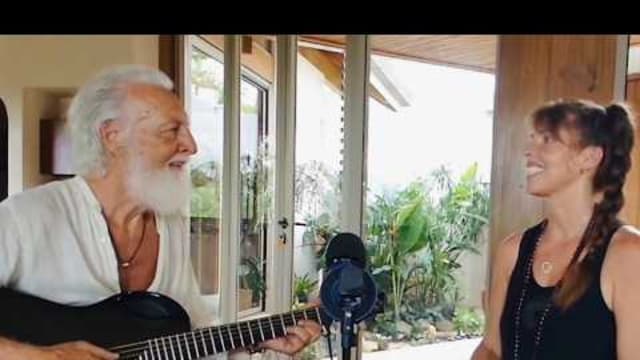
Ancestral Resonance: Opus Live Sessions is an eighty-minute sound journey by the musician Poranguí, recorded live at SXSW inside the OPUS SoundBed with 100 people present for a single night. Built from improvised playing and channeled vocals, it moves through six named movements, from the primordial forest's first heartbeat through dreamtime trance, Tonantzin's embrace, the awakening of the golden sun, Yemanjá's haunting call, and finally the soul's return. Charango, ngoni, didgeridoo, native flutes and ancestral rhythms carry the journey, and the release describes its purpose plainly: deep listening, embodiment and ceremony, not the casual consumption of a conventional album.
This guide works from the release's published description and its title, not from a transcript of the audio. What follows explains the ideas that the framing puts forward, so that a listener arriving at the eighty minutes knows what they are being asked to do with their attention.
Most long-form ambient and world-music records are assembled over weeks: layers added, sections trimmed, the best take chosen from many. A live session removes that safety net. The performance happens once, in front of people, and whatever the room does to the sound becomes part of the record. The description for Ancestral Resonance is explicit about this. It says the piece was "captured in one transformative night with 100 souls traveling together," and it frames the result as "both ritual and remembrance."
That phrasing matters. A studio recording tends to present music as an object to be replayed. A ceremony is an event that is only complete when people are inside it together. By placing the recording in a room of a hundred people rather than a booth, the release asks the listener to hear the album as a record of a shared night, with its own tempo of breath, movement and attention. Even if you are listening alone on a train, the framing invites you to imagine the room.
The release also calls itself "a living transmission." Taken literally, that means the sound is not meant to be finished the way a product is finished. It is meant to be entered. Live improvisation suits that idea because it cannot be fully repeated. Each hearing is a second encounter with something that happened once.
The description credits the work to "Poranguí's masterful improvisation and channeled vocals." Improvisation in this context is not the same as noodling. In ceremonial and devotional music across many traditions, the performer's job is to listen to the room and respond, letting the form emerge rather than imposing a score. A long improvised set gives the performer room to move from one state to another without rushing, which is why the release can describe its movements as portals rather than tracks.
Channeled vocals sit in the same territory. The term is used in the release's own language, and it signals a practice in which the voice is treated as a conduit for something larger than the singer's personal intention. Whatever one makes of that claim, it shapes how the vocal behaves on the record: less like a lead line that a listener follows for a melody, and more like a presence that rises, settles and returns across the eighty minutes.
For a listener, the practical consequence is that you should stop waiting for the song to arrive. A piece built on improvisation does not have a chorus to anchor on. Its structure reveals itself over time, through repetition, through the gradual change of texture, and through the points where a new movement's character begins to take over.
The release names five sources of sound: charango, ngoni, didgeridoo, native flutes, and what it calls ancestral rhythms. Each carries a long lineage, and the choice to braid them together is the core of the album's argument.
- Charango is a small stringed instrument of the Andean region. Its bright, shimmering attack gives the Andean strand of the record a crisp, high register that can sound almost like a pulse.
- Ngoni is a lute associated with West African musical traditions. Its plucked, resonant strings add a rootedness that is different from the Andean timbre, and their overlap with the charango creates an ancestral dialogue across continents.
- Didgeridoo is the long drone pipe associated with Aboriginal Australian music. In a piece that opens with a "primordial forest's first heartbeat," its low, continuous drone is the instrument most suited to the idea of something older than memory.
- Native flutes provide breath-centered melodic lines that move between the drone and the rhythmic material, giving the piece its sense of air and open space.
- Ancestral rhythms are the pulse underneath everything, the element that makes the eighty minutes feel like a body rather than a sequence of sounds.
The drone deserves particular attention. In a long-form piece, a sustained low tone does the work that a harmonic progression does in a pop song: it tells the listener where they are, and it changes only when the music is ready to change. The didgeridoo's sustained breath, and the way the other instruments float above or sink into it, is the practical mechanism behind the release's promise to take listeners "inward." Listen for moments when the drone seems to hold still while the upper voices move. That contrast is where much of the meditative effect lives.
The description lays out six movements, each framed as a portal. Taken in order, they trace a movement from the earliest and most elemental to the most personal.
The first, the primordial forest's first heartbeat, starts at the level of pulse and origin. Its job is to establish the body before any story begins. Dreamtime's trance follows, which draws on the Australian Aboriginal concept of Dreamtime in the way the release invokes it: a state of altered awareness in which time loosens and ordinary categories blur. The release positions the trance as the point where the listener is most likely to drift.
Tonantzin's embrace shifts to a maternal, devotional register. Tonantzin is a name associated with the Mexican tradition of a mother goddess, and in the description she is paired with the image of the "pulse of the mother" that runs through the whole project. The awakening of the golden sun then turns toward light and emergence, the moment the piece lifts after its descent. Yemanjá's haunting call, Yemanjá being the Afro-Brazilian orisha associated with the sea, brings in water and longing, a call that the description treats as one of the most emotionally charged passages. The final movement, the soul's return, closes the arc and brings the listener back toward themselves.
What is notable about this sequence is that it moves from the cosmic and the ancient toward the intimate. Elemental pulse comes first, then altered consciousness, then the maternal, then the solar, then the watery and emotional, and only at the end the individual soul. Whether you hear this as a literal map or as a suggestion, it gives the eighty minutes a clear emotional shape that a listener can follow even without knowing the names.
The description offers its own practical guidance, and it is worth taking seriously because it is built into the design. The advice is to use high-quality headphones or a good sound system, to find a comfortable place to lie down or move freely, to invite others to journey alongside you, and to set an intention, breathe deeply, and let the sound carry you home.
The first recommendation is about fidelity. Drones and overtones are sensitive to playback quality; a small phone speaker will flatten exactly the low-frequency material that makes the didgeridoo and the forest's heartbeat work. The second is about posture. Lying down removes the habit of watching the music, which suits a piece whose structure reveals itself gradually. The third is about company. The release's own framing is communal, and the room of 100 people that the live recording captured is the model it invokes.
The intention step is the one most listeners skip, and it is the one that changes the experience most. Deciding in advance what you are listening for, whether rest, grief, gratitude or simply presence, gives the piece something to hold. It also gives you a point of return when your attention wanders, which over eighty minutes it almost certainly will.
The video of the performance has been viewed 85,366 times at the time of this article, a number that indicates the material has reached a substantial audience beyond the room where it was recorded. Long-form sound journeys have a particular listening culture: people return to them during sleep, during meditation, during long stretches of work or travel, rather than playing them once through like a conventional album. The release's language about "embodiment" and "ceremony" fits that pattern. It asks for repeated, attentive, unhurried listening.
The release's description also points to a wider frame it calls Music is Medicine, language that appears in its hashtags and in its invitation to subscribe. That phrase places the work within a tradition in which music is understood as something that can heal, not only entertain. Whether or not a given listener accepts that frame, it is the clearest statement of what the project wants from its audience: not applause, but a change in the state of the person listening.
If you are new to this kind of music, start with the full eighty minutes in one sitting, using headphones and lying down, and set a simple intention before you press play. Afterwards, go back to the six movements and notice which one landed hardest. Then listen to the piece again and attend to the drone, the place where the upper instruments rest and reach. The release is available through Sol Creation Records, and the performance itself can be found on the channel where it was published. If the live recording draws you in, the description also points to a newsletter and a Facebook presence through which the project shares further work.
Ancestral Resonance is less an album to be analyzed than a night to be entered. Its strength lies in patience: a single room, a single improvised performance, and a set of named portals that carry the listener from the forest's first heartbeat to the soul's return. Approach it as a ceremony, and the eighty minutes will do what the release promises.