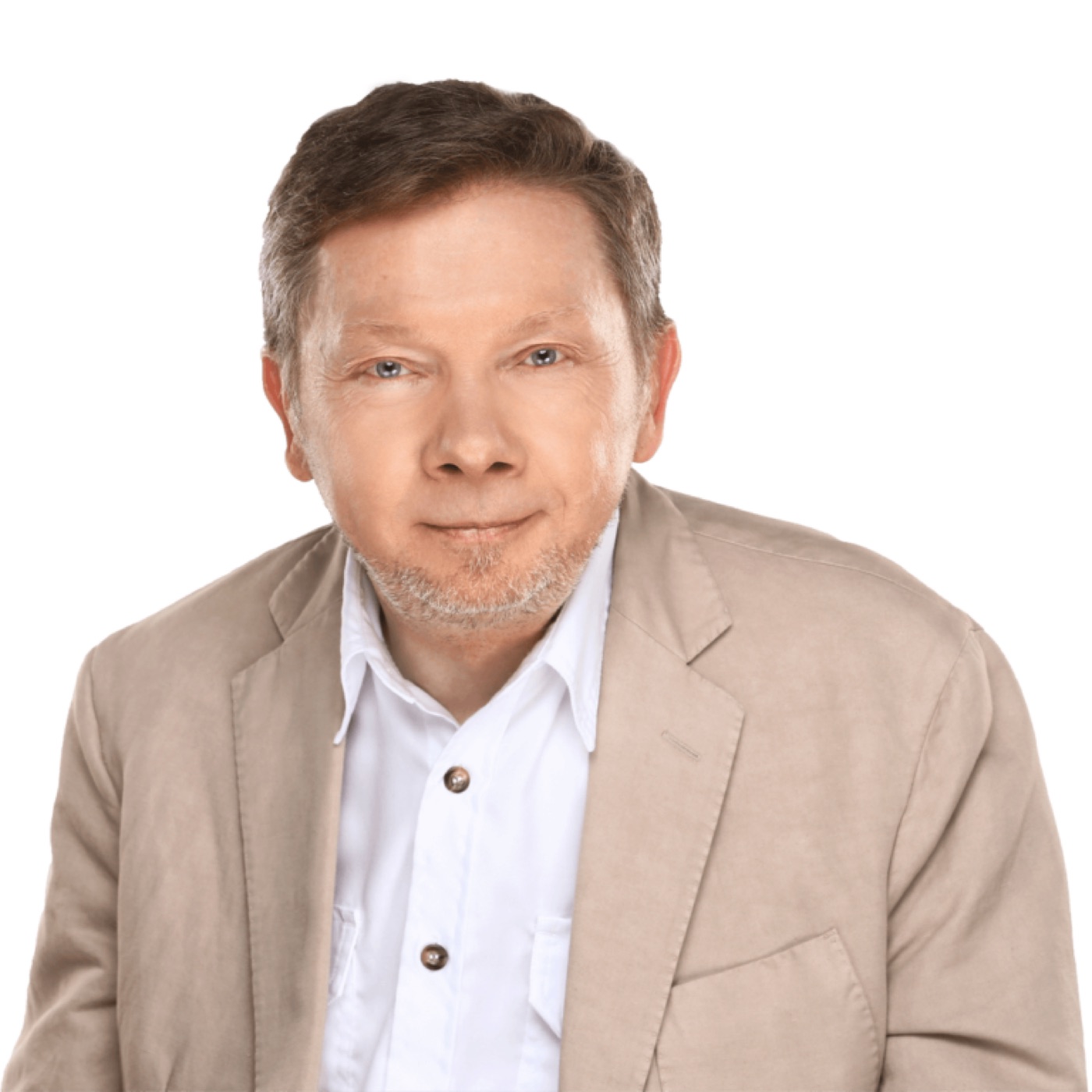

Eckhart Tolle is a German-born spiritual teacher and author whose work centers on present-moment awareness. He asks for no religious conversion and no institutional allegiance. If you're new, the question is where to begin, and the answer depends partly on whether you read or listen.
Start with The Power of Now: A Guide to Spiritual Enlightenment (1997). It is the book that made his name, and it is built for newcomers. It opens with his personal crisis and awakening, so you get narrative and direct testimony before any teaching. It is structured as a question-and-answer handbook, which suits a first read: you can see the objections a skeptical person would raise, and watch him answer them by pointing back to your own present-moment experience.
You need no spiritual background. He avoids Sanskrit terminology and doctrinal references, and he grounds the teaching in things you already know: anxiety, regret, distraction, the feeling of being separate from everything else.
If you prefer audio, the audiobook version is available through Audible, Apple Books and other retailers. His speaking pace and use of silence are part of how the teaching lands, so audio is a legitimate way in.
A New Earth: Awakening to Your Life's Purpose (2005). Written as a traditional narrative rather than Q&A, it examines how moving beyond ego-based consciousness leads to personal happiness and an end to conflict and suffering. It also extends the teaching from individual liberation to collective transformation, and takes up the question of purpose. Read it second, once the core idea is familiar.
Stillness Speaks. This gathers short teachings into 10 chapters. It suits dipping in: read a few pages, put it down, and sit with them.
His YouTube channel (@EckhartTolle). It hosts hundreds of talk recordings, Q&A sessions and meditations. Spotify, where his profile has 187,426 followers, is another route to the spoken-word teachings. Recordings matter because his voice, pacing and pauses are integral to the transmission. If a passage in the book feels abstract, a talk often makes it click.
Expect something quiet. His style is contemplative rather than performative: measured, deliberate, with frequent pauses. What newcomers sometimes mistake for hesitation is intentional silence used as a teaching tool. In live settings he typically opens with silent meditation and then takes questions, often returning the questioner to their direct experience instead of giving an abstract answer.
Expect the teaching to be austere. His central claim is that psychological suffering comes from identification with thought, especially rumination about past regrets and future anxieties, and that freedom comes from disidentifying from mental content and returning to the present. He is not offering self-improvement. The self, in his view, is something to be seen through, not optimized.
Expect little technique. He offers principles and pointers, not staged systems.
Treating it as intellectual material. The most common mistake is to understand the ideas and stop there. He argues repeatedly that conceptual understanding of presence is not presence. You can underline every page and change nothing.
Mistaking it for positive thinking. He is distinct from law-of-attraction and positive-psychology teachers. Nothing here promises abundance or success. If you come looking for affirmation, you may find it bleak.
Expecting a path. There are no stages, initiations or ordained structures, and he maintains no formal affiliation with a single tradition. Some people read that freedom as a missing roadmap. The responsibility for verification rests with you.
Thinking enlightenment is a distant goal. He treats liberation as available only now, not as a future achievement. Beginners who keep waiting for the big shift are working against the teaching.
This work tends to hit hardest when thought has become a source of suffering: periods of heavy rumination, anxiety about the future, regret about the past, or a sense that your life narrative is no longer holding. His own awakening came out of an existential crisis in 1977 while he was doing doctoral studies at Cambridge, which is why the teaching speaks so directly to people in a breakdown or a stall. It also suits people who are skeptical of religion and want something secular and testable. It is a poor fit if you want ritual, doctrine, community structure or a rigorous philosophical system.
Day 1: Read the opening of The Power of Now, his account of his crisis and awakening. Notice, without forcing anything, how often your mind is somewhere other than where you are.
Day 2: Continue the book and read slowly. Stop whenever a passage points at your own experience, and check it right then.
Day 3: Watch one talk or Q&A from his YouTube channel. Pay attention to the pauses and let them be pauses.
Day 4: Read a few pages of Stillness Speaks. Pick one short teaching and carry it through the day.
Day 5: Return to The Power of Now. Observe one recurring thought pattern, regret or anxiety, without arguing with it.
Day 6: Listen to a guided meditation or another recorded talk while walking or commuting.
Day 7: Review. Which passages changed anything in your direct experience, and which only sounded true? Then decide whether to move on to A New Earth.
If you want to see him in person, his official website (eckharttolle.com) is the source for current events and retreat registration. Autumn 2026 appearances have been confirmed in Warsaw (September 30), Edinburgh (October 4) and Copenhagen (October 8), and the site will have anything newer.