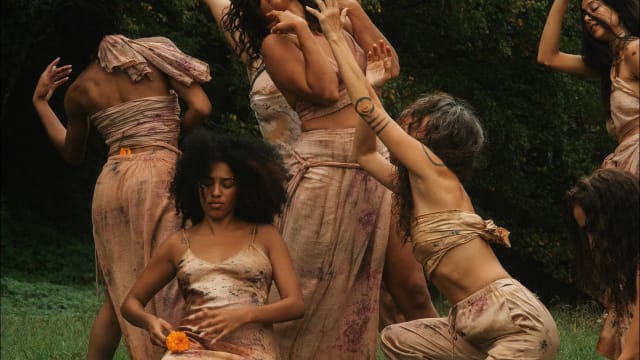
A half-hour morning practice filmed in Ibiza asks for something most yoga videos only gesture toward: a flow that starts with the body waking up and ends with the body inverted, balanced and, if the practice is working, a little more graceful than when it began. The video, a progressive Prana Vinyasa session posted by the teacher Delamay Devi in September 2018, is framed in its description around three words: strength, stamina and overall grace. It moves through standing poses, handstand transitions and inversions, and it is set to "You and I Are Falling, You and I Are Free" by Rising Appalachia, from their album The Sails of Self. This article is written from the video's title, its description and its music credit. No transcript was available, so what follows explains the practice on its own terms rather than quoting the teacher's spoken cues.
The name carries two Sanskrit ideas. Prana is usually translated as breath or vital life energy, and in yoga it is the thread that connects the physical body to the breath. Vinyasa refers to a sequence in which movement is linked to breath, so that each inhale and exhale marks a change in shape. Put together, a prana vinyasa practice is a flow in which the breath sets the tempo and the body follows, rather than a set of poses held for long periods.
That distinction matters for the way a session like this one is meant to feel. A flow moves. The student is not stopping to find a position and then leaving it; they are passing through shapes, and the transitions between them carry as much of the practice as the postures themselves. For a viewer, the clearest sign of a vinyasa practice is that the breath is never allowed to go missing between poses.
The description names handstand transitions and inversions explicitly, and it is worth understanding why a teacher would organize a progressive morning flow around them. Inversions, poses in which the head drops below the heart, change how the body handles blood flow, balance and spatial orientation. Handstands ask the arms to carry the full weight of the body, the shoulders to stabilize, and the core to organize the whole line from wrists to heels. They are demanding, and they reward patience.
The word "progressive" in the description points to the logic of the session. A practice that moves toward inversions usually spends its early minutes warming the hips, hamstrings, shoulders and wrists, then layers in standing work that builds leg and core strength, before the transitions that lead the body upside down. Each stage prepares the next. Students who skip the early work tend to rush the inversions, and that is where the strain and the injuries tend to come from.
If you are trying a handstand transition for the first time, a few general principles are widely taught. Warm the wrists before loading them. Practice near a wall so that falling is controlled. Keep the ribs drawn in so the lower back does not arch sharply. Bend the knees and come down slowly rather than dropping out of the pose. None of this is specific to the Ibiza video, but it is the kind of groundwork that makes a flow like this one safe to attempt.
The three qualities named in the description are a useful way to read the practice. Strength is the obvious one: standing poses and inversions ask the legs, core, back and arms to hold the body in positions that gravity is always trying to collapse. Stamina is the quieter demand. A flow that continues without a long rest asks the cardiovascular system and the breath to keep pace, so the practitioner learns to recover mid-movement rather than stopping to catch their breath.
Grace is the hardest of the three to describe and the easiest to recognize. In a flow practice it usually appears as continuity: transitions that do not stutter, a breath that stays even when the body is working hard, and a sense that the shapes arrive from the inside rather than being forced into place. The description does not define grace further, and it would be a mistake to pretend it does. But it is a fair reading that a practice aiming for all three is aiming for a body that is capable and at ease at the same time.
The title places the practice in Ibiza, and the choice of a morning session is part of the atmosphere. Morning practice is traditionally used to set the tone for the day, and a flow filmed outdoors in the early hours carries a different quality from a studio class under fluorescent light. The description does not say more about the location, so it is best to take the setting as an invitation to imagine the practice in an open space rather than as a claim about how the session was run.
The music credit is worth noting too. Rising Appalachia are a duo whose work blends folk and roots influences, and "You and I Are Falling, You and I Are Free" is a track that suits a practice built on the idea of letting go into balance. The pairing of an unhurried song with a practice that asks for controlled power is part of why the video feels the way it does.
If the video appeals to you, the most useful next step is to start with the foundations rather than the handstands. Spend a week on a simple vinyasa built around sun salutations, paying attention to the breath at each transition. Then add a few standing poses that build leg and core strength, and only after that begin to practice inversions near a wall with a teacher or a spotter if you can. Watch the full video for the sequence and the pacing, and treat it as a guide to the order of the work rather than a set of instructions to copy in one sitting. Progress in a flow like this is measured in months, not in a single morning.
The video is available on the Delamay Devi channel on YouTube, and the teacher's own site, delamaydevi.com, is listed in the description for anyone who wants to follow further work.