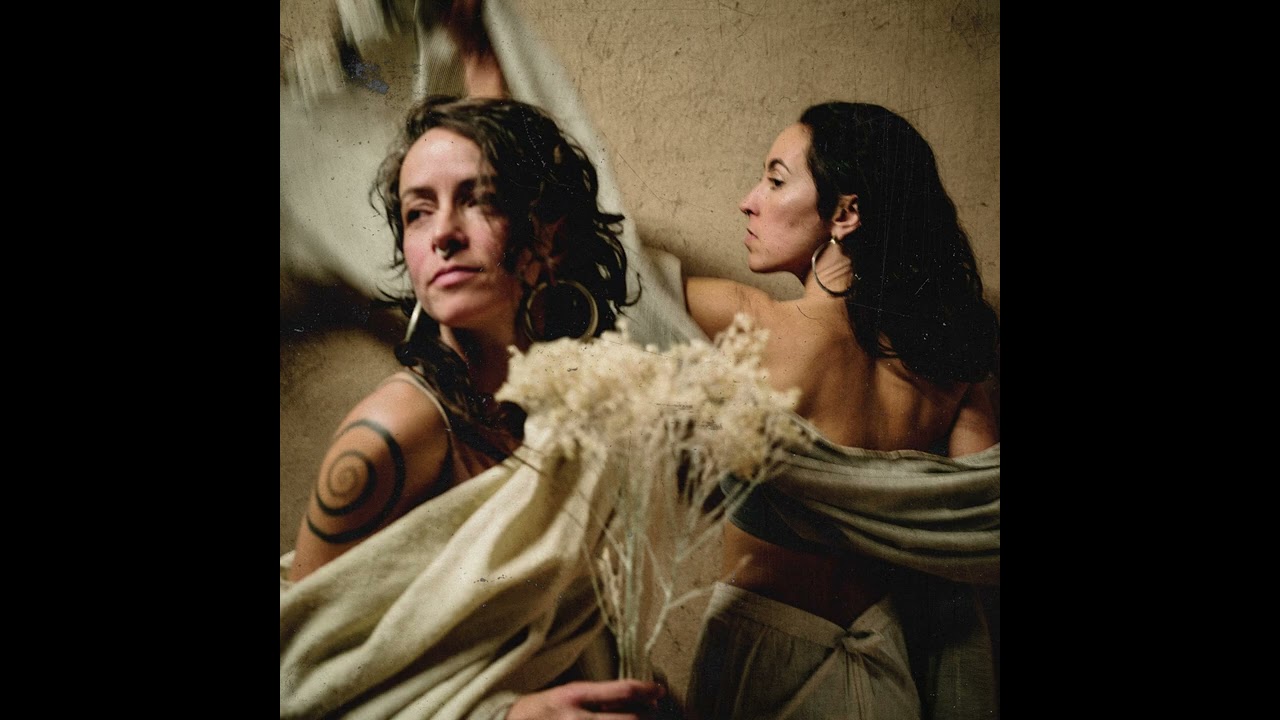
There is a long lilt to the shape of things, southern things, summer things. We cleave to dawn here. Sisters of song gather around the inherited shapes of Appalachia—the oak, the clay sky, the rain that arrives like a lover's return. This is where Rising Appalachia begins, not with preamble but with incantation, the film Trade My Troubles opening into a landscape of voice and longing that has taken years to crystallize into form.
What makes this art film distinct among the recent wave of musician-driven documentary work is its refusal of the salvage narrative. Rising Appalachia—the songwriting and performance partnership of Leah Song and Chloe Smith—do not position themselves as archivists rescuing mountain music from oblivion. Instead, they locate themselves inside a living tradition, one that bends and transforms with each telling, each crisis, each season. Trade My Troubles is less a retrospective of a finished album than a working document of how art functions as "second responder," as the film's creators frame it—not replacing official aid but moving through trauma as witness, as chronicler, as keeper of what was broken and what endures.
The film charts a journey that spans geographies and timescales. Leah Song and Chloe Smith move through music and folklore traditions rooted in the Appalachian South, then westward across the Pacific coastlines of Northern California, and back into the devastation Hurricane Helene left in its wake across their homelands. This is not a linear arc. The structure mirrors how grief actually works—circling, returning, finding new pathways through familiar terrain. The songs themselves become way-stations: "I'll trade my troubles for bird songs / Take me back in time," Song sings, her voice carrying the weight of that exchange, the negotiation between past and present that defines so much of Appalachian culture.
The core aesthetic decision in Trade My Troubles is to treat craft—whether musical, choreographic, or textile—with the reverence typically reserved for inherited wisdom. When the film focuses on basket-making, it is not incidental texture. The basketweaver's hands repeat patterns that contain centuries. The blacksmith's forge, the plant-dyer's vat, the bee-tender's relationship with the hive—these become counterpoints to the voice. Duncan Wickel's production and the contributions of David Brown and Biko Casini in the ensemble create a sonic landscape where tradition and contemporary studio work are not opposed but woven together. The songs exist in that conversation, belonging fully to neither the past nor the present moment alone.
The film's most urgent segment addresses Hurricane Helene directly. "Water rising down below / Everywhere I look, everywhere I go," the singers intone, the chorus building as documentary footage shows the scale of loss—800,000 trees down across the ground, the river that becomes a force that cannot be reasoned with. What distinguishes Rising Appalachia's response is its refusal to separate the personal from the ecological, the ancestral from the immediate. The masks created by House of Arulu, featuring Jade Sanchez, Leah Song, and others, transform faces into vessels for collective grief. This is not metaphor-making; it is ritual in the post-catastrophe moment, the body becoming a language when words fractured.
The choreography by Jade Sanchez—performed by Quetzal Jordan, Delacey Ault, Rachel Eliza Bennett, Kayla Gupta, Hana Nubia, Deonna Banks, and MaLeah Raymer—embodies this same commitment to grounding emotion in the body's knowledge. The section titled "Come Undone" features dancers moving through the phrase "Don't let me come undone," which functions simultaneously as prayer and warning, as recognition that coherence is fragile and that community holds us together in the fractures. The clothing designed by Wild Verbena carries its own story, textile as protection and adornment, the body cared for even in crisis.
One of the film's recurring gestures is its precision with nomenclature. When singers ask "Who at the cradle? Who sing a song? / Who rock the cradle when I'm gone?"—this is not abstraction. It is the question of continuity, of transmission, of what survives our absence. The answer comes not as resolution but as commitment: "I'll rock the cradle when you're gone." The music carries Appalachian tonal patterns—the blues inflection, the modal shifts—but filtered through a distinctly contemporary consciousness. "Decolonize," one voice sings, invoking a word rarely heard in traditional mountain music, yet fitting naturally into the melodic shape because the work of decolonization has always been embedded in the gesture of reclaiming indigenous relationship to land, to water, to the more-than-human world.
The film does not separate its strands neatly. A sequence moves from honey and bees to questions of desire and power, from the economics of survival ("keep stacking dimes in paper packs") to the refusal of confinement ("I don't like that fish bowl structure"). These are not random associations. Rising Appalachia works with the Appalachian tradition's own logic—the ballad's method of accumulating images, the folk sermon's way of moving from the particular to the universal and back again. Kristy Bogart's plant dyes, Tyler Lavenburg's basket-making, Tod Kersaw's blacksmithing are shown not as separate from the music but as parallel utterances, each one answering the same question: how do we continue? How do we make something beautiful from what is at hand?
The decision to film Appalachian scenes at Lake Eden in Black Mountain, North Carolina—a location steeped in its own history as a center for arts and educational experimentation—grounds the work in a specific terrain while acknowledging that Appalachia is not monolithic. The Pacific Ocean sequences, filmed on the Northern California coast, create productive dissonance. Rising Appalachia is not returning to restore some pure regional identity; they are moving through it, taking what is necessary, leaving room for what comes next. The landscape itself becomes a kind of third voice in the trio of Leah Song, Chloe Smith, and the ensemble. Water appears across the film as both ancestral memory and present-day threat, as the element that connects all the places they sing about.
What Memory Terra's hurricane footage contributes is documentary precision without documentary coldness. The images of storm and flooding are real, specific, undeniable. They do not serve as backdrop to the music; the music serves the images, sits with them, witnesses them. This is the stance the film models throughout: presence without sentimentality, tradition without nostalgia, grief without despair.
Trade My Troubles arrives at a moment when "art as activist practice" has become something of a cliché. What Rising Appalachia accomplishes instead is demonstrating how traditional forms of artistic practice—singing, dancing, making with the hands—already contain within them the resources for response, repair, and reckoning. The film does not argue this case; it enacts it. To watch is to feel that argument take root in your own body, in the memory of songs you have heard, in the knowledge that your hands contain patterns older than your words for them.