BrightStar

Ver todos os Events

Descubra encontros conscientes

events

Yoga
Meditation
Breathwork
Qigong
Tai Chi
Sacred Music
World Music
Medicine Music
Sound Healing
Ecstatic Dance
Destinos populares
BaliSedonaLos AngelesCosta RicaNew YorkSan FranciscoAustinMiamiJoshua TreeTulum
Ver todas as categoriasVer todos os destinos

Explorar todos os recursos

Ferramentas poderosas para expandir seus eventos

Recursos da plataforma

Precificação dinâmica inteligente
Categorias de ingressos
Lugares marcados
Recuperação de carrinho abandonado
Recuperação de visitantes
Doações e preço variável
Sistema de afiliados
Scanner de ingressos
Códigos de desconto
Perguntas personalizadas
Compartilhamento de ingressos
Upsells e adicionais
Análises e relatórios
Sequências de e-mail
Lista de espera / Notificar / Lembrar
Pessoas e Lugares
Artists & TeachersEvent OrganizersVenues & StudiosKnowledge BaseGlossaryInspiration
Ver todos os recursosSobre nós
PreçosBlog
Language
Saved events
Ver todos os eventos

events

YogaMeditationBreathworkQigongTai ChiSacred MusicWorld MusicMedicine Music

Destinos populares

BaliSedonaLos AngelesCosta RicaNew YorkSan Francisco

Pessoas e Lugares

Artists & TeachersEvent OrganizersVenues & StudiosKnowledge BaseGlossaryInspiration

Recursos da plataforma

Precificação dinâmica inteligenteCategorias de ingressosLugares marcadosRecuperação de carrinho abandonadoRecuperação de visitantesDoações e preço variávelSistema de afiliadosScanner de ingressosCódigos de descontoPerguntas personalizadasCompartilhamento de ingressosUpsells e adicionaisAnálises e relatóriosSequências de e-mailLista de espera / Notificar / Lembrar
Ver todos os recursosSobre nós
PreçosBlog
EntrarBuscadoresCriadores
  • Ver todos os Eventos
  • Para buscadores
  • Yoga
  • Meditação
  • Respiração consciente
  • Qigong
  • Tai chi
  • Música sagrada
  • World music
  • Música de medicina
  • Terapia sonora
  • Dança extática
  • Retiros
  • Workshops
  • Todas as categorias →
  • Bali
  • Sedona
  • Los Angeles
  • Costa Rica
  • Tulum
  • Byron Bay
  • San Francisco
  • Austin
  • New York
  • San Diego
  • Denver
  • Seattle
  • Portland
  • Miami
  • Todas as cidades →
  • Join the Movement
  • Why we list
  • Sell Globally
  • Para criadores
  • Para equipes
  • Para escritores
  • Para professores
  • Para artistas de kirtan
  • Para estúdios
  • Para festivais
  • Para centros de retiro
  • Para organizações sem fins lucrativos
  • Embaixador da marca
  • Ingressos grátis
  • Elevate
  • Amplify
  • Rede de 500K+ compradores
  • Recuperação de carrinho abandonado
  • Precificação dinâmica inteligente
  • Categorias de ingressos
  • Eventos recorrentes
  • Lugares marcados
  • Sistema de afiliados
  • Lista de espera / Notificar
  • Scanner de ingressos
  • Widget incorporável
  • Distribuição de eventos
  • Central de mensagens
  • Integrações
  • Relatórios
  • Todos os recursos →
  • Sobre
  • O ecossistema
  • Blog
  • Glossário
  • Inspiração
  • Central de ajuda
  • Contato
  • Documentação da API
  • Recursos da marca
  • Carreiras
  • Imprensa
  • Termos de Serviço
  • Política de Privacidade

Eventos

  • Ver todos os Eventos
  • Para buscadores
  • Yoga
  • Meditação
  • Respiração consciente
  • Qigong
  • Tai chi
  • Música sagrada
  • World music
  • Música de medicina
  • Terapia sonora
  • Dança extática
  • Retiros
  • Workshops
  • Todas as categorias →

Destinos

  • Bali
  • Sedona
  • Los Angeles
  • Costa Rica
  • Tulum
  • Byron Bay
  • San Francisco
  • Austin
  • New York
  • San Diego
  • Denver
  • Seattle
  • Portland
  • Miami
  • Todas as cidades →

Para criadores

  • Join the Movement
  • Why we list
  • Sell Globally
  • Para criadores
  • Para equipes
  • Para escritores
  • Para professores
  • Para artistas de kirtan
  • Para estúdios
  • Para festivais
  • Para centros de retiro
  • Para organizações sem fins lucrativos
  • Embaixador da marca
  • Ingressos grátis
  • Elevate
  • Amplify

Recursos

  • Rede de 500K+ compradores
  • Recuperação de carrinho abandonado
  • Precificação dinâmica inteligente
  • Categorias de ingressos
  • Eventos recorrentes
  • Lugares marcados
  • Sistema de afiliados
  • Lista de espera / Notificar
  • Scanner de ingressos
  • Widget incorporável
  • Distribuição de eventos
  • Central de mensagens
  • Integrações
  • Relatórios
  • Todos os recursos →

Empresa

  • Sobre
  • O ecossistema
  • Blog
  • Glossário
  • Inspiração
  • Central de ajuda
  • Contato
  • Documentação da API
  • Recursos da marca
  • Carreiras
  • Imprensa
  • Termos de Serviço
  • Política de Privacidade
BrightStar
Baixe o app
Baixar naApp StoreDisponível noGoogle Play
© 2026 BrightStar. Todos os direitos reservados.
Inspiration

Great Compassion Dharani: Purifying Mind, Not Asking Blessings

BB
BDG: Buddhistdoor Global
Nov 9, 2026
7 min de leitura

De BDG: Buddhistdoor Global

Assistir · 7

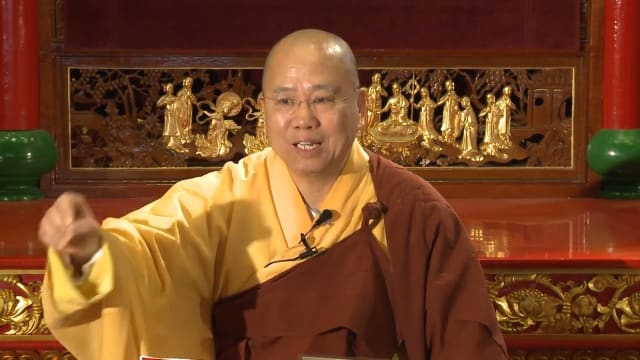
Ven. Guan Cheng, abbot of the International Buddhist Temple in Richmond, British Columbia, takes a single phrase from the Great Compassion Dharani and turns it into a working lesson on the mind. In this installment of an eight-part dharma series, published by Buddhistdoor Global, he argues that chanting is not a request for favors from the Buddha but a daily instruction to clean up what we do, say and think. The talk moves from a bathing analogy to karma and cause and effect, then lands on two ideas that run against the usual picture of devotional practice: that blessings do not replace your own effort, and that procrastination is the most common way practitioners stall.

Leitura · 7 seções

Why would you wash your mind the way you wash your body?

The talk opens on something everyone does without thinking. "What do we do to purify our body every day?" Ven. Guan Cheng asks at 1:37 in the video. Bath, soap, shampoo. Clothes get dirty and we purify them. "We only thought of cleaning the body," he says, "but we never thought of cleaning our own mind." The rest of the talk depends on that small reversal. The mantra's language of purity is not decoration; it names a job.

He glosses the opening words of the phrase as "my," and frames the whole invocation around purity and liberation: my purity, my liberation. He is careful about the limits of this kind of reading. A mantra, he says, "would only give you the key points," and the detailed explanation has to be drawn out separately. That honesty about what a short formula can hold is worth noticing. He is not offering a decoder ring. He is offering a way to hold the words while you chant.

What exactly is being purified: body, speech, or mind?

The answer he gives is a sequence, and the order matters. Thought arises from the mind. Behavior arises from thought. Speech follows both. At 4:26 he names the three channels directly: the body, which means behavior; the mouth, which means speech; and the mind, which means the thoughts that arise from it. He then lists the kinds of conduct he has in mind, including fighting, killing, stealing and sexual misconduct on the body side, and cursing, lying, slander, flattery, double-tongued talk and tattling on the speech side.

He is blunt that the mind drives all of it. "Our mind drives us to behave," he says at 2:41. Sometimes we are kind and considerate; sometimes we go to extremes. The practical claim is that the chant is aimed at these three channels together, not at one of them in isolation. Purifying only the outward act while the mind keeps producing the same urges is, by his logic, a half job.

If karma works, why does anyone need to chant?

This is where the talk makes its strongest case, and where he is most direct about consequences. Purified thought, speech and behavior, he says, produce good karma. Staying away from cursing, lying, flattery, sexual misconduct, intoxication and drugs leads to a happier life. He presses the point with a familiar image: a clever criminal may evade the police, but "causality, karma would get you one day." At 5:58 he adds an instruction that cuts against ordinary resentment. If someone has wronged you, do not nurse a grudge. Forgive, because "naturally, spontaneously, by the law of cause and effect, karma will get him." You do not have to wish harm on anyone; the law does the work.

The payoff he names is liberation: freedom from "your cocoon of ego," from mental afflictions, and from unhappiness, because a mind that is pure stops generating the material of its own suffering. Cause and effect at 16:46 is the frame he returns to. Whatever you sow in thought and speech is what you harvest.

Is coming to the temple for blessings the wrong approach?

The talk's most pointed passage is a joke he says he has told many times, and a complaint he says he hears often. At 7:17 he describes visitors who arrive at the temple for blessings, who want this and that, and who then discover the abbot is telling them to purify themselves and reminding them that everything is impermanent. Some leave unhappy. His answer is not that blessings are fake, but that they are misunderstood. "That's superstition," he says, if coming to the temple means only wanting things from the Buddha.

"You can just sit there and let Buddha bless you and you don't do anything. You continue to do your bad thoughts. You continue to be a criminal. You continue to be impure and you are expecting God or Buddha to bless you. Why don't you improve on yourself first?" (Ven. Guan Cheng, dharma talk, approx. 8:25 onward)

What he proposes instead is a twofold model of practice. One side is self-effort: meditation, purifying yourself, improving yourself. The other is help from outside, from bodhisattvas, Buddhas and arhats who are already there to assist. But the second side only activates after the first. "You must walk the path. You must initiate that first step." He sums up the stance in a line that gives the talk its spine: "You create your own world with your own hands, with your inconceivable mind."

What does "quick quick" mean for someone who keeps putting practice off?

He returns to the Dharani's syllables for a teaching on timing. He admits that one word in the sutra is still untranslatable; he says the text is around 2,600 years old and that the language has changed so much that its exact meaning has been lost. Rather than force a gloss, he takes the sense he can work with, which is urgency. "Quick quick" becomes an instruction: do not wait, do not procrastinate, make the decision and act.

His examples are ordinary on purpose. The student who wonders whether to go to university, or whether to travel for three years before deciding, is caught in the same trap as the person who wants to change a habit and keeps postponing it. "You haven't make a decision," he tells the listener at 11:58. "You always procrastinate on what you're doing." The Buddha's advice, as he tells it, is to decide and do it now.

He pairs this with a warning about the things that charm us away from the path. The Sanskrit phrase he glosses as "strong being" points to whatever attracts you and captures your attention. If the mind is not under control, he says, you are squandering precious time. Restraint is not the enemy of joy in this telling; it is the precondition for not losing your life to distraction.

Why does the talk connect the Dharani to Avalokiteshvara and causality?

In the later portion of the transcript he moves into doctrine, touching on Avalokiteshvara, the Dharmakaya, and the idea that certain things exist independently of cause and effect. He describes a principle of causality that underlies the whole practice: outcomes come from causes, and the causes are things you can change now. The talk does not fully develop these threads in the portion available, so it is best read as a set of signposts pointing toward the rest of the series rather than a complete doctrinal account.

Where to go from here

If this talk made you rethink what chanting is for, the most useful next step is to try the lesson it actually teaches. Pick one channel, body, speech or thought, and watch it for a week before you chant. Notice where cursing, flattery or grudges show up, and notice when you are putting off a decision you already know you need to make.

To hear the full series, look for the other installments from Buddhistdoor Global, which publishes the talks with permission from the International Buddhist Temple. The temple's own site is buddhisttemple.ca, and Buddhistdoor Global's home is buddhistdoor.net. Watch the full talk for the parts of the Dharani and the doctrine that this summary can only touch.

Comments

Loading the conversation…

Transcript

[0:07] [music]

[0:12] [music]

[0:15] >> Today, we would like to

[0:18] continue with explanation on the

[0:25] And last time we stopped at

[0:35] We stopped at

[0:38] So mama

[0:42] uh Sanskrit Sanskrit word mama that

[0:45] means my

[0:47] uh Vimala means purity, pure.

[0:52] And

[0:52] means liberation.

[0:55] So it is my purity and my liberation.

[0:59] Of course, it contains a lot of meaning

[1:01] in purity

[1:02] and liberation.

[1:04] Um

[1:06] but a mantra would only give you the key

[1:08] points in it. A mantra would not give

[1:11] the detailed explanation. It just give

[1:13] the the key points.

[1:15] But then when you come to chant it,

[1:18] what are we trying to purify?

[1:22] Our clothes

[1:25] is get dirty, purify clothes.

[1:28] And to purify is to make it clean.

[1:32] You know, what do we do to purify our

[1:34] body every day? What do we do

[1:37] to make it clean? What do we do? Take a

[1:38] bath.

[1:40] We use soap,

[1:42] ivory, you know, whatever you want to

[1:44] use,

[1:44] shampoo to clean your hair.

[1:47] You you're cleaning. You're taking a

[1:49] bath every day to keep clean up your

[1:51] body.

[1:53] We only thought of cleaning the body,

[1:55] but we never thought of cleaning our own

[1:57] mind.

[2:00] Do we need to clean our

[2:01] How do we clean it?

[2:04] My brain, how do I clean my brain? My

[2:06] brain, how can I clean it?

[2:09] The Buddha taught us how to clean our

[2:11] mind.

[2:15] What does the mind do?

[2:18] Thoughts originates from the mind.

[2:22] What kind of thoughts?

[2:25] Wholesome thoughts

[2:27] and wholesome thoughts,

[2:29] indeterminate

[2:31] thoughts.

[2:34] And previously I will explain

[2:36] we have more unwholesome thoughts coming

[2:39] up than wholesome thoughts.

[2:41] Our mind drives us to behave.

[2:44] Our behavior comes from

[2:46] thought,

[2:47] behavior.

[2:49] What kind of behavior do we do every

[2:50] day?

[2:52] We do wholesome and unwholesome ones.

[2:55] Sometimes we are kind, sometimes we are

[2:56] considerate. Those are the wholesome

[2:58] behavior.

[3:00] We very polite, ladies first,

[3:03] you know.

[3:05] And don't ask me why we always go

[3:06] gentlemen first to the big factory.

[3:11] Um

[3:12] so we have behavior.

[3:15] What kind of behavior?

[3:18] Sometimes we go to extreme.

[3:21] Fighting, fighting,

[3:24] killing,

[3:27] um what else? Stealing,

[3:30] what else?

[3:32] Sexual misconduct,

[3:34] what else?

[3:35] Lots of them.

[3:38] Refer to the newspapers, the Globe and

[3:39] Mail man killed her son. How how how

[3:42] much misbehavior resulted in crimes?

[3:47] Do we need to purify them? Yes.

[3:54] What does the the mind drive next

[3:57] drive us to do?

[3:59] Our mouth, speech.

[4:02] What does the mouth do?

[4:05] The mouth

[4:06] curse,

[4:07] lie, slander,

[4:11] flattery,

[4:13] what else?

[4:15] Bad language,

[4:17] double tongue, tattle telling,

[4:20] stopping people back using language.

[4:24] The mind drive that. So, why are we

[4:26] trying to purify our mind? We purify our

[4:29] body, which means behavior, our mouth,

[4:32] which means speech,

[4:34] and our mind, which means

[4:36] the thoughts arising from it. So, that's

[4:38] what we're purifying.

[4:41] Whenever you chant this mantra or mama

[4:50] that means my I have to purify my pure I

[4:53] have to purify my body, my my speech, my

[4:56] behavior,

[4:58] not just

[5:00] not just body physically per se, the

[5:02] body.

[5:04] I have to purify my behavior, my speech,

[5:06] and my thought.

[5:10] So, what is the result that you really

[5:12] can purify these?

[5:16] I didn't see any result.

[5:18] So, what's the use of purifying them?

[5:22] When you purified

[5:25] your mind, your thought, your speech,

[5:28] what comes?

[5:29] Good karma comes.

[5:31] Pure karma comes.

[5:34] When you always stay away from cursing,

[5:36] stay away from flattery, stay away from

[5:39] lying, you will always stay away from

[5:42] behaviorally speaking, you will stay

[5:44] away from sexual misconduct, you stay

[5:46] away from intoxication, you stay away

[5:48] from drugs, you stay away from bad

[5:50] conduct. What do you What's the result?

[5:53] You lead a happy life.

[5:55] Because whatever bad things you have

[5:56] done, bad deeds,

[5:58] you think you can get away with them?

[6:01] There's cause and effect. You can get

[6:02] away from karma. Karma will get you.

[6:06] The police may not be able to get you.

[6:08] If you're clever, if you're very clever

[6:10] crime um

[6:12] uh imposer, crime actor, crime I don't

[6:15] know um

[6:16] criminal, if a clever criminal the the

[6:19] the police may not get you, but

[6:20] causality karma would get you one day.

[6:23] You can't get away with it.

[6:27] So if somebody done you wrong, don't

[6:29] always have grudges in in in yourself.

[6:32] Forgive because

[6:34] anyway

[6:35] karma will get him.

[6:37] You don't want karma to get him, but

[6:39] naturally, spontaneously, by the law of

[6:42] cause and effect, karma will get him.

[6:46] So you always have to purify it.

[6:50] And if we purify all this,

[6:53] what's the result?

[6:56] A

[6:57] is the result.

[6:58] Liberation.

[6:59] You're liberated from your cocoon of

[7:01] ego. You're liberated from all your

[7:03] mental afflictions. You are liberated

[7:06] from unhappiness

[7:08] because you're always pure.

[7:10] When you come to the temple,

[7:13] this has been a

[7:14] this has been a a

[7:15] a joke that I've been always talking

[7:17] about and I encounter many times

[7:21] comments like that.

[7:23] Um

[7:24] I come to the temple for blessings.

[7:28] I come to the temple for blessings, and

[7:31] you, reverend, you're telling me that I

[7:33] have to purify myself?

[7:37] And you always telling me that

[7:38] everything is impermanent and I'm going

[7:39] to die, so I'm not happy coming to the

[7:41] temple.

[7:44] Coming to the temple to get blessings is

[7:46] I want this, I want that. That's not the

[7:48] teaching of the Buddha.

[7:51] That's superstition if you just I want

[7:53] this, I want

[7:55] I want blessings from the Buddha.

[8:00] A practice is two-way.

[8:03] Twofold in every practice.

[8:05] One is depending on your own efforts.

[8:08] That's my meditation, by purifying

[8:10] yourself,

[8:12] by improving yourself.

[8:14] That's one aspect. That is the yourself

[8:17] coming from yourself aspect of the

[8:19] practice. Another is from the from

[8:21] others' help,

[8:23] from the Bodhisattva's help, from the

[8:25] Buddha's help. There are Buddhas and

[8:27] Bodhisattvas and Arhats already to help

[8:29] you, but first of all, you must walk the

[8:32] line first. You must walk the path. You

[8:34] must initiate that first step.

[8:37] You can just sit there and let Buddha

[8:39] bless you and you don't do anything.

[8:41] You continue to do your your your bad

[8:43] thoughts. You continue to be a criminal.

[8:46] You continue to be impure and you are

[8:48] expecting

[8:50] God or Buddha to to bless you.

[8:54] Why don't you improve on yourself first?

[8:57] You got to walk that path yourself.

[9:00] Don't rely on Buddha to give you

[9:01] everything the best you want.

[9:06] You create your own world of your own

[9:08] hands,

[9:09] with your inconceivable mind.

[9:12] You can create your own destiny, create

[9:14] your own bright future. Don't depend on

[9:17] the Buddha to do it.

[9:19] Don't depend on God.

[9:21] You can do it yourself.

[9:24] Starting from tomorrow, whatever you

[9:25] want to do,

[9:27] as long as they're wholesome,

[9:28] compassionate, considerate,

[9:31] they're on the right path, righteous,

[9:33] you got it done.

[9:36] But you've got to lay out the methods to

[9:37] do it. You got to have the confidence to

[9:39] do it. You got to have the persistency

[9:42] to do it.

[9:47] Again, we're coming to the cause of

[9:49] positive thinking.

[9:52] In Buddhism, it's all positive.

[9:55] The life is negative, but Buddhism is

[9:58] positive.

[10:01] You can't be a lazy practitioner.

[10:04] You got to walk, do it, try your

[10:06] efforts.

[10:08] Next next.

[10:10] So

[10:20] That means come, come. You got to do it.

[10:25] is still untranslatable. We still don't

[10:27] know because this this sutra is more

[10:31] than 3,000 years, 2,600 years old and

[10:35] and and and Sanskrit has developed and

[10:37] and a lot of changes in the language. So

[10:40] we don't even know what the meaning of

[10:42] is.

[10:43] And so we don't even translate it.

[10:46] That means the

[10:47] affairs develop. Such a

[10:50] practice, a method

[10:52] gradually develop. It develops out.

[11:01] That means universally, universally.

[11:06] That means having conquered.

[11:09] Having conquered what?

[11:13] Having conquered your own mental

[11:15] afflictions.

[11:17] Having conquered your own illusions.

[11:19] Having conquered your own ignorance.

[11:29] That means quick, quick.

[11:31] means quick, quick. That means when you

[11:34] do this liberation, when you do this

[11:35] purity, when you want to improve

[11:37] yourself, don't wait.

[11:39] Do it now.

[11:42] Get your first step out.

[11:45] Don't procrastinate.

[11:48] A lot of people procrastinate in doing

[11:50] many, many things.

[11:53] Why don't I wait? I think about it. Oh,

[11:55] maybe I shouldn't do it.

[11:57] Should I go to university? Maybe I

[11:58] shouldn't. I haven't got the marks yet.

[12:01] Oh, how do I do it? Well, people say

[12:03] that you really have to work hard at

[12:04] grade 12 and now I'm at grade 11. Well,

[12:07] should I plan to go to university?

[12:10] I'll see. Maybe I'll travel for 3 years

[12:12] and after grade 12 and come back again.

[12:15] You haven't make a decision.

[12:17] You always procrastinate on what you

[12:19] doing.

[12:22] The Buddha said quick quick make a

[12:24] decision. Do it, do it.

[12:30] So whenever you

[12:32] want to do something always think of

[12:33] this

[12:36] means quick quick do it do it fast. Mara

[12:39] that means strong being. You have to be

[12:41] strong, you have to have the confidence.

[12:43] So Mara Mara Mara Mara also means

[12:47] the devil I mean the strong devil is

[12:49] also strong. What entices you, what

[12:51] attracts you, what charms you, the Mara

[12:54] is also very strong. The world is full

[12:56] of enticements, the world is full of

[12:58] full of

[12:59] things that that attracts your

[13:01] attentions, that entices you to do

[13:03] something bad.

[13:05] Um

[13:06] stay away from it. You be stronger than

[13:08] them.

[13:10] You have to be stronger than the

[13:12] than the objects that draw your

[13:13] attention.

[13:14] You always put your mind under control.

[13:19] If you don't put your mind under control

[13:22] [clears throat] like when you when

[13:22] you're playing with your Facebook one

[13:24] hour has passed away, the second hour,

[13:26] third hours you know that you're not

[13:28] right. You know that you are squandering

[13:30] your precious time away on the Facebook.

[13:33] You're squandering your precious time

[13:34] away on seeing something that is

[13:37] doesn't that does not mean anything.

[13:40] But you still go on and on and on and on

[13:44] because

[13:45] you're not strong enough.

[13:47] You're not strong enough to pull

[13:48] yourself back.

[13:50] You be strong.

[13:54] Mara you be strong on yourself.

[13:58] the next night.

[14:01] means quick quick

[14:03] What is

[14:04] is the seed syllable of Amitabha and

[14:08] Avalokiteshvara.

[14:12] is a very strong very very important

[14:14] word or if we put it in common English

[14:17] language, it is

[14:19] a word of energy.

[14:21] Hri, a word of energy.

[14:24] Um

[14:25] it combines

[14:28] uh

[14:29] four sounds.

[14:37] It's

[14:38] it combines

[14:42] means cause.

[14:44] But this is

[14:46] actually independent of cause and

[14:48] effect. It's beyond cause and effect.

[14:52] Um

[14:54] beyond cause and effect.

[14:56] It also symbolizes air according to some

[15:01] Sanskrit explanation.

[15:04] Vra means purity.

[15:08] It cannot be polluted

[15:10] uh with dirt and dust.

[15:12] It also symbolizes fire.

[15:15] I I

[15:20] uh like the English word alphabet for

[15:22] this I. I is pronounced in Sanskrit as I

[15:26] and not as I.

[15:27] So

[15:29] I consists of

[15:31] three

[15:32] uh

[15:34] perspectives in it. Remember the three

[15:36] bodies. The Dharma body is invisible.

[15:38] There is there is no form. The Dharma

[15:41] Dharma Kaya, Dharma body. It it's it's

[15:44] the

[15:45] the the suchness, the invisible, the

[15:48] essence of it, the phenomena of it. If I

[15:50] borrow the word from Kant, remember

[15:52] Kant, the the Western philosophers

[15:55] mentioned that there is phenomena

[15:57] outside and there is also the the

[15:59] phenomena inside.

[16:01] The the phenomena is all visible.

[16:04] The phenomena is invisible.

[16:07] That is the Dharma Kaya. And then

[16:09] there's also the Prajna. And that is

[16:11] also the liberation, emancipation. So

[16:15] there's three levels in I.

[16:17] And the A

[16:19] means

[16:20] Sunyata and

[16:23] and existing. Sunyata is emptiness.

[16:28] Everything is empty.

[16:30] Empty does not mean it is nothing. Empty

[16:33] because it does not have its own

[16:35] it does not have its own nature. It

[16:37] comes together because of causes and

[16:40] it's impermanent. Everything is like

[16:41] that. Everything is empty because

[16:44] everything comes together because of

[16:45] causes.

[16:46] And that's the law of causality.

[16:50] Nothing doesn't come nothing does not

[16:52] become itself without causes.

[16:55] The fact that you're coming here today

[16:57] is without causes.

[16:59] Think about it. Why do you come today?

[17:01] I'm a first time comer.

[17:03] And I heard about the temple

[17:05] and maybe I

[17:06] go to to meditate for a day to see what

[17:08] they're doing.

[17:09] It's interesting, right?

[17:11] I Google and find out the meditation is

[17:14] it's helpful. So it's helpful for me. So

[17:17] what are causes?

[17:18] So many causes to bring you here today.

[17:23] My brother's giving a lift. He's going

[17:25] to the gym and okay, I give me a lift

[17:28] and he dropped me off at the temple. So

[17:30] I I came here and he promised to pick me

[17:33] up at at 12:30.

[17:36] So all these are causes to bring you

[17:37] here.

[17:39] Nothing happened without a cause.

[17:46] And nothing disintegrate without a

[17:47] cause.

[17:50] Nothing becomes successful without a

[17:52] cause.

[17:54] And nothing becomes as in successful

[17:56] without a cause. Nothing fail with no

[17:59] cause.

[18:03] And some people will say what does that

[18:04] teach me? I know. I know everything has

[18:07] a cause, have a reason for it. I know

[18:09] everything is a reason for it, have the

[18:11] cause for it. How does that help me?

[18:17] Because you haven't opened your door of

[18:19] wisdom to see how that law of emptiness,

[18:24] that law of causality help you. Let me

[18:27] tell you.

[18:30] When you know that there's causality in

[18:32] everything,

[18:33] what are you going to do?

[18:35] You're going to make causes. You're

[18:36] going to make it happen.

[18:39] I want to be successful. You're going to

[18:41] make successful causes happen.
BB
Artist
BDG: Buddhistdoor Global

Watch more from BDG: Buddhistdoor Global on YouTube.

Site
Explorar temas
Great-compassion-dharaniDharma-talkPurificationKarmaMantra-practice

Tem perguntas?

Perguntas frequentes

The central teaching is that chanting should purify the body, speech and mind, not serve as a request for blessings. Ven. Guan Cheng argues that thought drives behavior and speech, so cleaning up the mind is the root of the work. He frames good karma and liberation as the results of that purification.
In this talk, Ven. Guan Cheng says outside help is real but comes second. He describes practice as twofold: self-effort first, such as meditation and self-improvement, and help from Buddhas, bodhisattvas and arhats after you have taken the first step. Relying on blessings while continuing harmful thoughts and actions is what he calls superstition.
In the talk, Ven. Guan Cheng uses the sense of urgency in the Dharani to warn against procrastination. He tells listeners to make decisions and act now rather than waiting, using examples like postponing university or delaying a change of habit. He admits one word in the sutra is still untranslatable, so he works from the urgency the text conveys.
He argues that cause and effect operates independently of human justice. A clever criminal may evade the police, but karma will eventually bring consequences. This is why he urges forgiveness rather than grudges, since the law of cause and effect will take its course.
According to Ven. Guan Cheng, a mantra gives the key points while a detailed explanation has to be developed separately. In the talk, he links chanting to purifying behavior, speech and thought, and he describes the result as a happier life and liberation from ego and mental afflictions.
Yes, this installment is labeled part seven of eight in Buddhistdoor Global's series of talks by Ven. Guan Cheng, abbot of the International Buddhist Temple in Richmond, BC. The series is published with permission, and more information is available at buddhistdoor.net and buddhisttemple.ca.

Continuar lendo

More from BDG: Buddhistdoor Global

Ver Tudo
Great Compassion Dharani: Why Its Words Resist Translation
Inspire

Great Compassion Dharani: Why Its Words Resist Translation

Ven. Guan Cheng unpacks the Great Compassion Dharani word by word, from "malamala" as mental garbage to the call to hold fast. Liberation, h…

9 min read
Why Children Copy Parents: A Buddhist View of Teen Rebellion
Inspire

Why Children Copy Parents: A Buddhist View of Teen Rebellion

In a live Dharma Q&A, a Korean Seon master reframes hypocrisy, imitation and teen rebellion as a power struggle. Here is his case for why pa…

8 min read
Light in Shining Armour: A Goddess Myth Set to Mantra Pop
Inspire

Light in Shining Armour: A Goddess Myth Set to Mantra Pop

A four-and-a-half-minute video turns an ancient goddess story into a sung prayer about slowing down, guarding your energy, and remembering y…

10 min read
Offload the Day Tonight: A Sleep Hypnosis for a Full Mind
Inspire

Offload the Day Tonight: A Sleep Hypnosis for a Full Mind

A close look at a two-hour bedtime hypnosis that helps a busy mind set the day down, through weight shifts, body release, a ten-to-zero coun…

9 min read

Continue explorando

Continue sua jornada

Mais sabedoria e mais encontros de todo o diretório BrightStar.

Mais artigos

Explore a biblioteca completa de ensinamentos, entrevistas e guias.

Voltar a todos os artigos →

Professores e artistas

Conheça as linhagens, os músicos e os guias do mundo consciente.

Explorar artistas →

Encontre um evento

Kirtan, retiros, banhos de som, breathwork, festivais — acontecendo em breve.

Ver eventos →