BrightStar

Sfoglia tutti i Events

Scopri incontri consapevoli

events

Yoga
Meditation
Breathwork
Qigong
Tai Chi
Sacred Music
World Music
Medicine Music
Sound Healing
Ecstatic Dance
Destinazioni popolari
BaliSedonaLos AngelesCosta RicaNew YorkSan FranciscoAustinMiamiJoshua TreeTulum
Vedi tutte le categorieVedi tutte le destinazioni

Esplora tutte le funzionalità

Strumenti potenti per far crescere i tuoi eventi

Funzionalità della piattaforma

Prezzi dinamici intelligenti
Categorie di biglietti
Posti assegnati
Recupero carrelli abbandonati
Recupero visitatori
Donazioni e prezzi variabili
Sistema affiliati
Scanner biglietti
Codici sconto
Domande personalizzate
Condivisione biglietti
Upsell e componenti aggiuntivi
Analisi e report
Sequenze email
Lista d'attesa / Notifica / Promemoria
Persone e Luoghi
Artists & TeachersEvent OrganizersVenues & StudiosKnowledge BaseGlossaryInspiration
Vedi tutte le funzionalitàChi siamo
PrezziBlog
Language
Saved events
Sfoglia tutti gli eventi

events

YogaMeditationBreathworkQigongTai ChiSacred MusicWorld MusicMedicine Music

Destinazioni popolari

BaliSedonaLos AngelesCosta RicaNew YorkSan Francisco

Persone e Luoghi

Artists & TeachersEvent OrganizersVenues & StudiosKnowledge BaseGlossaryInspiration

Funzionalità della piattaforma

Prezzi dinamici intelligentiCategorie di bigliettiPosti assegnatiRecupero carrelli abbandonatiRecupero visitatoriDonazioni e prezzi variabiliSistema affiliatiScanner bigliettiCodici scontoDomande personalizzateCondivisione bigliettiUpsell e componenti aggiuntiviAnalisi e reportSequenze emailLista d'attesa / Notifica / Promemoria
Vedi tutte le funzionalitàChi siamo
PrezziBlog
AccediRicercatoriCreatori
Tibetan BuddhistOm Mani Padme Hum · Om Mani Padme Hum · Om Mani Padme Hum · Om Mani Padme Hum ·
  • Sfoglia tutti i Eventi
  • Per i ricercatori
  • Yoga
  • Meditazione
  • Breathwork
  • Qigong
  • Tai chi
  • Musica sacra
  • Ritiri
  • Workshop
  • Tutte le categorie →
  • Bali
  • Sedona
  • Los Angeles
  • Costa Rica
  • Tulum
  • Byron Bay
  • San Francisco
  • Austin
  • Tutte le città →
  • Per i creatori
  • Per team
  • Per gli scrittori
  • Per gli insegnanti
  • Per gli artisti kirtan
  • Per gli studi
  • Per i festival
  • Per i centri ritiro
  • Per le no-profit
  • Ambasciatore del brand
  • Case study
  • Biglietteria gratuita
  • Elevate
  • Amplify
  • Rete di 350K+ acquirenti
  • Recupero carrelli abbandonati
  • Prezzi dinamici intelligenti
  • Categorie di biglietti
  • Eventi ricorrenti
  • Posti assegnati
  • Sistema affiliati
  • Lista d'attesa / Notifica
  • Scanner biglietti
  • Widget incorporabile
  • Distribuzione eventi
  • Centro messaggi
  • Integrazioni
  • Report
  • Tutte le funzionalità →
  • Chi siamo
  • L’ecosistema
  • Blog
  • Glossario
  • Ispirazione
  • Centro assistenza
  • Contatti
  • Documentazione API
  • Risorse del brand
  • Carriere
  • Stampa
  • Termini di servizio
  • Informativa sulla privacy

Eventi

  • Sfoglia tutti i Eventi
  • Per i ricercatori
  • Yoga
  • Meditazione
  • Breathwork
  • Qigong
  • Tai chi
  • Musica sacra
  • Ritiri
  • Workshop
  • Tutte le categorie →

Destinazioni

  • Bali
  • Sedona
  • Los Angeles
  • Costa Rica
  • Tulum
  • Byron Bay
  • San Francisco
  • Austin
  • Tutte le città →

Per i creatori

  • Per i creatori
  • Per team
  • Per gli scrittori
  • Per gli insegnanti
  • Per gli artisti kirtan
  • Per gli studi
  • Per i festival
  • Per i centri ritiro
  • Per le no-profit
  • Ambasciatore del brand
  • Case study
  • Biglietteria gratuita
  • Elevate
  • Amplify

Funzionalità

  • Rete di 350K+ acquirenti
  • Recupero carrelli abbandonati
  • Prezzi dinamici intelligenti
  • Categorie di biglietti
  • Eventi ricorrenti
  • Posti assegnati
  • Sistema affiliati
  • Lista d'attesa / Notifica
  • Scanner biglietti
  • Widget incorporabile
  • Distribuzione eventi
  • Centro messaggi
  • Integrazioni
  • Report
  • Tutte le funzionalità →

Azienda

  • Chi siamo
  • L’ecosistema
  • Blog
  • Glossario
  • Ispirazione
  • Centro assistenza
  • Contatti
  • Documentazione API
  • Risorse del brand
  • Carriere
  • Stampa
  • Termini di servizio
  • Informativa sulla privacy
BrightStar
© 2026 BrightStar. Tutti i diritti riservati.
Inspiration

Tai Chi Walking: EnergyPractice for Any Pace

LH
Lee Holden
Sep 4, 2026
7 min di lettura
Guarda · 7

Most people think of a walk as pure exercise—a way to move the body, clock some steps, maybe log some cardio. But there's a lineage that stretches across continents and centuries where walking is something else entirely: a vehicle for cultivating energy, connecting to place, and anchoring the mind in the present moment. Shamans, yogis, and ancient Qigong masters all understood this. Now Lee Holden has translated that wisdom into a practice you can do anywhere—on a city street, a forest trail, or a beach—without drawing a glance. The patterns are subtle. The effect is profound.

Lettura · 8 sezioni

What Makes Tai Chi Walking Different From an Ordinary Stroll

The difference between a regular walk and a Tai Chi walk is the intention layered into movement. When you walk with Qigong principles, you're not just covering ground; you're actively drawing energy—what practitioners call qi—into your body and organizing it within your energy system. This happens through the combination of three elements working in concert: specific arm patterns, nasal breathing, and a particular quality of attention.

The arm patterns themselves are deceptively simple, which is their genius. Holden emphasizes that Tai Chi walking patterns need not be elaborate or eye-catching. "There's some Tai Chi walking patterns that are very elaborate and more noticeable, but this one is very effective to cultivate energy, and it's not that noticeable," he explains. The subtlety matters. You're not performing for an audience. You're accessing a practice that's available to anyone, anywhere, without self-consciousness.

The Pulsing Pattern: Drawing Energy With Open Hands

The first arm pattern is a pulsing motion. Stand with a slow, natural walking pace. Open your fingers and extend your arms out to the sides, roughly at shoulder height. Then pulse your hands back and forth gently—a rhythmic opening and closing, as if drawing something toward you with each contraction. The motion is relaxed, continuous, and coordinated with your walking pace.

This pattern works because of what it signals to your nervous system and energy body. By keeping your fingers open and your palms receiving, you're embodying a posture of openness. The pulsing motion mirrors a fundamental principle in energy work: expansion and contraction, inhalation and exhalation, the breathing of the universe itself. Holden notes that "it brings energy into the body, surprisingly so. It's very simple, but you don't look too strange when you're out in public." The pulsing pattern is the gateway pattern—the one that makes the practice immediately accessible and repeatable.

Breathwork and Peripheral Vision: The Mind Drops Into Now

The second layer of the practice is breath and vision. As you pulse your arms, shift your breathing to the nose. Breathe slowly through your nostrils—not straining, not forcing, just a conscious, deliberate nasal breath. Simultaneously, soften your gaze forward and allow your peripheral vision to open up. Don't narrow your focus to a point ahead. Instead, let the horizon and the entire landscape come into your awareness.

This combination of nasal breathing and open peripheral vision has an almost immediate effect on the mind. "Immediately as you open up your periphery, your mind becomes deeply rooted into the moment," Holden says. There's neuroscience here: nasal breathing activates the parasympathetic nervous system, the rest-and-digest branch of your autonomic nervous system, while open peripheral vision pulls you out of the narrow, reactive mode of the sympathetic nervous system. Together, they drop you into presence almost automatically. This is mindfulness, but accessed through the body rather than through effort or instruction.

The Circular Pattern: Spirals and Natural Flow

After several minutes of the pulsing pattern, you can shift to a second arm pattern: circular, spiraling movements. Keep your fingers open and relaxed. Make slow circles with your arms—you can do simultaneous circles or opposite circles (one arm circles forward while the other circles backward). The pace remains slow and meditative, matched to your walking speed.

Holden emphasizes why this pattern resonates: "Everything in nature moves in spirals and in circles. Look at the patterns of the water. Look at the waves in the ocean. Notice the way the trees grow. Things are spiraling. And so as I move the arms in these spiraling patterns, it opens up a very natural flow of energy with you." This is not metaphor—it's observation. DNA spirals. Galaxies spiral. Water drains in a spiral. When you move your body in patterns that mirror the deep structures of nature, your energy system aligns with natural flow rather than fighting against it. Your nervous system recognizes the pattern as harmonious.

The circular pattern also grounds you in the earth. As you move, place your attention on two points simultaneously: the earth below your feet and the sky above your head. "I'm putting my mind and attention on the earth below me and the sky above me," Holden notes. This vertical alignment is central to Qigong practice. You become a conduit—drawing earth energy up through your feet, sky energy down through your crown, meeting and circulating through your center.

Energy Is Everywhere: You're Simply Learning to Receive It

One of the most liberating aspects of Tai Chi walking is Holden's teaching on energy itself. He doesn't present energy as something rare or difficult to access. "Energy's all around us," he says. "It's in the waves of the ocean. It's in the movement of the trees. It's in the wind. And so these movements with the arms are soaking up that energy."

This reframes the practice entirely. You're not generating energy from nothing. You're learning to sense and absorb what's already present in your environment. The pulsing and circular arm patterns are like tuning forks—they attune your body to frequencies that are constantly broadcasting. A few minutes of this practice "pulls energy into your body," which means it becomes conscious, integrated, and available to your internal energy system rather than remaining ambient and untapped.

The Warm-Up: Knocking on the Door of Life

Before stepping into the main practice, Holden begins with a preparatory movement called "Knocking on the Door of Life." Bend your knees slightly and turn from your hips and waist, letting your arms swing and knock gently across your lower back and through your ribcage. This isn't forceful—it's a rhythmic, spiraling motion that mobilizes your spine and wakes up your center. The lower back and kidney region are energetically significant in Qigong—they're associated with vital force and resilience. The warm-up opens this region and centers your awareness there before you begin the walking practice.

The Closing: Pulling Down the Sky

At the end of the walk, Holden performs a closing movement called "Pulling Down the Sky." Raise your arms overhead as if gathering something from above, then draw that energy downward as you inhale and exhale, bringing it all into your center. This isn't just a nice finishing gesture—it's an essential part of the cycle. You've spent the walk drawing energy in through peripheral, open states. Now you concentrate it, integrate it, and anchor it in your body. You end not with dissipation but with the "focused mind, present moment awareness, and abundant energy" that will persist into the rest of your day.

Accessibility and Universality

One of the remarkable things about Tai Chi walking is its accessibility. You don't need special clothes, a studio, a teacher present, or even a lot of time. The practice works "in a park, on a trail, at the beach, in the woods, or even down a city street." A few minutes is enough. This is important because it means the practice can be woven into the fabric of daily life rather than relegated to special occasions or dedicated practice sessions.

The lineage behind it is also nearly universal. "So many cultures from around the world, the shamans, the ancient Qigong masters, the yogis, do some form of walking practice to feel connected." Walking practices appear across Taoist, Buddhist, Indigenous, yogic, and Sufi traditions—not as coincidence, but as recognition of a fundamental truth: the body in motion, paired with intention and attention, is a portal to energy and presence. Tai Chi walking is simply a contemporary, secular, accessible doorway into that wisdom.
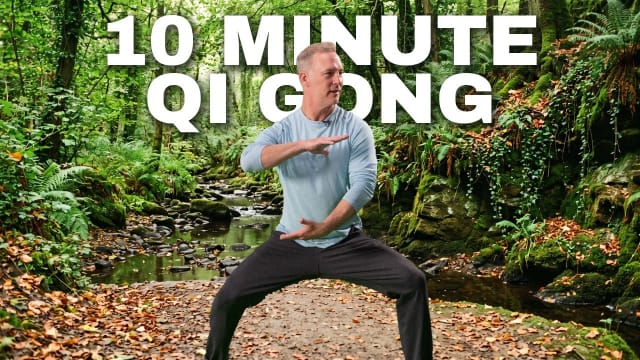
Transcript

[0:08] What a beautiful day here at the beach. I'm getting ready for a Tai Chi walk.

[0:13] I'm getting warmed up, so why don't you go ahead and just start by doing a little

[0:17] knocking on the door of life. You just bend your knees, you turn from your hips and

[0:22] your waist, let your arms knock across your lower back and right through your

[0:27] ribcage.

[0:30] It's warming up our center.

[0:32] Now, Tai Chi walking is a little bit different than normal walking.

[0:37] You get so many benefits when you do a walk, and you get extra benefits when you do

[0:42] a Tai Chi walk, because during Tai Chi walking, you're going to be cultivating

[0:47] energy. You're going to be bringing that energy in. So, nice, slow walking pace.

[0:55] And then what I'm going to do is activate energy by moving my hands in different

[1:00] positions. So I'm going to open my fingers, have my arms out to the sides, and then

[1:05] I'm going to just start to pulse the hands back and forth like this.

[1:11] And I like this first pattern because it brings energy into the body, surprisingly

[1:16] so. It's very simple, but you don't look too strange when you're out in public.

[1:22] There's some Tai Chi walking patterns that are very elaborate and more noticeable,

[1:27] but this one is very effective to cultivate energy,

[1:32] and it's not that noticeable. Now, what I'm going to do is start to take some deep

[1:36] breaths. So I want you to breathe through your nose and just pulse your arms back

[1:41] and forth.

[1:44] And then

[1:46] work with your mind. So I'm going to look forward, and I'm going to let the whole

[1:51] horizon and the landscape open up, and I open up my peripheral vision,

[1:57] and immediately as you open up your periphery,

[2:00] your mind becomes deeply rooted into the moment.

[2:05] So it's a mindful walk, it's energy cultivation,

[2:10] and it's a little bit of breathwork.

[2:11] Breathe slowly through the nose,

[2:15] pulsing the arms out to the sides, back and forth.

[2:21] Mind spacious like the sky, nice and open.

[2:31] Good, and when you've done this arm pattern for a few minutes, you can switch it

[2:35] up. I like to do a circular pattern, so I'm going to just make circles with the

[2:39] arms. My fingers are open, nice and open. I'm feeling connected to the earth.

[2:46] The pace of the walk doesn't matter too much. Slow is a little better.

[2:51] And just feel your feet touching the earth.

[2:56] Nice and slow, circular movement with the arms, feeling grounded.

[3:02] I'm putting my mind and attention on the earth below me

[3:06] and the sky above me.

[3:10] Energy's all around us. It's in the waves of the ocean.

[3:14] It's in the movement of the trees. It's in the wind.

[3:17] And so these movements with the arms are soaking up that energy.

[3:22] When you're out in nature, there's a perfect time to absorb energy, to recharge

[3:26] your batteries.

[3:30] Breathe it all in. Take a moment during this walk to be in the moment,

[3:36] to connect to yourself,

[3:38] to recharge your internal energy system.

[3:49] Little circular movements with the arms and the hands. Fingers are open.

[3:54] And I'm doing two circles at opposite times,

[3:59] and that'll help to bring the energy in.

[4:03] And I like the circular movement because

[4:06] everything in nature moves in spirals and in circles.

[4:11] Look at the patterns of the water. Look at the waves in the ocean.

[4:15] Notice the way the trees grow. Things are spiraling.

[4:18] And so as I move the arms in these spiraling patterns, it opens up a very natural

[4:23] flow of energy with you.

[4:27] Taking a few slow, deep breaths.

[4:32] You can do this Tai Chi walking anywhere. You could do it in a park.

[4:36] You could do it walking on the street, here at the beach, in the woods.

[4:40] A few minutes of this practice pulls energy into your body.

[4:44] So many cultures from around the world, the shamans, the ancient Qigong masters,

[4:49] the yogis, do some form of walking practice to feel

[4:53] connected.

[4:59] And you can go for as long as you'd like to.

[5:02] Pulse the arms back and forth, make those little circles, and at the end, what I

[5:07] like to do is just bring it all into my center. Do a little pulling down the sky.

[5:13] Inhale

[5:16] and exhale.

[5:23] Bring it all into your center and maintain that focused mind, that

[5:29] present moment awareness, and that abundant energy in your body. Enjoy.

[5:40] Oh, and I forgot to tell you, we got a Tai Chi walking course.

[5:44] We're going to be walking with lots of different patterns and movements.

[5:48] We filmed it in Tuscany and Italy. You're going to love it.

[5:51] Check out the Tai Chi walking course.

LH
AutoreLee Holden

Watch more from Lee Holden on YouTube.

Vedi il profiloSito web
Esplora i temi
Tai-chi-walkingQigongEnergy-cultivationMindful-movementBreathwork

Hai domande?

Domande frequenti

You can practice Tai Chi walking anywhere—parks, trails, beaches, woods, or even city streets. The arm patterns are subtle enough not to draw attention. Lee Holden emphasizes that the practice works wherever you are; nature amplifies the experience, but the core technique is portable and accessible in any environment.
Even a few minutes of Tai Chi walking pulls energy into your body and shifts your state. There's no minimum threshold—consistency matters more than duration. Integrating it into daily walks, whether that's weekly or daily, allows the practice to deepen over time and become a natural part of your routine.
Tai Chi walking combines mindfulness with active energy cultivation through specific arm patterns and breathwork. While mindfulness walking focuses on present-moment awareness, Tai Chi walking pairs that awareness with deliberate movements designed to draw qi into your body using pulsing and circular arm patterns coordinated with nasal breathing.
The physiological benefits—stress reduction, grounding, nervous system regulation—occur whether or not you conceptualize them as 'qi.' The nasal breathing activates the parasympathetic nervous system, open peripheral vision drops you into presence, and the rhythmic arm movements create a meditative state. Belief enhances the experience, but the body responds to the practice itself.
Tai Chi walking is designed for accessibility at any level. The arm patterns are simple—pulsing motions and circles—and the practice unfolds naturally. You don't need prior experience. Holden teaches the movements step-by-step, and the beauty of the practice is that subtle movements can be as effective as elaborate ones.
The pulsing pattern (arms extended to the sides, opening and closing rhythmically) brings energy in through a contracting-expanding motion and is especially grounding. The circular pattern mirrors natural spirals found everywhere in nature and opens a more flowing, organic energy circulation. You can alternate between them or use whichever feels right for your practice.
Open peripheral vision—letting your awareness take in the whole landscape rather than focusing on a point ahead—activates the parasympathetic nervous system and pulls your mind out of narrow, reactive focus. Combined with nasal breathing, it creates an almost immediate shift into present-moment awareness, which is the mindfulness foundation of the practice.
Pulling Down the Sky is the closing movement that gathers and integrates the energy you've cultivated during the walk. You raise your arms as if drawing energy from above, then bring it down into your center as you exhale. It anchors the practice in your body so the benefits persist throughout your day rather than dissipating when you finish walking.

Continua a leggere

More from Lee

Vedi Tutto
How Sitting Still Proves You're Already Awakening
Inspire

How Sitting Still Proves You're Already Awakening

Most people can't sit quietly without discomfort, but if you can, you're already further along spiritually than you realize. Eckhart Tolle e…

1 min read
The Missing Piece: How Real Thinking Creates Real Results
Inspire

The Missing Piece: How Real Thinking Creates Real Results

Most vision boards fail because people skip the actual thinking. Eckhart Tolle reveals the rhythm that unlocks insight and the two distinct …

1 min read
Relax Into Happiness: The Art of Letting Go
Inspire

Relax Into Happiness: The Art of Letting Go

A guided meditation practice that reveals happiness as something already present, accessed through softening the body and releasing the effo…

1 min read
First Meeting with a Living Guru: Recognition and Transformation
Inspire

First Meeting with a Living Guru: Recognition and Transformation

Krishna Das reflects on his first encounters with his teacher Maharaj-ji and Ram Dass, describing the moment he recognized something real ab…

1 min read

Continua a esplorare

Continua il tuo viaggio

Altra saggezza e altri incontri da tutta la directory BrightStar.

Altri articoli

Sfoglia l’intera raccolta di insegnamenti, interviste e guide.

Torna a tutti gli articoli →

Insegnanti e artisti

Esplora i lignaggi, i musicisti e le guide del mondo consapevole.

Esplora gli artisti →

Trova un evento

Kirtan, ritiri, sound bath, breathwork, festival: in arrivo presto.

Sfoglia gli eventi →