BrightStar

Parcourir tous les Events

Découvre des rassemblements conscients

events

Yoga
Meditation
Breathwork
Qigong
Tai Chi
Sacred Music
World Music
Medicine Music
Sound Healing
Ecstatic Dance
Destinations populaires
BaliSedonaLos AngelesCosta RicaNew YorkSan FranciscoAustinMiamiJoshua TreeTulum
Voir toutes les catégoriesVoir toutes les destinations

Explorer toutes les fonctionnalités

Des outils puissants pour développer tes événements

Fonctionnalités de la plateforme

Tarification dynamique intelligente
Catégories de billets
Places assignées
Récupération des paniers abandonnés
Récupération des visiteurs
Dons & Prix variables
Système d'affiliation
Scanner de billets
Codes promo
Questions personnalisées
Partage de billets
Ventes additionnelles & Options
Analyses & Rapports
Séquences d'emails
Liste d'attente / Notifier / Rappeler
Personnes & Lieux
Artists & TeachersEvent OrganizersVenues & StudiosKnowledge BaseGlossaryInspiration
Voir toutes les fonctionnalitésÀ propos
TarifsBlog
Language
Saved events
Parcourir tous les événements

events

YogaMeditationBreathworkQigongTai ChiSacred MusicWorld MusicMedicine Music

Destinations populaires

BaliSedonaLos AngelesCosta RicaNew YorkSan Francisco

Personnes & Lieux

Artists & TeachersEvent OrganizersVenues & StudiosKnowledge BaseGlossaryInspiration

Fonctionnalités de la plateforme

Tarification dynamique intelligenteCatégories de billetsPlaces assignéesRécupération des paniers abandonnésRécupération des visiteursDons & Prix variablesSystème d'affiliationScanner de billetsCodes promoQuestions personnaliséesPartage de billetsVentes additionnelles & OptionsAnalyses & RapportsSéquences d'emailsListe d'attente / Notifier / Rappeler
Voir toutes les fonctionnalitésÀ propos
TarifsBlog
ConnexionChercheursCréateurs
  • Parcourir tous les Événements
  • Pour les chercheurs
  • Yoga
  • Méditation
  • Breathwork
  • Qi gong
  • Tai-chi
  • Musique sacrée
  • Musiques du monde
  • Musique médecine
  • Soins sonores
  • Danse extatique
  • Retraites
  • Ateliers
  • Toutes les catégories →
  • Bali
  • Sedona
  • Los Angeles
  • Costa Rica
  • Tulum
  • Byron Bay
  • San Francisco
  • Austin
  • New York
  • San Diego
  • Denver
  • Seattle
  • Portland
  • Miami
  • Toutes les villes →
  • Join the Movement
  • Why we list
  • Sell Globally
  • Pour les créateurs
  • Pour les équipes
  • Pour les écrivains
  • Pour les enseignants
  • Pour les artistes de kirtan
  • Pour les studios
  • Pour les festivals
  • Pour les centres de retraite
  • Pour les associations
  • Ambassadeur de marque
  • Billetterie gratuite
  • Elevate
  • Amplify
  • Réseau de 500K+ acheteurs
  • Récupération des paniers abandonnés
  • Tarification dynamique intelligente
  • Catégories de billets
  • Événements récurrents
  • Places assignées
  • Système d'affiliation
  • Liste d'attente / Notifier
  • Scanner de billets
  • Widget intégrable
  • Diffusion d'événements
  • Messagerie
  • Intégrations
  • Rapports
  • Toutes les fonctionnalités →
  • À propos
  • L'écosystème
  • Blog
  • Glossaire
  • Inspiration
  • Centre d'aide
  • Contact
  • Documentation API
  • Ressources de marque
  • Carrières
  • Presse
  • Conditions d'utilisation
  • Politique de confidentialité

Événements

  • Parcourir tous les Événements
  • Pour les chercheurs
  • Yoga
  • Méditation
  • Breathwork
  • Qi gong
  • Tai-chi
  • Musique sacrée
  • Musiques du monde
  • Musique médecine
  • Soins sonores
  • Danse extatique
  • Retraites
  • Ateliers
  • Toutes les catégories →

Destinations

  • Bali
  • Sedona
  • Los Angeles
  • Costa Rica
  • Tulum
  • Byron Bay
  • San Francisco
  • Austin
  • New York
  • San Diego
  • Denver
  • Seattle
  • Portland
  • Miami
  • Toutes les villes →

Pour les créateurs

  • Join the Movement
  • Why we list
  • Sell Globally
  • Pour les créateurs
  • Pour les équipes
  • Pour les écrivains
  • Pour les enseignants
  • Pour les artistes de kirtan
  • Pour les studios
  • Pour les festivals
  • Pour les centres de retraite
  • Pour les associations
  • Ambassadeur de marque
  • Billetterie gratuite
  • Elevate
  • Amplify

Fonctionnalités

  • Réseau de 500K+ acheteurs
  • Récupération des paniers abandonnés
  • Tarification dynamique intelligente
  • Catégories de billets
  • Événements récurrents
  • Places assignées
  • Système d'affiliation
  • Liste d'attente / Notifier
  • Scanner de billets
  • Widget intégrable
  • Diffusion d'événements
  • Messagerie
  • Intégrations
  • Rapports
  • Toutes les fonctionnalités →

Entreprise

  • À propos
  • L'écosystème
  • Blog
  • Glossaire
  • Inspiration
  • Centre d'aide
  • Contact
  • Documentation API
  • Ressources de marque
  • Carrières
  • Presse
  • Conditions d'utilisation
  • Politique de confidentialité
BrightStar
Téléchargez l'app
Télécharger dans l'App StoreDisponible surGoogle Play
© 2026 BrightStar. Tous droits réservés.
Watch

Kalki Mantra: Three Sanskrit Names in One Devotional Chant

Prashanti Paz
Prashanti Paz
Mar 27, 2016
7 min de lecture
À regarder · 6

Kalki Mantra runs about four and a half minutes, and it begins the way a lot of devotional recording does: a few seconds of instrumental air, then a held tone under a voice. The voice arrives on a single line of Sanskrit, "Om Sri Kalki Sarveshwaraya Namaha," and beneath it a harmonium keeps a low, unbroken sound moving. From there the track circles back to the same three invocations for its whole length, until the words stop reading as text and start working like weather. This piece looks at how that circle is built, what the three names say, how the arrangement supports them, and where the recording came from. It is a devotional version of a mantra, released by Prashanti Paz as part of the album Inner Light, and it rewards slower listening than its running time suggests.

Lecture · 6 sections

What do the three names in the Kalki Mantra actually mean?

The mantra is three short lines, each built the same way: an opening syllable, an honorific, the name being addressed, a title in the dative case, and the closing word Namaha. Taken one at a time, the structure is clear. "Om" is the opening syllable that sits at the head of most Sanskrit mantras. "Sri" is an honorific. "Kalki" is the name at the center of all three lines. The endings do the rest. "Sarveshwaraya" comes from sarva, meaning all, and ishvara, meaning lord, so it addresses Kalki as lord of all. "Ishwaraya" addresses the same name simply as lord. "Avataraya" addresses it as avatar, a descent or incarnation. "Namaha" is the bow, the salutation: I bow.

So the three lines are not three different prayers. They are one figure addressed from three angles, lord of all, lord, and incarnation, with each line closing on the same gesture of bowing. That is worth knowing before you listen, because the repetition in the recording is not filler. Each return to the name is another angle on the same figure.

The captions in the video's transcript render the names inconsistently, with variant spellings and a few garbled syllables. That is an artifact of automatic transcription, not a reading of the lyrics. The audio, not the caption file, is the reliable source for what is sung.

How does the repetition build the chant?

The structure is cyclical rather than narrative. The voice opens on the first invocation at 0:16, and the "Avataraya" line enters at about 0:39. By 1:20 the chant has gone back to the opening line and is moving through the cycle again, with "Ishwaraya" and "Avataraya" placed among the returns. The track does not climb toward a climax in the way a pop song builds to a chorus. It settles, and the settling is the point.

Around 2:18 a new run of the cycle begins, with "Sarveshwaraya" sung again and a line that the captions render as a variant ending. The variant is probably a mishearing of the name, but the sense of the passage holds: the same names, returned to, each time landing in a slightly different place in the phrase. If you want to hear the design, follow one word, say "Namaha," through the whole track. You will notice that its position moves against the beat, and that the bow at the end of each line arrives more like a breath than a full stop.

A practical note for listeners: repetition is the oldest working tool in chanting. A single phrase sung enough times stops asking for attention and begins to hold it. The track is built to let that happen, and the best way to hear it is to stop trying to follow a melody and listen for the names returning.

Why does the arrangement matter so much here?

The credits list the players, and the arrangement tells you what each of them is for. Paz Leon sings lead vocals and plays harmonium, and she is credited with the music composition. Lucho Milocco adds back vocals and handles the arrangements. Diego Marchionatti plays acoustic guitar, harmonium and percussion, and he shares mixing and mastering with Fidel Mulet, who plays fretless bass.

The harmonium is the piece to give the most attention to. It is a reed instrument that can sustain a chord under a voice for as long as the player keeps the bellows moving, which makes it a natural source of drone. Here it sits underneath the lead line and gives the mantra its floor. A devotional recording built on repetition needs something that does not move, and the harmonium, played by two people on this track, is that stillness. Treat it the way a guitarist treats a good Les Paul: as the instrument that carries the sound, not as backdrop.

Fidel Mulet's fretless bass is the other key voice. Without frets, a bass line can slide between pitches and sound closer to a human voice than a fretted instrument does. Under a chant, that quality matters. It keeps the low end warm and connected to the vocal instead of sitting apart from it, and it gives the track a weight that the acoustic guitar and percussion would not supply alone.

Where did this recording come from?

The release notes provide the most useful piece of history on the page. The description explains that the recording is a devotional version inspired by a mantra shared by Oneness University on Sri Bhagavan's Janmadina, which the description calls the "Day of Oneness," on March 7, 2016. The video was published on March 27, 2016, twenty days after that date. The short timeline is a useful detail: a mantra shared on a significant day in the community's calendar was turned into a sung recording within a few weeks.

The description also states that Kalki Mantra is part of the album Inner Light, available in digital stores. The track is credited to Paz Leon and the group above, with special thanks to Universo Diksha, Daniel Bellone, and Kevin Johansen, along with family and friends. The video had reached 219,311 views at the time of the metadata captured for this piece. Those numbers describe reach, not meaning, but they show the recording has found a listening audience well beyond its original release week.

How should you listen to a chant like this?

Start with the drone, not the voice. Listen for the harmonium as a floor under everything, then notice how the bass sits against it. Next, follow one name through a full cycle. Choose "Sarveshwaraya," since it is the longest word and the one that begins each new run. Let yourself hear the same phrase return rather than trying to anticipate where it goes. Then, if you are inclined, sing along quietly on the bow at the end of each line, "Namaha." The chant asks for participation more than appreciation, and the bow is the easiest place to join in.

Where to go from here

The most direct next step is to hear the full album. Kalki Mantra is one track on Inner Light, and the description points listeners to the digital stores where the album is available. Listen to the track a second time with the transcript in front of you, and mark the places where the captions break down. Then read the three lines again with their meanings in mind. The mantra makes more sense after one sung run than before, and a second run will show you how much the repetition is doing. For background on the mantra itself, the Oneness University material cited in the release notes is the place to start, since the recording is described as inspired by a mantra that organization shared.
Comments

Loading the conversation…

Transcript

[0:01] [संगीत]

[0:16] ओ श्री कलकी

[0:20] सर्वेश्वराया

[0:24] नमः ॐ श्री कल्की

[0:28] स्वराय नम

[0:31] [संगीत]

[0:33] ॐ श्री कलकी

[0:39] अवतार

[0:48] नमः ओ श्री कलकी

[0:53] सर्वेश्वराया

[0:56] नमः ॐ श्री कल

[1:01] स्वराय

[1:04] नमः ॐ श्री कलकी आवता

[1:10] [संगीत]

[1:12] राया

[1:13] [संगीत]

[1:20] महा ओम श्री कलकी

[1:26] सर्वेश्वरा

[1:27] [संगीत]

[1:29] नमः ओम श्री कल्की

[1:34] स्वराय

[1:37] नमः ओम श्री कल्की

[1:44] अवतार

[1:50] [संगीत]

[1:52] नमः नम

[1:59] [संगीत]

[2:18] ओम श्री कलकी

[2:22] सर्वेश्वराया

[2:25] नमः ओम श्री कलकी

[2:31] विराया

[2:34] नमः ओ श्री कल्की

[2:41] अवाया

[2:46] [संगीत]

[2:50] नमः ओम श्री कलकी

[2:55] सवाया नमः

[2:58] [संगीत]

[3:00] श्री कलकी

[3:03] स्वराय

[3:06] नमः ओ श्री कल्की

[3:13] अवतारा

[3:18] [संगीत]

[3:22] नमः ओम श्री ककी

[3:28] सर्वेश्वराया नमः

[3:32] ओम श्री कल्की

[3:36] स्वराय

[3:39] नमः ओम श्री कलकी

[3:45] [संगीत]

[3:46] अवतार

[3:52] [संगीत]

[3:54] नमः नमः

[3:57] [संगीत]

Prashanti Paz
ArtistPrashanti Paz

Devotional singer, musician, writer and meditation teacher whose luminous, soothing chanting invites listeners into joy, peace and the oneness in all.

Voir le profilSite web
Explorer les thèmes
Kalki-mantraSanskrit-mantraDevotional-chantHarmoniumOneness-university

Des questions ?

Questions fréquemment posées

The mantra addresses Kalki three ways: as Sarveshwara, lord of all; as Ishwara, lord; and as Avatara, incarnation or descent. Each line ends with Namaha, meaning I bow. The three lines are one figure approached from three angles rather than three separate prayers.
According to the video description, Kalki Mantra is part of the album Inner Light, which is available in digital stores. The track runs about four and a half minutes, and the description also credits the musicians on the recording.
The description says the devotional version is inspired by a mantra shared by Oneness University on Sri Bhagavan's Janmadina, the day it calls the Day of Oneness, March 7, 2016. The video was published on March 27, 2016.
Paz Leon sings lead vocals and plays harmonium and is credited with the music composition. Lucho Milocco provides back vocals and arrangements, Diego Marchionatti plays acoustic guitar, harmonium and percussion, and Fidel Mulet plays fretless bass. Marchionatti and Mulet also handled mixing and mastering.
Repetition lets a short phrase stop demanding attention and begin to hold it, which is why chanting relies on it. In Kalki Mantra the three invocations return across the whole track, so each pass places the same name in a slightly different phrase position.
The description calls it a devotional version inspired by a mantra, and Paz Leon is credited with the music composition. So the recording sets a mantra to a newly composed musical arrangement rather than presenting a traditional melody as written.

Continuer la lecture

More from Prashanti

Voir tout
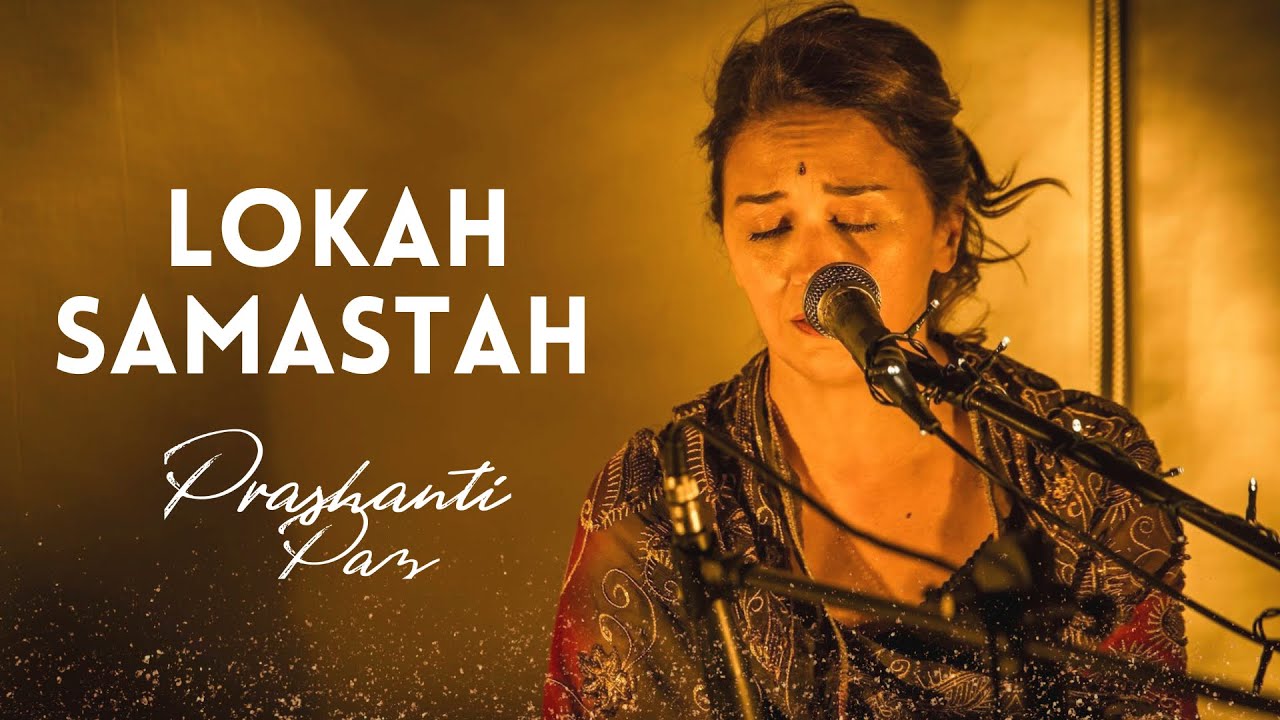
Lokah Samastah: An Unrehearsed Reunion in Buenos Aires
Inspire

Lokah Samastah: An Unrehearsed Reunion in Buenos Aires

A devotional mantra session recorded in Buenos Aires in December 2022, with no rehearsal and three musicians back in the same room after thr…

1 min read
Icaros and the Amazonian Heart Song "Abrete Corazón"
Inspire

Icaros and the Amazonian Heart Song "Abrete Corazón"

Prashanti Paz's lyric video presents "Abrete Corazón," an icaro from Peruvian Amazonian healing work. Here is what the song is, where it cam…

1 min read
Mantra Medicine for Letting Go: Listening to "I Release"
Inspire

Mantra Medicine for Letting Go: Listening to "I Release"

A close listen to Beautiful Chorus's "Mantra Medicine: Release," a seven-minute sung affirmation built on "I release" and what repeating a s…

1 min read
Chanting as Home Base: Faith, Thought, and the Restless Mind
Inspire

Chanting as Home Base: Faith, Thought, and the Restless Mind

Krishna Das explains why chanting steadies a restless mind, how faith grows from lived experience, and what "vote" we really have over the t…

1 min read

Continue d’explorer

Poursuis ton chemin

Plus de sagesse et de rassemblements dans tout l’annuaire BrightStar.

Plus d’articles

Parcours toute la bibliothèque d’enseignements, d’entretiens et de guides.

Retour à tous les articles →

Enseignants et artistes

Découvre les lignées, les musiciens et les guides du monde conscient.

Explorer les artistes →

Trouver un événement

Kirtan, retraites, bains sonores, breathwork, festivals — bientôt près de chez toi.

Parcourir les événements →