BrightStar

Parcourir tous les Events

Découvre des rassemblements conscients

events

Yoga
Meditation
Breathwork
Qigong
Tai Chi
Sacred Music
World Music
Medicine Music
Sound Healing
Ecstatic Dance
Destinations populaires
BaliSedonaLos AngelesCosta RicaNew YorkSan FranciscoAustinMiamiJoshua TreeTulum
Voir toutes les catégoriesVoir toutes les destinations

Explorer toutes les fonctionnalités

Des outils puissants pour développer tes événements

Fonctionnalités de la plateforme

Tarification dynamique intelligente
Catégories de billets
Places assignées
Récupération des paniers abandonnés
Récupération des visiteurs
Dons & Prix variables
Système d'affiliation
Scanner de billets
Codes promo
Questions personnalisées
Partage de billets
Ventes additionnelles & Options
Analyses & Rapports
Séquences d'emails
Liste d'attente / Notifier / Rappeler
Personnes & Lieux
Artists & TeachersEvent OrganizersVenues & StudiosKnowledge BaseGlossaryInspiration
Voir toutes les fonctionnalitésÀ propos
TarifsBlog
Language
Saved events
Parcourir tous les événements

events

YogaMeditationBreathworkQigongTai ChiSacred MusicWorld MusicMedicine Music

Destinations populaires

BaliSedonaLos AngelesCosta RicaNew YorkSan Francisco

Personnes & Lieux

Artists & TeachersEvent OrganizersVenues & StudiosKnowledge BaseGlossaryInspiration

Fonctionnalités de la plateforme

Tarification dynamique intelligenteCatégories de billetsPlaces assignéesRécupération des paniers abandonnésRécupération des visiteursDons & Prix variablesSystème d'affiliationScanner de billetsCodes promoQuestions personnaliséesPartage de billetsVentes additionnelles & OptionsAnalyses & RapportsSéquences d'emailsListe d'attente / Notifier / Rappeler
Voir toutes les fonctionnalitésÀ propos
TarifsBlog
ConnexionChercheursCréateurs
  • Parcourir tous les Événements
  • Pour les chercheurs
  • Yoga
  • Méditation
  • Breathwork
  • Qi gong
  • Tai-chi
  • Musique sacrée
  • Musiques du monde
  • Musique médecine
  • Soins sonores
  • Danse extatique
  • Retraites
  • Ateliers
  • Toutes les catégories →
  • Bali
  • Sedona
  • Los Angeles
  • Costa Rica
  • Tulum
  • Byron Bay
  • San Francisco
  • Austin
  • New York
  • San Diego
  • Denver
  • Seattle
  • Portland
  • Miami
  • Toutes les villes →
  • Join the Movement
  • Why we list
  • Sell Globally
  • Pour les créateurs
  • Pour les équipes
  • Pour les écrivains
  • Pour les enseignants
  • Pour les artistes de kirtan
  • Pour les studios
  • Pour les festivals
  • Pour les centres de retraite
  • Pour les associations
  • Ambassadeur de marque
  • Billetterie gratuite
  • Elevate
  • Amplify
  • Réseau de 500K+ acheteurs
  • Récupération des paniers abandonnés
  • Tarification dynamique intelligente
  • Catégories de billets
  • Événements récurrents
  • Places assignées
  • Système d'affiliation
  • Liste d'attente / Notifier
  • Scanner de billets
  • Widget intégrable
  • Diffusion d'événements
  • Messagerie
  • Intégrations
  • Rapports
  • Toutes les fonctionnalités →
  • À propos
  • L'écosystème
  • Blog
  • Glossaire
  • Inspiration
  • Centre d'aide
  • Contact
  • Documentation API
  • Ressources de marque
  • Carrières
  • Presse
  • Conditions d'utilisation
  • Politique de confidentialité

Événements

  • Parcourir tous les Événements
  • Pour les chercheurs
  • Yoga
  • Méditation
  • Breathwork
  • Qi gong
  • Tai-chi
  • Musique sacrée
  • Musiques du monde
  • Musique médecine
  • Soins sonores
  • Danse extatique
  • Retraites
  • Ateliers
  • Toutes les catégories →

Destinations

  • Bali
  • Sedona
  • Los Angeles
  • Costa Rica
  • Tulum
  • Byron Bay
  • San Francisco
  • Austin
  • New York
  • San Diego
  • Denver
  • Seattle
  • Portland
  • Miami
  • Toutes les villes →

Pour les créateurs

  • Join the Movement
  • Why we list
  • Sell Globally
  • Pour les créateurs
  • Pour les équipes
  • Pour les écrivains
  • Pour les enseignants
  • Pour les artistes de kirtan
  • Pour les studios
  • Pour les festivals
  • Pour les centres de retraite
  • Pour les associations
  • Ambassadeur de marque
  • Billetterie gratuite
  • Elevate
  • Amplify

Fonctionnalités

  • Réseau de 500K+ acheteurs
  • Récupération des paniers abandonnés
  • Tarification dynamique intelligente
  • Catégories de billets
  • Événements récurrents
  • Places assignées
  • Système d'affiliation
  • Liste d'attente / Notifier
  • Scanner de billets
  • Widget intégrable
  • Diffusion d'événements
  • Messagerie
  • Intégrations
  • Rapports
  • Toutes les fonctionnalités →

Entreprise

  • À propos
  • L'écosystème
  • Blog
  • Glossaire
  • Inspiration
  • Centre d'aide
  • Contact
  • Documentation API
  • Ressources de marque
  • Carrières
  • Presse
  • Conditions d'utilisation
  • Politique de confidentialité
BrightStar
Téléchargez l'app
Télécharger dans l'App StoreDisponible surGoogle Play
© 2026 BrightStar. Tous droits réservés.
Inspire

Para Sanar: Inside a Call-and-Response Healing Chant

SV
Spirit Voyage
Oct 9, 2026
6 min de lecture
À regarder · 7

Roughly ninety seconds into the audio-only release "Para Sanar," a single phrase begins to circle back on itself, stretched across the beat and split by silences: "to heal." The Spanish title means exactly that, and the track gives it nothing but its own repetition. Spirit Voyage's upload credits Ajeet with vocals, udu, percussion, synths and guitar, Alex Serra with vocals, synths and programming, and Toti Dub with percussion and programming. Siobhán Moore recorded and mixed it and Piper Payne mastered it. What the three minutes add up to is a collective invocation: a group of voices calling on the sky, the sea and the earth to take a wound, sung in a form simple enough that anyone can join in.

Lecture · 6 sections

What is the call in "Para Sanar" actually calling?

The opening lines move in a deliberate arc. "We call to heaven," the voices sing at about 0:10, and then "We call to the sea," followed by "We call upon the waves" to sing to heal. The address travels downward, from the sky to the open water and then to the moving surface where water meets air. Each line names a larger and more elemental force than the one before it, and each one asks for the same thing.

The lyric then identifies who is doing the calling. At about 0:32 the singers state, "we are women, daughters of the moon," and a few lines later they describe the act as "with a single voice." That phrase matters. It frames the chant as unison rather than solo performance, a set of separate voices deliberately made into one. The healing is not requested by a single speaker on behalf of others; it is generated by the group making the sound together.

The sequence also shows a reliable structural habit of call-and-response forms: the question or summons is sung, then the answer comes back in the same words, sometimes altered. By keeping the lines short and the verbs few, the track lets the listener catch the pattern within a single pass.

Why does the refrain keep coming back?

Repetition does most of the work in this track. "To heal" appears again and again, and in the timestamped transcript it is often split: "To" lands on one beat and "heal" on the next, with a musical bar in between. At about 0:46 the phrase arrives as "with a single voice. To heal. To heal." and then returns at 0:51 and 0:56. The effect is less like a sentence and more like a pulse.

This is the central craft decision on the record. A lyric that says "heal" once is a wish. A lyric that says "heal" dozens of times, slightly displaced each time, becomes a rhythm the body can latch onto. The phrase stops being information and starts operating as a repeated gesture, something you return to the way you return to a breath. Anyone familiar with devotional and meditative singing will recognize the principle: the words are kept short precisely so that the repetition can carry the meaning.

The gaps matter too. The transcript shows frequent "[music]" markers between phrases, meaning the instruments often carry the space while the voices rest. Those rests give the call time to settle before the answer returns.

What do the udu and percussion bring to the chant?

The credits give the instrumental picture clearly. Ajeet is listed on the udu, a clay vessel drum that produces a hollow, breathy thud rather than a sharp slap. Placing a vessel drum at the center of a track like this changes its character: the pulse sounds closer to the earth, which fits lines that speak of "bodies of the earth" and the sea's waves. Percussion from Ajeet and Toti Dub sits alongside that low tone, while synths and programming from Alex Serra and Toti Dub supply the electronic floor beneath the voices.

That combination of acoustic and programmed sound is one of the track's most interesting features. The vessel drum is about breath and material; the synths and programming are about repetition, sustain and space. Read together, the instrumentation mirrors the lyric's two registers, the body and the world, and it lets the recording move from intimate to wide without changing the basic pulse.

Where does the chant move from invocation to grief?

About halfway through, the tone shifts. At roughly 2:04 the lyric turns from calling outward to naming the body: "Bodies of the earth," with the earlier calls to sea and sky now folded into the body itself. Then at about 2:23 the most direct line in the track arrives: "Our body aches with the wounds of our world."

This is where "Para Sanar" stops being abstract. Healing is no longer a general request addressed to the heavens; it is tied to pain that the singers say they carry. The chant does not explain the wound or name its source. It simply places the ache in the body and asks for the same call that opened the track to answer it.

"Our body aches with the wounds of our world." (lyric, approx. 2:23)

The track then returns to its opening line, "We call to heaven," at about 2:42. The circle closes. A healing that starts with the sky and the sea ends in the body and the wounded world, and then starts again at the top.

How can you listen to or use a chant like this?

The most useful way in is simple. Play the track once without singing, noticing where the voices enter and where the instruments take the space. Then play it again and join the refrain at the points where "to heal" lands. Because the lines are short and the pattern repeats, a listener can enter the call within a single pass, which is part of the point. The form is built so that the group, not the recording, does the work.

The upload has drawn 8,301 views so far, a modest number for a track of this kind. Its reach may grow as more listeners find it, but its method is already clear on first listen: a few lines, one repeated phrase, and a sequence that moves from heaven to the body and back again.

Where to go from here

Listen to "Para Sanar" in full through the audio link in Spirit Voyage's upload, then return to the moments noted above and listen for the voice-and-instrument handoffs. If the chant has moved you, try writing your own short call of two or three lines and repeating it with a silence after each pass. The track shows how little a collective healing call needs: a clear address, a repeated word, and room for the answer to come back.

Comments

Loading the conversation…

Transcript

[0:01] [music]

[0:10] We call

[0:12] to heaven. [song]

[0:15] We call

[0:17] to the sea.

[0:20] We call upon the waves [to sing]

[0:25] to

[0:27] heal.

[0:30] We call [music]

[0:32] we are women.

[0:35] Daughters of the moon.

[0:40] We call

[0:42] with a single voice.

[0:46] To

[0:47] heal.

[0:51] To

[0:52] heal.

[0:54] [music]

[0:56] To

[0:58] heal.

[1:01] Under the stars. [singing]

[1:04] [music]

[1:06] I see the walking.

[1:11] [music]

[1:11] As [sing] the earth turns

[1:16] to [music]

[1:17] [sing] heal.

[1:21] To

[1:23] heal [sing]. [music]

[1:26] Beyond Time. [music]

[1:31] I want [singing] to remember.

[1:36] Hearts sing [song]

[1:41] to

[1:43] heal. [music]

[1:46] To

[1:48] heal.

[1:49] [music]

[1:56] [music]

[1:59] Sisters.

[2:00] the waters. [music]

[2:04] Bodies of the earth.

[2:09] Sing, sing with

[2:12] strength [music]

[2:14] for

[2:19] Our body aches [music]

[2:23] with the wounds of our world.

[2:27] [music]

[2:29] We call [song]

[2:31] with our strength

[2:34] for

[2:36] [music]

[2:39] for

[2:40] [music][song]

[2:42] We call

[2:43] to heaven.

[2:45] [music]

[2:47] We call [song]

[2:48] the sea.

[2:52] We call the waves [music][song]

[2:57] for

[2:58] [music]

[3:02] for

[3:03] [music][song]

[3:07] for

[3:09] [music]

SV
Artist
Spirit Voyage

Watch more from Spirit Voyage on YouTube.

Site web
Explorer les thèmes
Para-sanarHealing-chantCall-and-responseUdu-drumCollective-healing

Des questions ?

Questions fréquemment posées

Para sanar is Spanish for "to heal." The track's chorus repeats the phrase "to heal" throughout its three minutes, so the title and the lyric share the same meaning.
Spirit Voyage's upload credits Ajeet on vocals, udu, percussion, synths and guitar, Alex Serra on vocals, synths and programming, and Toti Dub on percussion and programming. Siobhán Moore recorded and mixed the track, and Piper Payne mastered it.
A udu is a clay vessel drum that makes a hollow, breathy sound. In Para Sanar, Ajeet is credited with playing it, and its low, earthy tone supports lyrics about the earth, the sea and the body.
Call-and-response is a form in which one voice or group sings a line and another answers it. Para Sanar uses this structure, opening with calls to heaven, the sea and the waves, and returning those calls as a shared answer.
The track runs about three minutes and twenty seconds. It is released as audio only, so there is no video; the lyrics and rhythms carry the entire piece.
Repeating a short phrase such as "to heal" turns words into a rhythm that listeners can join quickly. In Para Sanar, the repetition, split across beats and interrupted by silence, lets the group carry the meaning rather than a single speaker.

Continuer la lecture

More on Inspire

Voir tout
Om Namah Shivaya Live Kirtan: Call, Response and the Shiva Chant
Inspire

Om Namah Shivaya Live Kirtan: Call, Response and the Shiva Chant

A live kirtan of Om Namah Shivaya, recorded at Medicine Festival 2026 in Reading, moves from slow mantra into ecstatic chant. Here is what t…

1 min read
Om Namah Shivaya: Inside a Live Maha Shivaratri Chant
Inspire

Om Namah Shivaya: Inside a Live Maha Shivaratri Chant

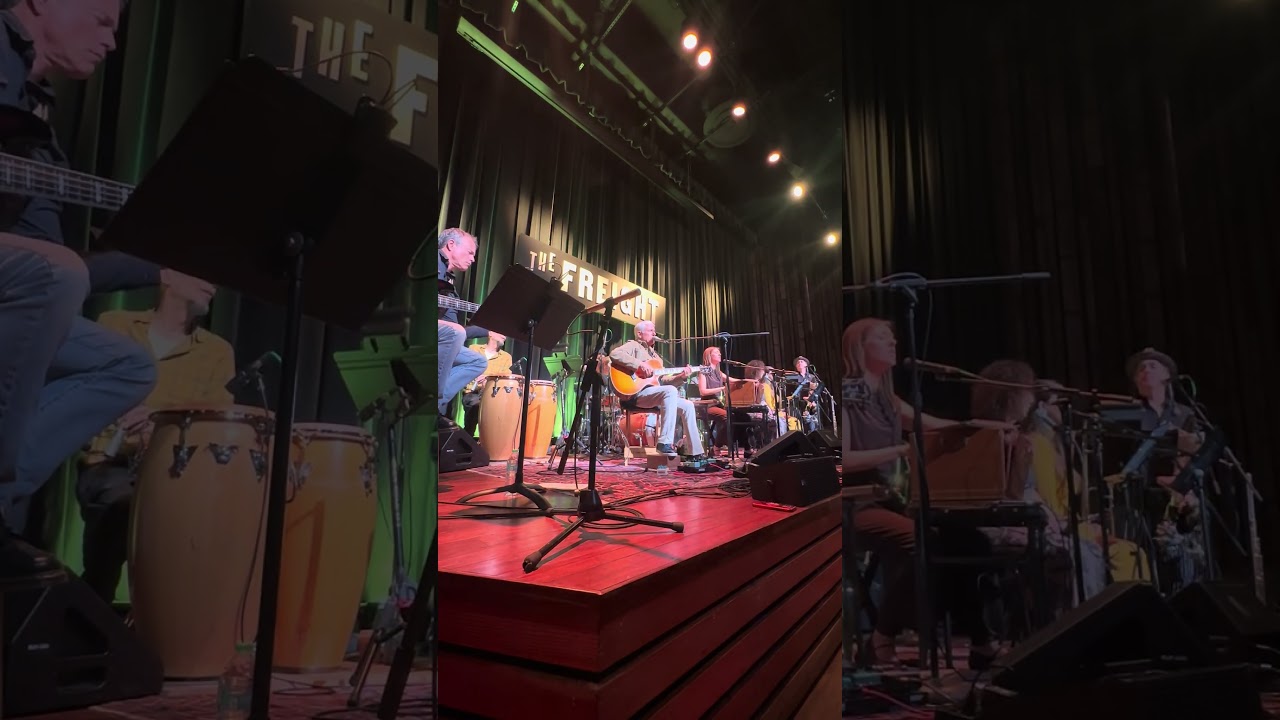
A two-and-a-half-minute recording of Om Namah Shivaya, captured live at The Freight in Berkeley on Maha Shivaratri 2020. Here is what the ch…

1 min read
Gaia Ma: How a Sacred Mantra Becomes Electronic Prayer
Inspire

Gaia Ma: How a Sacred Mantra Becomes Electronic Prayer

Deva Premal's devotional invocation finds new life through Liquid Bloom's atmospheric remix, bridging ancient mantra with modern production.…

1 min read
Friday Maa: Water, Refrain, and a Yoga Music Veteran's Ritual Track
Inspire

Friday Maa: Water, Refrain, and a Yoga Music Veteran's Ritual Track

A single voice over a patient pulse opens "Friday Maa," a five-minute video that ties a goddess-and-river myth to a repeating refrain. Here …

1 min read

Continue d’explorer

Poursuis ton chemin

Plus de sagesse et de rassemblements dans tout l’annuaire BrightStar.

Plus d’articles

Parcours toute la bibliothèque d’enseignements, d’entretiens et de guides.

Retour à tous les articles →

Enseignants et artistes

Découvre les lignées, les musiciens et les guides du monde conscient.

Explorer les artistes →

Trouver un événement

Kirtan, retraites, bains sonores, breathwork, festivals — bientôt près de chez toi.

Parcourir les événements →