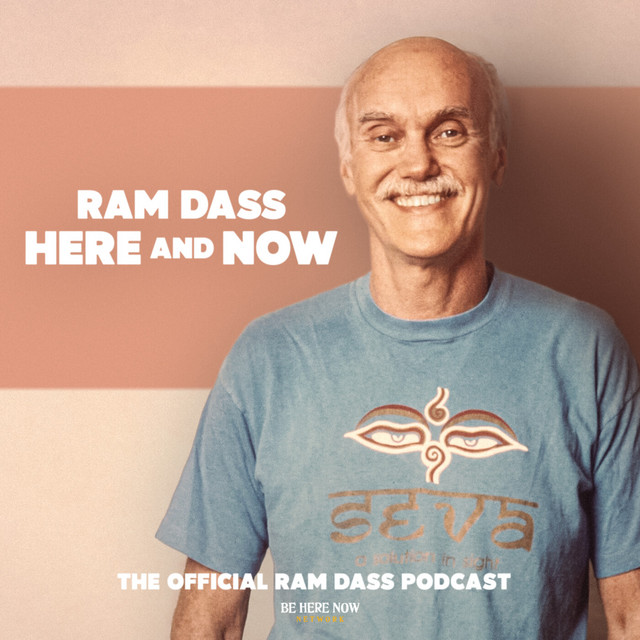
In this classic 1980s Q&A session, Ram Dass addresses core questions about intimate relationships through a spiritual lens—what soul mates actually are, how mismatched spiritual paths can work, whether open relationships serve growth, and how truth functions as a deliberate practice for deepening spiritual awareness between two people. His central insight: truth is not just honesty for honesty's sake, but a vehicle for creating what he calls a "liquid spiritual relationship" where both partners become increasingly able to express their authentic impulses without fear, thereby accelerating inner work together.
Ram Dass begins by dismantling the romantic mythology around the term "soul mate." Rather than a single predetermined partner written in the cosmos, he reframes the concept in terms of spiritual work: people come together because they have specific inner work to do with one another, and "at times" they may manifest that connection in different forms—marriage, friendship, mentorship, or other arrangements.
This perspective shifts soul mates from a passive recognition of cosmic destiny to an active recognition of mutual function. Two people are "soul mates" not because they were fated to meet, but because their respective patterns, wounds, and growth edges interact in ways that require attention. The relationship becomes the container for that work, and the form the relationship takes becomes secondary to the quality of mutual development possible within it.
A central tension in contemporary spiritual life: one partner meditates, reads Vedanta, attends retreats; the other is not interested in formal spiritual practice. Ram Dass addresses this directly, affirming that the gap itself is workable. A partner who is not "on the path" in the conventional sense is still engaged in the deepest spiritual work—the everyday confrontation with love, desire, fear, and commitment.
What matters is whether the couple can use the relationship itself as a mirror. If the spiritually formal partner can approach their less-formal partner with genuine curiosity rather than proselytizing, and if the less-formal partner respects their partner's practice, the misalignment becomes generative. The tension between different speeds or frameworks of awakening can actually clarify both partners' commitment to truth and authenticity.
One of Ram Dass's key teachings in this session centers on truth as a technology for spiritual deepening. He distinguishes between polite civility (which can mask the actual texture of what one is experiencing) and the practice of expressing your authentic impulse in real time, even when it's messy, contradictory, or uncomfortable.
As he articulates it: "It is certainly possible to work with truth in a relationship, to get to the point where, more and more, you are safe in expressing what your impulses are and your truth of your moment." This safety—the gradual removal of fear around authentic expression—becomes the ground for what he calls a "liquid spiritual relationship," one that is fluid, responsive, and alive rather than rigid or performative.
Truth in this framework is not weaponized honesty ("I'll tell you exactly what I think of you to hurt you"). Rather, it is the careful, growing capacity to say "Here is what I'm actually feeling, wanting, fearing, or perceiving right now—without filtering it through shame, people-pleasing, or defensiveness." Over time, both partners learn that truth-telling does not destroy the relationship; it deepens it. The relationship becomes a safe laboratory for authenticity.
When the question of open relationships arises, Ram Dass does not dismiss or endorse the arrangement on moral grounds. Instead, he returns to his core teaching: the viability of any relational structure depends on whether partners can work with truth. An open relationship built on honest agreement about boundaries and ongoing communication could be deeply spiritual work. A nominally monogamous marriage built on silence, resentment, and unspoken compromises is spiritually impoverished by comparison.
The structure matters far less than the willingness to be honest about what is actually happening—desire, jealousy, grief, attraction outside the partnership, unmet needs. If both partners agree to address these realities directly rather than pretend they don't exist, the framework becomes workable. If either partner pretends, the relationship becomes a place of spiritual stagnation.
Ram Dass addresses a final dimension: do men and women face different spiritual challenges when awakening through relationship? His response invokes a quality he calls "androgyny" that can emerge in spiritual identity—a wholeness that transcends conventional gender roles and conditioning.
Men, he suggests, may be conditioned toward detachment, intellectualization, and separation; women toward merger, emotional responsiveness, and relational immersion. Yet mature spiritual work involves integrating both—the capacity for clarity and discernment alongside the capacity for fluid connection. A spiritually mature person of any gender develops what might be called an "inner androgyny," capable of both the warrior's clarity and the lover's surrender. This is not about androgynous presentation but about the full spectrum of human capacities available to anyone willing to develop them.
Underlying all of Ram Dass's responses is a conviction that truth is not a moral absolute imposed from outside, but a practical recognition: truth is efficient for spiritual work. It takes enormous energy to maintain a false self, to edit what you actually feel, to perform roles rather than inhabit them. That energy, when released through truth-telling, becomes available for actual transformation.
In his words: truth is "an absolutely optimum way of coming into a liquid spiritual relationship with another person"—whether that person is a guru, friend, lover, or spiritual teacher. The specific role matters less than the quality of honesty between you. Each time you risk expressing something true—a fear, a desire, a perception—and the other person receives it without punishment, you train both nervous systems toward greater safety. The relationship literally becomes a technology for rewiring reactivity into responsiveness.
If you are in a partnership and drawn to these ideas, one concrete practice emerges: notice where you are editing yourself. Where do you smile when you actually feel frustration? Where do you agree when you feel uncertain? Where do you remain silent about what you actually desire or perceive? Begin small—one honest expression per week, offered without blame or expectation. Observe what happens when you speak a truth you normally would have concealed. Does the relationship rupture, or does it deepen? Most often, you will discover that the other person has been waiting for permission to do the same.
For those in a partnership with someone not formally on a spiritual path, consider: what if their groundedness in ordinary life—work, family, embodied presence—is already the spiritual work? What if your job is not to convert them but to learn from them? And for those considering alternative relational forms, ask yourself the question Ram Dass implicitly poses: "Is this arrangement built on increasing honesty and mutual growth, or on hiding from something I'm afraid to face?" The answer will tell you whether the structure itself is the problem or your capacity to be truthful within it.