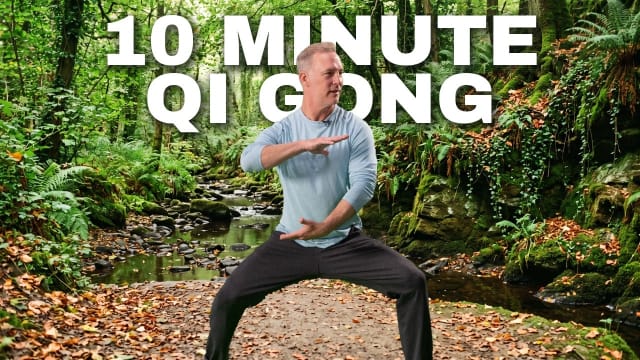
Lee Holden's six-and-a-half-minute lymphatic flow routine is a study in how little equipment a body needs to get fluid moving. There is no rebounder, no weights and no sweat-soaked cardio block. What there is: a belly that expands and contracts on purpose, a short burst of fast breathing with a firm squeeze of the abdomen, a set of arm swings that bend and straighten the knees, a double-arm pump, and a bounce performed on the floor as if it were a trampoline. Each piece is framed around one idea that runs through the whole video, the one Holden states outright near the end: stagnant fluid is the problem, and movement is the answer. This article walks through each movement, explains the reasoning Holden gives for it, and flags the one instruction that deserves more attention than he gives it.
Holden opens with a metaphor that does most of the work for the rest of the session. "Now, the lymph system is like the garbage system of a city. We want to take out the trash and get rid of the toxicity in your body." (Lee Holden, Holden QiGong, video published October 27, 2026, opening at 0:00)
That framing matters because it sets the goal. The routine is not presented as a workout that burns calories or builds muscle. It is presented as a set of motions meant to keep a city's waste-removal system running: if the trash doesn't move, the streets clog. Holden's word for the approach is circulation, and he returns to it repeatedly. The lymph should flow, the blood should flow, and the chi should flow. The rest of the practice is a sequence of ways to make that happen.
It is worth being precise about what the video itself claims. Holden describes the sequence as a way to get things circulating and to feel the body respond. The video description is more careful still, saying the practice "may support circulation and help you feel more energized." Treat the garbage-city language as Holden's teaching metaphor, not a clinical finding, and read the rest of this piece as an explanation of his method rather than a verdict on its outcomes.
The first movement is the simplest and, in Holden's telling, the foundation. "Number one, let's start with some deep abdominal breathing." (Lee Holden, opening segment, 0:16)
The instruction is concrete. Place your hands on the belly. On the inhale, the belly expands outward. On the exhale, it draws back toward the spine. Holden's reasoning is anatomical: he says there is "a lot of lymph right on the aorta through the abdomen," and that breathing deeply enough to get the diaphragm moving activates the lymphatic system. The breath, in other words, is not a warm-up for the body. It is the motor that begins the movement he wants everywhere else.
He also places the practice inside qigong's larger logic. Qigong, he says, is "an ancient Chinese medicine practice" built on getting things circulating, and that idea was, in his words, "mirrored by watching nature." His example is water: look at a flowing stream and everything is in motion. The body, he suggests, should be the same. That image returns at the very end of the routine and gives the whole session its organizing principle.
For a beginner, the practical tip is to keep the belly soft and let the breath set the pace. Don't force the expansion. If the diaphragm is moving, the belly will do its work on its own.
The second movement is the most intense breathing pattern in the video, and it is the one most likely to produce a surprising sensation. Holden calls it Fanning the Fire. "We're just going to breathe a little faster. You're going to inhale and then exhale through the mouth and squeeze the belly back." (Lee Holden, 1:10)
On the audio you can hear the effect: sighs, gasps, a few snorts as the breath quickens. Holden urges the pace up, then tells you to "feel how good that is for all the internal organs." After a short stretch, he calls for a slow, deep breath to find equilibrium again.
He is candid about the side effect. "You might feel a little light-headed after doing those deep breathing quicker breaths. That's absolutely fine. You are detoxifying." (Lee Holden, 1:58 region of the routine)
Here is where the piece needs to slow down. Holden treats light-headedness as expected and benign. The video's own description takes a more cautious line: keep the faster breathing comfortable, and pause if you feel dizzy or lightheaded. Those two instructions are not contradictory, but the second is the one to follow. Fast breathing with a squeezed belly changes your breath pattern, and no reader should push through dizziness to prove a point about detoxification. Stop, sit down if needed, and return to slow breathing. The video itself confirms that slow breathing is the reset.
After the breath comes the first large movement. Holden links it directly to the armpits: "The lymphatic flow, if we move the arms, all the lymph under your armpits gets circulating." (Lee Holden, 2:04) He describes the combination as "deep breathing plus arm swings," calling it an excellent way to get the lymph flowing.
The mechanics are simple. One arm swings up while the other swings back, and the knees bend and straighten with the motion. Holden's cues are short: bend, straighten, both arms down, straighten. Then he asks for a quicker, more expansive version.
He names this stage Invigorating the Qi, and the name is his. "In Qigong, we call this invigorating the qi. You're going to get the qi to get invigorated." (Lee Holden, 2:40) The movement also works the legs, and Holden specifically points to the inguinal area at the front of the hips as a place where a lot of lymph moves. He asks you to feel the hips working and the armpits engaged, and he notes that your heart rate will start to rise. He describes the stage as a warm-up that is also good for the lungs. Then he tells you to slow it down.
The sequence teaches a useful principle: the big swings are not random flailing. Each one is tied to a region Holden wants to work, from the armpits to the hips to the legs, and the breath coordinates the whole body into one motion.
The next stage builds on the swing. Both arms rise together, the knees bend, and the legs straighten as the body moves back. Then the body comes up and the legs straighten again. "Inhale up. Exhale back." (Lee Holden, 3:27) The rhythm is steady and the breath is tied to the direction of the swing.
Holden is specific about what this stage works. It is, he says, "a great exercise for the lower back and hamstrings," and he adds that it is "really good for the shoulders." The double-arm pump is therefore the most whole-body movement of the routine. It asks the lower back, the back of the legs and the shoulder girdle to move together, and it returns the attention to the breath every time the arms reach their high point.
For readers who want to keep the sequence gentle, this is the stage to reduce first. Smaller swings, shorter reach and a relaxed neck keep the movement accessible while preserving the pattern.
The last movement is the most unusual, and Holden explains it with a deliberate comparison. He notes that rebounders are often discussed in connection with lymphatic activation. Instead, he asks you to imagine a trampoline without the trampoline: "I want you to pretend like you're jumping on a trampoline without the trampoline. So, we're just going to bounce and shake." (Lee Holden, 4:24)
His reason for keeping feet on the floor is practical. "The benefit of this is you have a firm surface underneath you. You really work the leg muscles." (Lee Holden, approximately 4:40) The arms pump, the neck stays relaxed, and Holden asks for activation "right here in the front of the throat." He then asks for a long sigh on the exhale, and speeds the bounce up slightly.
This is where he draws the thread of the whole routine together. "Flowing water doesn't get stagnant." (Lee Holden, approximately 5:20) He describes the logic plainly: move the body in these various directions and you keep lymph circulating, blood flowing and chi active. He calls the chi "the life force energy" and asks for one more deep breath before the close.
The final stage is a slow down. "Now, slow it down. Slow it down. And notice how you feel." (Lee Holden, 5:41) Holden asks a pointed question: "Can you feel that electricity in your body? Your body is electric." He invites you to feel the circulation and then to return to the starting position, hands resting over the belly, taking a few deep breaths.
The closing move is the same as the opening move on purpose. The routine begins and ends in belly breathing, so the practitioner returns to the calm foundation after the more active stages. Holden's summary is that you have "the lymph circulating, the chi flowing, and your body exercising," and that the benefit extends beyond the lymph to "all of you."
- Begin with belly breathing and let the diaphragm do the work. Don't force the expansion.
- Keep Fanning the Fire comfortable. The video describes the quick breaths as a short round, not a sprint.
- If you feel dizzy or lightheaded, pause. Holden calls light-headedness "absolutely fine," but the video description advises stopping. Sit or lie down and return to slow breathing.
- Reduce the size of the arm swings and double-arm pump if the knees or lower back complain.
- Keep the neck relaxed during the bounce and let the sigh come out long.
- Finish with hands on the belly and a few slow breaths before getting up.
This routine is short enough to repeat daily, and that is the point Holden keeps returning to: the movement is simple, the breath does the coordinating, and the body responds. If you want to explore more guided sessions, the video description points to Holden's Video Class Subscription, which it describes as offering 8–12 new classes each month, live or on replay, with a free two-week trial. Start with the belly breath. Get the feel of the flow. Then let the water stay moving.