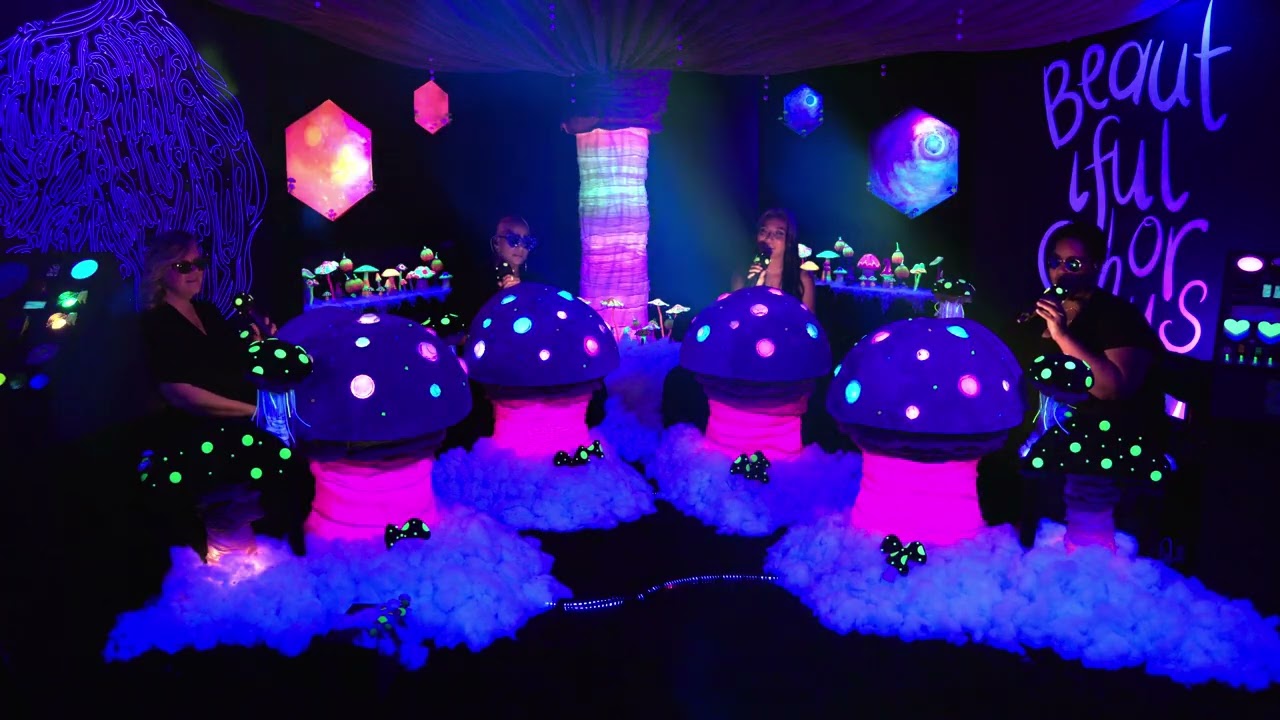
Somewhere past the edge of the screen, a single sustained tone begins to behave less like a note and more like a horizon. That is the territory Craig Pruess maps in Music for Space & Mind Travel, a roughly twenty-four-minute piece that layers his composition "Vastness" with "Sacred Temples," a monochord piece that also carries chanting he performed with Ilyana Vilensky, all set against animation by Jurgen Ziewe. The video's own description calls it a journey into outer and inner space and a travelogue into 3D awareness, and it notes that the whole work was originally created in virtual reality. That last detail matters. A travelogue is a form built on movement through unfamiliar places, and here the places are made of sound as much as image. This article works from the video's title and description rather than a transcript, so it focuses on the musical ideas the piece sets in motion and on why those ideas suit a journey that happens inside the listener.
Most popular music is organized around change: chords move, melodies resolve, rhythms push forward and then land. A drone works on different terms. It holds one pitch, or a small cluster of related pitches, long enough that the ear stops asking what comes next and starts paying attention to what is already there. Listeners who spend time with sustained tones often notice a shift in their own attention. Timbre, the particular color of a sound, becomes the thing to track. Small beats between nearly-matched frequencies, the faint shimmer when two tones almost but not quite agree, become a kind of weather.
That is why a drone suits a piece called "Vastness." A melody tells you where you are going. A sustained field tells you how large the room is. When the sound does not move forward, the listener has to supply the movement, and in a visual travelogue that movement becomes the sense of traveling. The music does not describe space so much as leave room for it. For anyone used to songs built on hooks, the first few minutes of this kind of writing can feel unusually open, almost like standing at the mouth of a canyon and waiting for the echo.
The craft question for a composer working this way is not how many ideas to include but how to make stillness feel alive. The answer usually lives in slow, deliberate changes: a filter opening by a few degrees, a harmonic creeping in under the fundamental, a level swelling and receding so gradually that the listener cannot point to the exact moment the room changed. Pruess's "Vastness," as the video presents it, sits in this tradition of patience. It asks the listener to be the one doing the traveling.
The monochord is one of the oldest and most austere instruments in the history of music. In its simplest form it is a single string stretched over a resonating body, with a movable bridge that divides the string into shorter and longer lengths. Slide the bridge and the pitch changes; pinch the string at precise points and you hear the intervals that make up the harmonic series. Because it has only one string, it strips away the choices a player makes on a multi-string instrument. What is left is the relationship between a single vibrating length and the ear that hears it.
That austerity is exactly what gives the monochord its power in contemplative music. A single tone, sounded with attention, can sound enormous. Its overtones bloom into a field of partials, and the listener is pulled into the question of how one string can contain so much. The video's pairing of "Sacred Temples" with the space-oriented "Vastness" gives the monochord a particular job: it is the instrument that makes the cosmic scale feel intimate. The vast and the close are placed side by side, and the listener is invited to notice that they are the same experience viewed from different distances.
Anyone who wants to hear this quality more clearly can try a simple exercise. Play a single sustained tone at a low volume in a quiet room and listen for ten full minutes without doing anything else. Notice when your attention wanders, notice when it returns, and notice how the sound itself seems to change as your listening changes. This is close to what a monochord piece asks of you, and it is the practice underneath the whole video's intent.
The description credits the chanting to both Craig Pruess and Ilyana Vilensky, and that layering adds a second kind of tone to the monochord's field. The human voice is a drone instrument of its own, able to hold a pitch, bend it, and let its overtones shape the room. When a chant sits inside a monochord texture, the two sources can blur into one another, so that it becomes hard to say where the instrument ends and the voice begins. For a listener, that blurring is part of the effect. The line between a made sound and a sung one softens, and the focus moves from the source of the sound to the sound's presence in the body.
Chant has long functioned this way across many contemplative traditions: a repeated tone or phrase gives the mind something to rest on while it lets go of its usual commentary. Placed next to a monochord, the chant gains a second anchor. The instrument holds the wide frame, and the voice gives it a human texture close to the ear. Together they suggest a journey that is both expansive and personal, which fits the video's stated theme of moving from outer to inner space.
The phrase "originally created in Virtual Reality" changes the frame for everything else. In a conventional music video, sound accompanies pictures that the director has already decided. In a piece conceived for virtual space, the question becomes what it means for a listener to be inside an environment rather than facing one. Sound becomes spatial. Tones can seem to come from above, below, or behind, and a slow sweep through the soundfield can mirror a slow movement through an imagined place.
Jurgen Ziewe's animation, which the description points to through a link to his own work, provides the visual half of that environment. The video's credits make clear that music and image were made as partners in a single travelogue, not as a track laid under a finished sequence. That collaboration model is one of the more interesting threads in the piece. It suggests that a drone can be a kind of navigational instrument, giving the viewer a steady sense of direction while the images shift and surprise.
There is also a practical lesson for anyone who wants to experience work like this. A visual piece built for immersion often asks for a different kind of listening than a playlist track does. Headphones help. So does clearing time, dimming the lights, and resisting the urge to multitask. A journey of twenty-four minutes is long enough to let a state of attention develop, and short enough to return to again.
The description frames the video as a movement from outer to inner space, and the piece's structure follows that arc. Opening with the vastness of a sustained field and the sense of distance it creates, the work gradually draws the listener toward the intimate, where the monochord and chant become the nearest voices in the room. The final effect, when it works, is less a destination than a change in the listener's sense of scale. The universe and the breath turn out to be measured in the same units of attention.
The video also has a second, quieter arc in its life as a published object. It was posted on October 22, 2015, under the channel name Craig Pruess filmcomposer, and at the time of the data available for this article it had 6,809 views. That number is modest by the standards of mainstream music video, which is part of its character. Work like this tends to find its audience slowly, through people who go looking for long, unhurried listening and then pass it along to someone who needs it.
For readers who want to follow the music beyond this single video, the description points to Craig Pruess's music site, Heaven on Earth Music, where his catalog can be explored directly. It is worth going to the source, because the video is one window onto a body of work that extends well beyond a single travelogue.
If this piece has opened your ear to drone and monochord, the natural next step is to listen in sequence rather than in fragments. Start with a full play-through of the video with headphones and no other input. Then, on a second listen, focus only on the lowest sound you can hear and follow how it changes as the chant enters. On a third, try sitting still with your eyes closed for the whole duration and noticing when the sense of space shifts.
From there, explore related territory: sustained-tone composition, the history of the monochord as both a teaching tool and a meditative instrument, and the wider world of chant across contemplative traditions. Each of these threads runs back to the same basic question that "Vastness" and "Sacred Temples" pose together, which is what a single tone can hold when we give it our full attention. Pruess's music site and Ziewe's linked portfolio are the best places to continue the journey from the sources themselves.