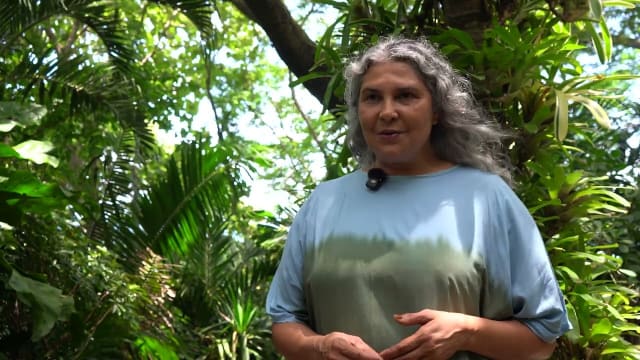
Start with a household that has a mischief problem. Salicrow, the psychic medium and author featured in this Gaia video, is describing the brownies that visit her home. Her explanation for the name is specific and a little delightful: brownies, she says, appear as a sepia-colored shadow, the way spirits in general tend to show up as gray shadows, as if they were shot on sepia film. They are short. They come indoors only in spring and fall. And the signs are unmistakable, because, as she puts it, "there is a lot of mischief going on," and her cats are the ones who pay for it. The crew laughs. She insists they are not mean. They just really do harass the cats.
It is an odd, warm opening for a conversation about the spectrum of modern witchcraft, and it is the right one. Before the video gets to traditions, structures, or ritual, it establishes what Salicrow actually does every day: she lives in a relationship with beings she can perceive and that she clearly treats as neighbors. That stance, more than any single tradition, is the thread that runs through the nearly five minutes of conversation available in the transcript.
Salicrow says her most developed relationship is with trolls. The reason is geography and affection: she loves mountains, and she has been working with trolls for a very long time at a place in the White Mountains, near Mount Washington. Her description of how that relationship changes over time is one of the more striking things she says. When you work with beings and acknowledge them, she explains, "they grow and all of a sudden they're like everywhere."
She then describes taking children into that world. She brought her 11-year-old grandchildren, along with a friend's 11-year-old, to the troll cave for the first time. She had doubts about how it would go. "I was just like I don't know if they're really going to get it or what," she says, "and it was absolutely the opposite. They were all over it. They saw trolls everywhere." Her interpretation is simple: children are more open, and they picked up on what the adults had trouble noticing.
That observation matters for anyone trying to understand this kind of practice. Salicrow is not describing a special effect or a costume. She is describing attention, and the claim that attention, given consistently, produces a kind of relationship that becomes visible to others.
This is the central argument of the clip, and Salicrow states it plainly: "So, I say that magic is the will and the way." Those two words do different work. The will is the force you bring. The way is the form you choose to express it. She is clear that the will is non-negotiable. "The will has to be there," she says, and "there's ways that we can develop our will, but it's necessary."
The way, by contrast, is open. Salicrow lists the forms it can take: activated prayer, witchcraft, meditation, working with a deity or with yourself. Then she widens the frame further. "Not all witches work with deities," she says. "Some witches are Christians. Some witches are elemental. I do work with deities as well, but some witches only work with elementals. Some witches work with the divine power of all and they're just channeling it."
This is the spectrum the video's own description promises to map, from structured, ritual-heavy traditions to intuitive, earth-based ones. Salicrow's point, at least as far as this excerpt goes, is that those differences are differences of way. They are not differences of commitment. A practitioner who works through elementals and one who channels a universal power may be doing equally serious work, provided the will is real.
Salicrow connects the will to something she says modern science also discusses, which is the power of belief. Her image is vivid. If you expect bad luck to keep coming, she says, you are "sitting at the life lunch counter of life saying like, 'I would like a lot of trouble, please.'" And, in her telling, life will serve it.
She is careful, though, not to turn this into a blame ledger. "It doesn't mean that everything that happens to us is our fault," she says. "But it does mean that when we can live with a strong will and focus it on what we want to see happening, that we're going to make changes in our life."
That distinction is worth holding onto. The claim is not that you caused every hardship. The claim is narrower and more useful: where you put your focused attention shapes what you do next, and that is a space where you have agency. For a reader new to witchcraft, it reframes the entire enterprise. The first tool is not a candle or a chant. It is the decision to direct your will somewhere specific.
The interviewer raises a pattern that Salicrow confirms from her own work. Many of the people who follow her, and many who enter her training, are women over 55. The interviewer connects this to the content itself, which is largely about sensitivity, intuition, and healing, qualities the interviewer describes as quite feminine.
Salicrow's answer is less about gender and more about history. Many of these people, she says, "have had things their whole life," and either they "were afraid of it when they were young, through religion, they were told it was evil." Those early messages are the blocks they must work through. "They have all these blocks that they have to shed before they can get where they want to be," she says.
Her examples are concrete. She had just run a witch retreat, a witch camp, and three of the people there were over 70. When she took people to Scotland to work on what she calls the witch wound, two participants were 75. Someone who went to Ireland with her the previous year was 80. "These are people who are now practicing magic," she says.
The witch wound, as she uses the phrase in this excerpt, is the inherited injury of being taught that your inner life is dangerous. It explains why a late start is not a failure of readiness. For many people, the work is first unlearning a fear, and only then learning a practice.
The full video, according to its description, goes further into practical advice for deepening your craft and into the everyday magic of cooking, gardening, and grounding in nature. The transcript excerpt available here ends before that material arrives, so it would be inaccurate to describe those specific recommendations. What the excerpt does offer is a clear sequence that a reader can apply.
First, develop the will. Salicrow treats it as a trainable faculty, not a personality trait. Second, choose a way that fits you. Deities, elementals, Christian practice, meditation, and channeling are all named as legitimate forms. Third, acknowledge the beings and forces you work with, because by her account the relationship deepens through attention. Fourth, watch what you expect. Her life-lunch-counter image is a reminder that the mind is always ordering something.
There is also a quieter lesson in the people she describes. The witches over 70 and the 80-year-old who went to Ireland were not waiting for permission to begin. The blocks were real, and they were old, but the will was still available. For anyone who has ever thought the door closed at a certain age, that may be the most useful thing in the whole conversation.
If this excerpt has you curious, the best next step is the full video on Gaia's YouTube channel, which covers the traditions the description names, including high ceremonial Wicca, granny magic, hedgecraft, and elemental work, along with the everyday practices it highlights. Read the material with Salicrow's central claim in mind: magic is will and way. Ask which parts of the spectrum already describe your instincts, and which parts describe what you were taught to fear. Then notice where your own attention is going, because, as she puts it, that is where change begins.
Watch for the brownies in your own life too. Her stories suggest that the signs of an unseen presence are often small, specific, and easy to dismiss until someone else sees them. Her grandchildren did not dismiss them. That may be the simplest instruction in the video: pay attention, and believe what you notice.
Note: this article draws on the transcript excerpt available for the video and its published description. Details beyond those sources are not included.