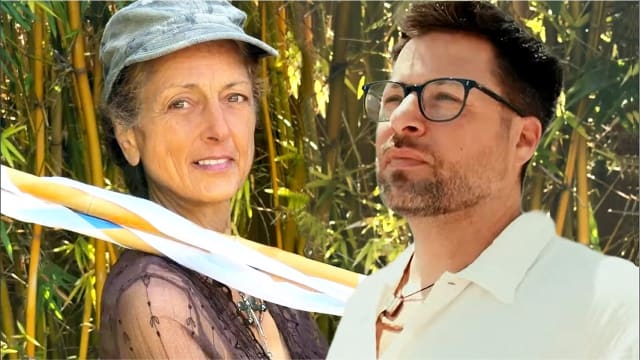
Amanecer means dawn, and this remix is built the way a dawn happens: slowly, then all at once, then settling into light. Cuervo Cuervo, the duo of Argentinian charango player Agustin Ganem and American producer Benjamin Hill, takes a track that began as a vocal prayer to the new day and wraps it in charango and strings, a warm analog arpeggio that keeps the sun climbing, a triplet passage stitched from chopped fragments of the original voice, and a peak where the charango breaks into full rasgueo before the strings ring out. The release description calls it "a sunrise, played by hand," and that phrase is a useful key to the whole piece. It is a remix about craft, about two improvising musicians meeting inside a song whose first life was a room full of listeners, and about what it sounds like when a melody is allowed to rise rather than drop.
According to the release description, the original Amanecer was performed in the Opus room at SXSW 2024, where about 100 people heard Poranguí play an improvised journey through vibroacoustic sound beds. The description says that this was the moment "the light came back after a night of deep listening," and it describes the voice that rose over that bed as a prayer to the new day.
It helps to know what a sound bed is before hearing the remix. A bed is a sustained layer of sound that sits underneath everything else, giving the listener a floor to stand on. In vibroacoustic work, that floor is often low frequency, the kind of sound you feel in the chest as much as hear in the ears. A bed that stays put for minutes is a kind of patience: nothing has to resolve yet, and the listener is free to drift. The original piece lives in that patience. The remix has to honor it and then move it somewhere.
The description tells a small, specific origin story. Agustin Ganem and Benjamin Hill met by chance on the streets of Bacalar, Mexico, in 2018. Ganem plays charango, the small high-pitched lute of the Andes. Hill is a producer. Their sound, in the description's words, fuses psychedelic electronics with Latin American folk, and they still build every show on the spot.
That last detail is the one that matters most for this remix. The description draws a direct line between Cuervo Cuervo's improvisation and Poranguí's own practice, noting that Poranguí loops his whole performance live. Looping and improvising can look like opposites, one repeating and one changing, but they share a root. In both, the musician makes form in real time. A loop is a cell that gets stacked and reshaped; an improvised phrase is a cell that gets bent on the way out. A remix made by two people who think this way will not simply tidy up the original. It will treat the original as material to be listened to and answered.
The description puts it plainly: Cuervo Cuervo "answers that prayer the way they make all their music, by improvising." The remix is, in that sense, a conversation with a finished recording, conducted at the speed of a live room.
The track has a clear arc, and it is worth hearing it in stages.
- The glow. Charango and strings enter first and wrap the original in what the description calls a "lush, slow-rising glow." Strings sustain and the charango spins light across them. Nothing is hurried.
- The arpeggio. A warm analog arpeggio arrives underneath. An arpeggio plays the notes of a chord one after another instead of all at once, so the harmony becomes motion. Analog synth tone adds the softness and slight instability that make it feel alive, and it keeps the sun, in the description's phrase, "from ever stopping its climb."
- The stitched voice. A triplet passage takes chopped fragments of Poranguí's voice and fits them into the groove. A triplet fits three evenly spaced notes into the time of two, which gives the rhythm a rolling, slightly off-kilter lift. Chopping a vocal into small pieces and rearranging them turns a sung line into a percussive texture while keeping the human breath audible.
- The peak. At the top of the arc, the charango breaks into full rasgueo. Rasgueo is a strumming technique in which the fingers sweep across the strings in a rapid cascade, and it is one of the most physical sounds in the guitar family. Here it is the sun clearing the horizon.
- The settle. The light settles, and the strings ring out. The remix ends the way a morning does, not with a crash but with the sound hanging in the air after the work is done.
What makes this structure work is that each layer answers a specific job in the dawn metaphor. The strings are the first color in the sky. The arpeggio is the climb. The chopped voice is the memory of the prayer, broken into pieces and carried forward. The rasgueo is the moment of full light, and the ringing strings are the warmth that stays after.
"A sunrise, played by hand."
The phrase is doing real work. A sunrise is a thing nobody performs. It happens on its own schedule, and no one can speed it up. To describe a piece of music as a sunrise played by hand is to say that the timing and the tone were chosen by people, not produced by a sequencer, and that the rise was built note by note. The charango's rasgueo, the hand-shaped triplets, and the analog warmth all point the same way: this is a made thing, and the making is audible.
That idea sits well with the duo's method. Musicians who improvise on stage cannot rely on the safety of a pre-set arc. They have to find the peak with their hands in front of an audience. A remix built by players who work that way tends to hear the original's emotional shape and then find its own route to the same feeling. Here the route is the climb, the peak, and the settle.
If you want to hear the piece, start with the release page the description links, at onerpm.link/AmanecerCuervoCuervoRemix. Then listen to the original Amanecer on Poranguí's music page at porangui.com/music.html, or on Bandcamp at porangui.bandcamp.com, and notice where the remix keeps the original's breath and where it changes the light. For the next step in the series, the description says the Chama das Águas (Desert Dwellers Remix) is due on November 20th. Follow Poranguí's newsletter at porangui.com/connect.html or the Facebook and Instagram pages listed in the description to catch it when it lands.