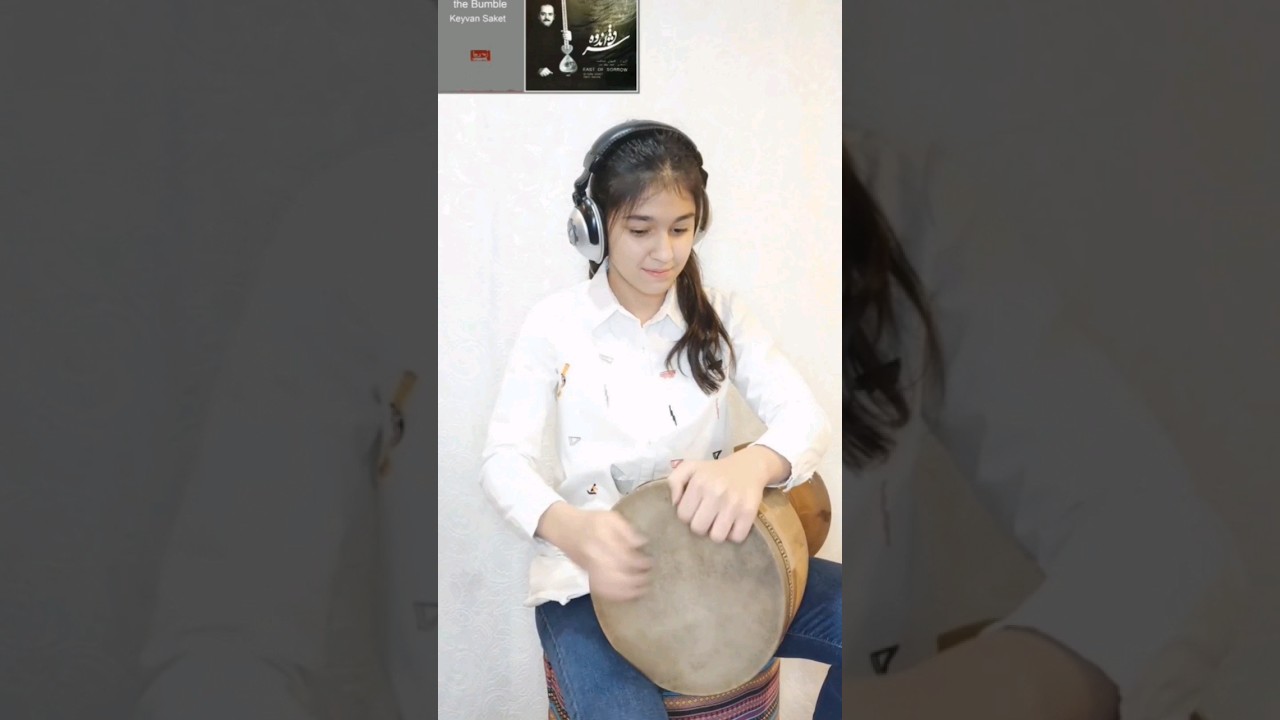

Yasna Safaei has dedicated her artistic life to the tombak, the ancient goblet-shaped hand drum that forms the rhythmic foundation of Persian classical music. In an era when traditional instruments often struggle to find their voice beyond ethnomusicological contexts, Safaei represents a quieter but no less vital current: the musician who goes deep rather than wide, who chooses mastery over reinvention, who serves an art form by refusing to compromise its essential character.
The tombak—also spelled tonbak—is an instrument that reveals its complexity slowly. Carved from a single piece of wood, typically mulberry or walnut, with a membrane of lambskin stretched across its wide opening, it produces an astonishing palette of sounds: booming bass tones from the center, crisp snaps from the rim, rolling thunder from rapid thumb technique. But these sounds don't come easily. The tombak demands years of disciplined practice to develop the hand speed, finger independence, and rhythmic precision that separate competent playing from artistry. This is the path Safaei has chosen.
Safaei's work exists within a centuries-old tradition. The tombak has accompanied Persian music through dynastic changes, cultural upheavals, and geographic dispersions, maintaining its role in everything from the highly structured radif system of classical performance to regional folk expressions. The instrument carries within it the memory of courtly performances and village celebrations alike, and to play it seriously is to enter into conversation with generations of masters.
She trained in the Persian percussion tradition, absorbing the vocabulary of zarbi patterns—the rhythmic cycles and formulae that give structure to Iranian music. These patterns, passed down through oral tradition and refined over centuries, represent not merely technical exercises but an entire philosophy of time, emphasis, and breath. A tombak player must internalize these patterns so completely that they become second nature, freeing the musician to interpret rather than simply execute.
The physical demands are considerable. The instrument is played seated, the drum tilted at an angle and tucked under one arm, requiring sustained postural control. The technique involves fingertip strikes for precision, palm slaps for resonance, and rapid thumb rolls for the signature cascading sounds. Safaei's practice demonstrates fluency across this technical spectrum, evidence of the thousands of hours required to make such complexity appear effortless.
While the tombak has historically functioned as an accompanying instrument—supporting the melodic lines of the tar, setar, or kamancheh in ensemble settings—Safaei's work encompasses both collaborative and solo performance. This dual focus is significant. Playing the tombak in ensemble requires deep listening, the ability to breathe with other musicians, to accent what needs accenting and recede when restraint serves the music. Solo performance demands something else entirely: the capacity to sustain interest and develop musical ideas through rhythm alone, to make percussion sing.
The tombak's position in Persian music differs fundamentally from the drum's role in many Western traditions. It is not merely keeping time but actively participating in the modal and emotional landscape of the music. A skilled tombak player doesn't just maintain a beat but responds to the melodic improvisations happening around them, adding commentary, creating dialogue, shaping the overall architecture of a performance. This requires not only technical mastery but deep knowledge of Persian musical modes, or dastgah, and their associated moods and conventions.
Safaei has turned to social media as a platform for sharing her performances and practice, describing her work as the pursuit of the art of tombak performance. This choice of venue speaks to the challenges and opportunities facing traditional artists in the contemporary moment. The tombak cannot rely on name recognition or crossover appeal; it must assert its value on its own terms. By documenting her ongoing practice, Safaei makes visible the daily work of artistic deepening—the repetition, the incremental progress, the dedication to craft that precedes any public performance.
Her focus remains on deepening her technical command and interpretive voice within the instrument's demanding repertoire. This is the statement of an artist committed to the long game, to the understanding that true mastery is asymptotic, always approaching but never quite reaching completion. It's a perspective increasingly rare in a cultural landscape that privileges novelty and viral moments over sustained inquiry.
Yasna Safaei's significance lies not in revolutionary innovation but in something equally important: the preservation and transmission of artistic excellence. She represents a vital link in the chain that connects contemporary audiences to ancient musical wisdom. In her hands, the tombak speaks with authority about the value of tradition, the beauty of constraint, and the rewards of patient devotion to craft.
Her work reaches those who hunger for depth in an age of surfaces, who understand that some artistic experiences cannot be compressed or simplified without fundamental loss. She matters because she reminds us that the world's musical diversity depends on artists willing to dedicate themselves to specific, demanding traditions—artists who measure success not in streams or followers but in the quality of the sound they coax from wood and skin, in their ability to honor what came before while making it live in the present moment.
The tombak will outlast trends. And artists like Yasna Safaei ensure that it will continue to be heard.