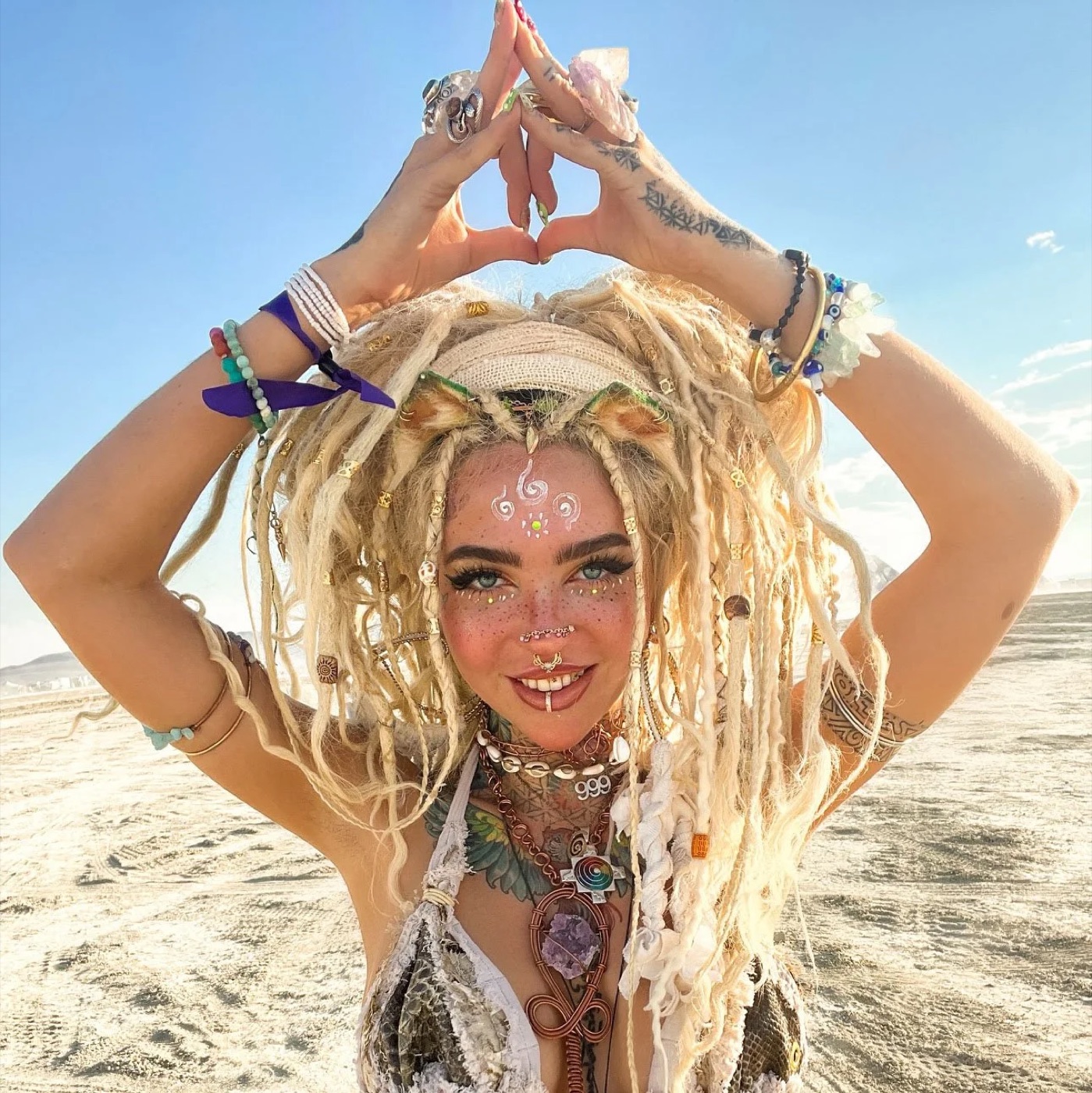

Shanin Blake is a conscious music artist who works as a musician, retreat leader, and sound healer. The artist's own site frames the work as "Music for the Heart." Calling it "teaching" needs a caveat: the available material describes songs, ceremony, and gatherings more than a curriculum. What follows is a reading of that format, with its limits stated where the record runs out.
The central unit of the work is the retreat-style private concert paired with ceremony. These are described as intimate and set in places called energetically charged. Live music and sound baths sit at the center. Around them, a gathering may include breathwork, yoga, meditation, intuition practices, and ShanTalks, along with what the bio calls deep community sharing. Time in nature, such as saunas, cold plunges, and wildlife adventures, can be part of it.
Shanin calls these gatherings a sound initiation held in a serene, supportive space. That phrase matters. It frames attendance as participation with a beginning, a middle, and a period of integration, not as a ticketed show. The available material does not specify duration, price, schedule, or group size beyond "intimate," so no minute-by-minute account is possible. The structure suggests a day or days organized around sound, with talk, movement, and rest arranged around it. Guests are expected to take part: to share, to practice, and to get cold in a plunge.
Recorded music feeds this format. The release Rainbow Codes ~ Medicine Music ~ Live Sound Healing, Vol. 1 names the connection directly, positioning recordings as material for receptive listening that echoes the live work.
The vocabulary the site returns to is consistent: soul family, vortex gatherings, sound initiation, sacred ceremonies. Beneath it runs one stated aim, helping people reconnect with their truth. The gatherings are also designed to help people meet like-minded others, go deeper within themselves and with the music, and restore mind, body, and soul.
Three themes follow. The first is return, or reconnection, as the purpose of the work. The second is community, shown in the emphasis on soul family and shared reflection. The third is the body as part of the practice: breath, heat, cold, and movement sit alongside sound instead of being treated as extras.
The catalog complicates this picture. Alongside the meditative register of Medicine Music, there are singles such as Money Flow, Lucky Girl Syndrome, and Bad Btch Energy, which belong to a more pop-facing, self-empowerment mode. Whether these are two voices or one, the available material does not say.
The material records no specific prompts, exercises, or guided inquiries, and none will be invented here. What can be said is what the format implies. Reconnecting with your truth presupposes a question: what is true for you beneath the noise? Intuition practices point to another: what do you know without being told? Deep community sharing asks participants to say aloud what surfaced. Beyond those inferences, the particular questions Shanin poses in ShanTalks are not documented.
The record is thin on tone. It does not describe Shanin's humor, their use of stories, or whether they draw on scripture. It documents no sacred text. The devotional music tag suggests songs meant to function as prayer-like or ritual material, but that is an inference from a tag, not a described habit.
Sound is the clearest element. Sound baths and the "live sound healing" framing imply that sustain and pacing matter more than rhythmic drive in the ceremony material, and that silence between and within sounds is likely part of the experience. Even this is reasoned from format, not witnessed. What is evident is the register of the language: warm, communal, and unembarrassed about spiritual vocabulary.
It is likely to land for people who want music as an intention-led experience, who are drawn to ceremony and group sharing, and who are comfortable with the modern sound bath and retreat scene. Listeners who like a mix of devotional and empowerment-oriented songs may find the range a feature.
It is a poor fit for those who want music purely as background texture. The retreat format asks for real commitment: travel, time away from routine, and participation in group sharing, which may feel intrusive to people who prefer anonymous concert-going. Saunas, cold plunges, and outdoor activities can be demanding. Skeptics of intuition practices and spiritual language will find that framing central and hard to avoid. Listeners expecting one consistent devotional sound may be surprised by the catalog's uneven tone. The same applies to fans of high-tempo electronic or club music, though that judgment rests on titles and format, not full listening.
The bio names no lineage, guru, teacher, or institutional tradition, and none should be assigned. The vocabulary places the work within the contemporary sound healing and ceremony circuit, the modern sound bath and intentional retreat scene, not within a historical school of practice. Anyone who wants to know whether Shanin has publicly named teachers should check their website and YouTube channel directly.
No awards, press coverage, or third-party reviews are documented. The reach that can be measured is a Spotify following of about 129,000 and a steady release cadence of roughly twenty releases between 2022 and 2026. What is clear is the format: music, ceremony, and community built into one structure. The finer points of Shanin's voice as a teacher remain, for now, unrecorded.