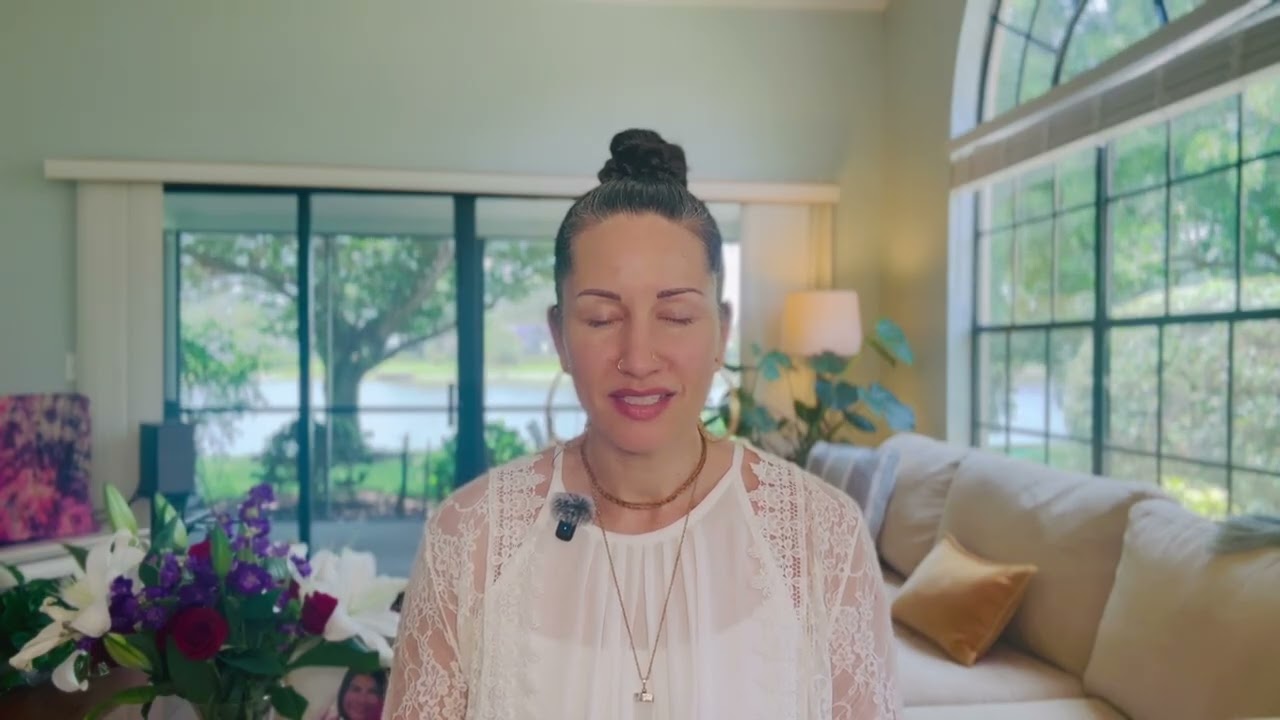
Start with a voice that arrives before any argument does. "There is no I, there is no you, there simply is space or nothingness, or within that nothingness is everything." That is the first line of Carrie Suwal's eleven-minute video "Alignment with the truth," published on YouTube in February 2019. There is no music bed, no visual setup worth describing, and no list of steps. There is a single speaker, slowing down her sentences the way someone does when they are less interested in persuading you than in letting you hear the pauses. Listened to once, it can feel like weather passing through. Listened to a second time with a pen in hand, it turns out to be a tightly organized set of ideas about oneness, personal responsibility, and the quiet work of accepting yourself while you are still in the middle of becoming someone.
This is a piece about what that teaching says, and about how its ideas hold together when you slow them down. The video is brief and does not develop a long argument. It repeats a handful of images and returns to them, and the repetition is part of how it works.
The opening claim is not a denial of your body or your name. Suwal moves quickly from the idea of nothingness to the idea of a boundary-free whole: "there is no border of the skin or the boundary of the human, no borders of the countries of the planet or the universe. It is all one, flowing within itself." The word that matters most in that passage is "flowing." She does not describe a static oneness like a sealed sphere. She describes movement, with beings flowing "in and out of each other."
Where do separations come from, then? She names them directly: "there are bits of consciousness and ego which create the walls of separation." The teaching is careful here. The walls are not presented as the world's fault, and they are not presented as illusions that vanish on command. They are built by consciousness and ego, which means they are something we participate in. And the remedy she offers is surrender, not a technique: "if we surrender to the depths we are not separate."
For a listener, the practical question is what it would look like to live from that flow instead of from the wall. The video does not give a checklist, but its later sections suggest an answer: it looks like being present, letting things be as they are, and recognizing that the same creative source runs through everything you encounter.
The teaching is emphatic on this point. "We all have the power to create our lives as we wish to see them unfold, and the power is the strongest in this moment, not when we're searching for it, but it's right here right now." At roughly the 1:25 mark, the speaker frames this as a claim about the present tense. Power is not stored in a future version of you who has finally figured it out. It is available in the act of noticing where you already are.
She does not separate creating from being. Her phrasing is "create, be, not become, be, just be in this moment fully." That line is worth sitting with, because much of modern self-improvement culture is built on the idea of becoming. Suwal is not rejecting growth; she addresses that explicitly later. What she is pointing to is a difference in orientation. You can create from presence, or you can create from the chase.
The most concrete version of this claim comes in the section on choice. Suwal says: "you are a creator, everyone's a creator, and our creations affect others, but we get to choose our reactions, or we get to be pulled by our reactions." That sentence separates two things many people run together: what happens to us and how we respond. The video names both kinds of choice, "choice within of how you want to interpret, choice without of how you want to react," along with the simpler choices of saying yes or no, being still or moving.
Around the 2:15 mark, the teaching turns to something most spiritual material skips past: the instruction to accept even your judgment. "Don't judge it, accept it, or accept that you're judging it. Why not create softness around everything, acceptance around everything, and love around everything, the perceived good and the perceived bad?"
This is a subtle move. Telling someone to stop judging themselves tends to add a new layer of self-criticism: now you are judging yourself for judging. Suwal's instruction sidesteps that loop. If the judging is happening, accept that it is happening. The distinction between the judgment and your relationship to the judgment is what she is pointing at.
She also insists that acceptance does not mean passivity. "I'm not saying don't make choices, don't grow, don't release old, that's not serving you. I'm saying do it all: make choices, grow, let go, surrender, be in the moment." The pairing of letting go with continuing to act is the core of the teaching. Acceptance is the ground from which you choose, not a replacement for choosing.
This is the section most listeners will either lean into or push back against. Suwal says plainly that "all of the beauty and all of the joy and all of the suffering and all of the pain is a gift." At about 3:33, she elaborates on the cost of resisting that frame. If you take ownership of your suffering, she notes, you may feel that you created it, and "that doesn't feel very good." But she offers a second way to take ownership: "with no judgment."
Her reasoning rests on a claim about what suffering is: "that suffering is still a form of life, of living, of being human." She is candid about the fact that humans cause pain to themselves and to others, and she does not pretend otherwise. "It is human to cause pain to ourselves and pain to others at times. It is also human not to want to suffer and cause pain." Both are true at once. The teaching does not ask you to pick one.
Then comes the line that gives the video its emotional center, a passage on contrast. At roughly 6:42, she says: "I'm grateful to feel pain, to know that when I feel pain I will really know when I am not feeling pain, and I will have even more gratitude for the joy that I feel, for the peace that I feel, and the love that I receive. Contrast is really a gift, because contrast illuminates the beautiful things in life. It allows you to see them more fully and clearly and appreciate them, and even want to hold on to them."
The argument is not that pain is good in itself. It is that pain sharpens perception, and that gratitude can be extended into the uncomfortable parts of experience without first requiring those parts to disappear.
Much of the video's later material concerns the idea of growth without an endpoint. Suwal says, "you are simply growing, but we are always growing. Every day, every moment will never get to that destination or end point. Every moment is the destination. You have arrived." At about 9:35, she describes self-love as the practice of staying with yourself through each step of change: "maybe you'll be wanting to grow and change all the time, but love yourself through every step of that, and know that you're always enough in each moment as you are."
This reframes a familiar tension. Many spiritual paths quietly promise that if you do enough work, you will finally arrive somewhere, free of struggle. Suwal's teaching removes that promise. There is nowhere to finish. If that sounds bleak, her framing suggests the opposite: the arrival is not postponed, it is the moment you are already in.
"There is no track. You are simply living, experiencing, and you are the experiencer who gets to witness these miracles of life."
The title promises alignment, so the video has to say what misalignment looks like. Its answer is gentle. "There are moments when you're not in alignment with that truth, but you're in alignment with other truths of your environment, of your mind, or of other people." The teaching does not treat drifting as failure. It treats it as a normal condition of living among other people and their expectations.
The final message is a permission slip, and a generous one: "It's okay to be pulled, or feel like you're off track, because there is no track." The closing line of the transcript carries the whole argument in a sentence: "It's okay to not be okay, that every imperfection is perfect, and that what you are looking for is already here."
Taken together, the teaching asks for a particular kind of attention. Notice the wall when it goes up. Accept the judgment that appears. Feel the pain without disowning it, and let it sharpen your sense of joy. Keep choosing, keep growing, and stop treating the growth as a road to a finish line you will someday reach.
The fastest way to learn from this teaching is to listen to it twice. The first pass lets the imagery land; the second pass lets you hear how the ideas connect. Try the practice Suwal's language points toward: when you notice a judgment rising, say to yourself that you are judging, and see whether accepting that changes the texture of the moment. Pay attention to the moments where you feel pulled by your reactions, and notice the small gap where a choice is still available.
If you want to go deeper, sit with the three ideas that recur through the video: oneness as flow rather than fixed state, choice as the difference between what happens and how you respond, and the claim that every moment already is the destination. Each is simple to state and harder to live. The video offers no more than that, and it does not need to.