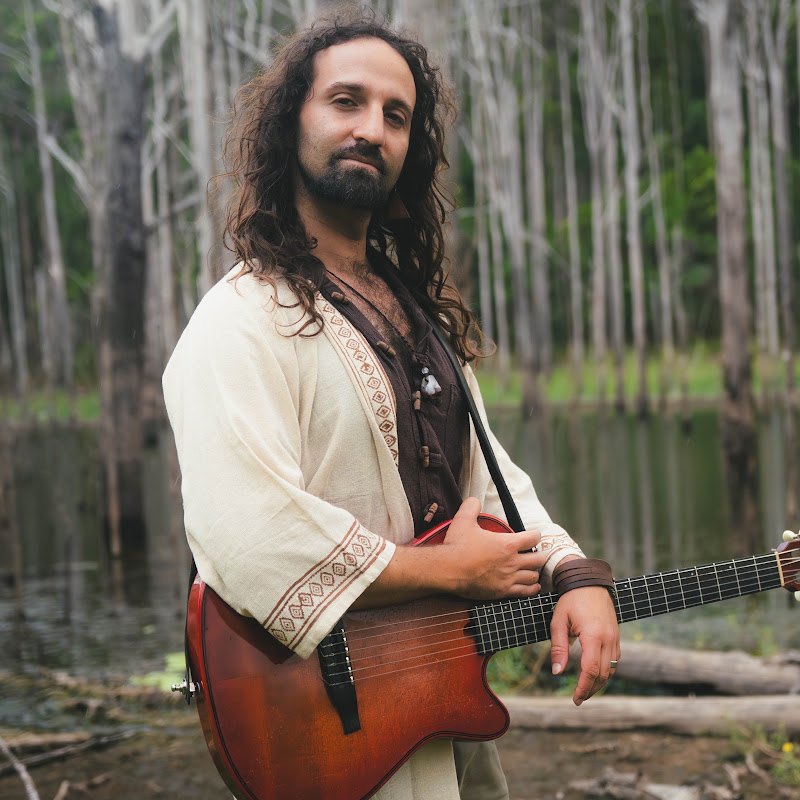
TLDR: Nadav Tabak presents "The Magic Garden," a newly composed live looping performance recorded in his back garden. The piece demonstrates how loop-based music production creates layered, immersive soundscapes by recording and stacking instrumental and vocal elements in real time. The performance captures the spontaneous creative process and the resonant, meditative qualities that arise from performing music in a natural outdoor setting.
What is live looping and how does it work?
Live looping is a technique in which a musician records themselves playing or singing, loops that recording, and then layers additional instrumental or vocal parts on top of it, all performed in real time without editing software. The performer acts as both instrumentalist and sound engineer, building a complete musical arrangement during the performance itself. In Tabak's "The Magic Garden," this technique creates depth and texture by combining multiple instrumental layers that would typically require a full band to perform.
The process begins with a foundational loop—often a rhythm, bass line, or harmonic foundation—and each subsequent layer adds melodic, harmonic, or percussive elements. The result is a rich, polyphonic soundscape built entirely by one performer. This approach has roots in ambient music, folk traditions, and contemporary electronic music, and it emphasizes spontaneity and present-moment musicianship.
Why does the garden setting enhance the musical experience?
Tabak explicitly notes in the description that "the vibes from playing in my back garden are always pretty magical." This observation points to the relationship between environment and creative expression. Recording music outdoors introduces several elements that indoor studio settings cannot replicate: natural acoustics, ambient environmental sounds, the psychological shift that comes with performing in nature, and the removal of artificial sonic boundaries.
A garden environment can subtly influence the emotional tone of a performance. The openness of outdoor space, the presence of living growth, and the connection to natural rhythms may contribute to the meditative quality evident in "The Magic Garden." Performers often report that natural settings encourage a different mode of creativity—one less self-conscious and more attuned to intuition. The composition itself appears to reflect this influence, with the title directly naming the space in which it was born.
How does spontaneous composition differ from pre-arranged songwriting?
Tabak describes the creation of this piece as something that "came to me the other day," and notes that this performance represents his "first performance of the song" after "a day of messing around." This workflow reveals a compositional process rooted in improvisation and exploration rather than careful pre-planning. The song emerged through play and experimentation, suggesting that the structure and melodies developed organically during the creative session.
When a musician composes through improvisation and looping, the first performance is often the moment of crystallization—the point at which intuitive explorations solidify into a recognizable form. This contrasts with traditional songwriting, where a composition is typically worked out privately before being performed publicly. Live looping compositions exist in a middle ground: they are both spontaneous and structured, both improvised and repeatable. Each performance can vary, but the core essence remains consistent.
What role does iteration play in developing new material?
The "messing around" phase Tabak mentions is not frivolous experimentation—it is a critical part of the creative process. During this phase, musical ideas are tested, combinations are tried, unsuccessful directions are abandoned, and effective moments are recognized and retained. The act of playing repeatedly in the garden until a coherent piece emerged demonstrates that spontaneity in music does not mean lack of refinement; rather, it means allowing refinement to happen through repeated engagement rather than intellectual design.
By performing the song for the first time on camera, Tabak captures the piece at a moment when it is fresh but also mature enough to stand as a complete work. The decision to potentially release "The Magic Garden" as an official recording suggests that the artist recognizes the piece has reached a form worthy of wider circulation. This decision often comes from intuitive recognition—a sense that the work has found its shape and is ready to be shared.
How does live looping create presence and immediacy?
Unlike studio recordings, which are typically assembled through multiple takes and edits, a live looping performance happens in a single temporal arc. The audience (or in this case, the camera) witnesses the composition unfold from its first element to its completion. There is no opportunity to undo mistakes or restart; the performance must succeed in real time. This constraint creates a particular kind of presence and authenticity.
The live looping format emphasizes the musician's agency and attentiveness moment by moment. Each decision to add a new layer, to introduce a particular melody, or to let a section breathe requires immediate musicianship. The listener experiences the piece not as a finished product delivered fully formed, but as something being woven into existence. This unfolding quality can create a deeper sense of connection than a pre-recorded track, because the listener is invited to experience the act of creation itself.
What makes a composition memorable enough to release?
Tabak's consideration of "The Magic Garden" as a potential next release suggests that the piece possesses qualities that distinguish it from passing improvisations. These qualities might include: a clear emotional arc, memorable melodic elements, effective balance between the layers, and a cohesive overall concept. The title itself—evoking an image of natural abundance and wonder—provides a frame that listeners can hold onto.
A song becomes release-worthy when it succeeds in multiple dimensions simultaneously: it must be technically sound, emotionally resonant, and distinct enough to warrant attention in a crowded musical landscape. For a live looping piece, this also means that the arrangement works well across multiple hearings and does not rely on the novelty of the performance itself. The piece must stand as music, independent of the method by which it was created.
Where to go from here
If you are interested in exploring live looping as a listener or as a musician, consider following Nadav Tabak's releases and social media presence to track how "The Magic Garden" develops. The artist maintains an active presence on Spotify and across social platforms (linked at nadavtabak), making it easy to hear both this new work and his broader catalog.
For musicians inspired to try live looping themselves, start with simple experiments: record a foundational loop (a rhythm, a repeating chord progression, or a vocal pad), and then layer a melody or counter-melody over it. Pay attention to how each layer changes the emotional quality of what came before. Notice how the act of listening and responding in real time differs from playing along to a pre-recorded track. If you have access to outdoor space, consider how environment affects your creative impulses and emotional state while playing.
For listeners seeking music that prioritizes present-moment musicianship and intimate connection between performer and listener, live looping offers a distinct experience. The format rewards close listening and reveals the musical intelligence required to balance multiple simultaneous elements while maintaining forward momentum and emotional coherence.