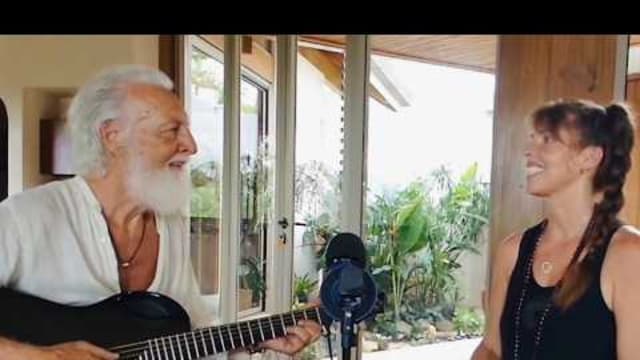
Eight minutes into a free weekly livestream, the room of listeners is asked to close their eyes, bring their hands to the center of the chest, and picture a point of light no bigger than a pearl. Over the next several minutes that pearl is asked to swell, to clear the body, and finally to spill outward into a sphere of radiance around the whole person, while a Tibetan bowl hums and a chant rises beneath it. This is the core of a 28-minute online session led by Paul Temple, who performs as RadianceMatrix and is known for musical meditations that he says build "harmonic architectures of sonic geometry." The session's central claim is that humans carry a dormant inner power located in what he calls the spirit heart, and that awakening it is both a personal practice and a contribution to the survival of the species. What follows explains that teaching, where its specific language comes from, how the visualization works step by step, and how a reader might weigh its claims without dismissing the experience.
Whydoesthespiritheartgetframedasasuperpower?
Temple opens with a provocation rather than a lesson. "What if the survival of the human species depended on you?" he asks at the start of the stream (1:18). He then pushes the idea further: that you have been taught, by parents, family, school, and work, to believe you are far less powerful than you are. The comparison he reaches for is the superhero story, which keeps returning to the same archetype, a hero who must remember their powers in order to save the world.
The move is a familiar one in contemplative teaching. The problem is framed as forgetting, not lack. In Temple's telling, the superpower is not strength or speed but light. "That inner power for us is the light in our hearts," he says, admitting it is "not quite as exciting as being Spider-Man or the Hulk," before adding that it is an "amazing magical power as we begin to remember" it. The rest of the session follows from that reframing: if the power already exists, the work is remembrance, which he describes in the language of "re-membering, re-activating and re-awakening" the heart, the wording of the event's own description.
The stated abilities are ambitious. The session's written description lists "intuitive awareness, telepathic communication and moving energy with our hands and hearts" as evolutionary capacities humans may grow into. Temple speaks in the stream of the heart's power "to fill a room with love and with light," and of being "very sensitive beings who can perceive subtle energy." These are his claims, offered within a spiritual frame. They are not presented with scientific evidence in the material, and this article reports them as his teaching rather than as established fact.
The first thing Temple does is separate his subject from biology. "This is very confusing because we use this word heart to describe different things," he says (3:11). The organ pumps blood. The spirit heart is an energy center in the middle of the chest, and he treats it as the place people already point to when they talk about love, truth, and spiritual connection, as in "I want to follow my heart" or "what is your heart saying."
Temple gives this center a dense set of roles. He calls it "the seed of divine consciousness that dwells within each of us" and "the seat of the soul." At 4:12 he describes it as "soul memory" or "akashic memory," which he says "reminds us why we are here on Earth and who we can become even in this life." He also calls the heart "the doorway" or portal into mystic realms, and cites the old phrase that "the mystic path is the path of the heart."
He is also candid that this heart has been sidelined. He describes it as "marginalized and ridiculed and lost and forgotten," language that echoes the way many contemplative traditions describe the heart as neglected in modern life. The argument becomes collective: "we need to awaken our hearts" if humanity is to solve problems "at the same level of consciousness at which those problems were created" (7:11, quoting the idea that echoes Einstein's well-known line, which Temple does not attribute in the stream).
Wheredidthispracticecomefrom?
Temple says the practice did not originate with him. He credits a spirit guide named Althor, whose teachings, he says, came to him as he "deepened my work and connection with my heart." Over time, he reports, that work opened his connection to his own higher self, to spirit guides, and to what he calls quantum consciousness (4:27). The practice he offers to listeners is one "taught to me by Althor," in his words, and he frames it as "a very simple practice" that begins to awaken inner power by activating the heart center.
For readers, the sourcing matters. The teaching rests on a channeled relationship that Temple describes personally. It is not drawn from a lineage with a documented historical record in the material available here. That does not make the practice unusable, but it does mean the authority behind it is first-person experience, and listeners should weigh it as such.
Temple's public profile sits within a wider world of sound-based devotional music. His album RADIANCE MIXES, featuring the voice of Deva Premal, reached #5 on the iTunes World Music chart, according to the event's description. He has toured internationally with his musical meditations, which the description calls "peaceful, penetrating, pure."
Howdoestheheart-orbvisualizationactuallywork?
The practice is built on a sequence, and the sequence is the most useful part to understand. Temple's instruction at 9:00 is to "visualize your heart as a beautiful orb of light right in the center of the chest." The hands rest over the center of the chest, eyes close, and the listener works through four stages.
The pearl. Temple distinguishes this from the heart chakra. He notes that the "bindu," or pearl of light, is sometimes called the heart bindu and sits within the chest's central vortex, but says the center he means is "this pearl." At 10:19 he describes it as "a seed of divine consciousness in the center of the chest, glowing and growing."
The growing orb. The pearl is imagined expanding into a larger sphere. Temple calls the quality "Diamond vajra effervescence," bubbling and radiating outward.
Filling the body. The light is pictured saturating the whole inner being, with "every cell in your body becoming infused with light." Listeners are invited to notice whether they feel "centered and at home" in the seat of their authentic soul self.
The outer orb. The glow moves past the skin and forms a surrounding sphere. The closing instruction joins the image into one act: "feeling, visualizing, realizing, making real your heart, remembering" the light.
Temple frames visualization as a tool of direction, not decoration. "Visualization is a very powerful tool for activating energy," he says, describing the mind as "telling the energy body and the heart what to magnetize and manifest." Whatever one makes of the metaphysics, the method is recognizable: attention given to a specific image, held steady, and returned to repeatedly. Meditation teachers across traditions use exactly this kind of anchoring. A listener who reads the sequence before trying it will find it easier to stay with each stage than if they simply follow the voice.
Whatroledothebowlsandchantingplay?
After the visualization, Temple moves into what he calls a sound transmission. He cites "an ancient Tibetan vajra mantra" and says the bowls and chanting "help resonate that light in our hearts" (8:00 area in the session). At 13:53 he invites listeners to "let the waves of the vibration of the bowls and the chanting wash your energy body your physical body and resonate, awake that light in your heart."
The chant uses the vocabulary of the whole practice: "pure indestructible diamond radiance," "luminous," "loving awareness," and a closing wish that everything be "beneficial for all." Sound in this format does structural work. The bowl's sustained tone gives the visualization a steady floor, and the chanted lines give the attention something to repeat. For a listener, the difference between reading the practice and hearing it done is significant. Temple's own recordings, the sort the RadianceMatrix project is known for, are designed around this kind of sustained sound.
For a home practice, the session's own preparation advice is sensible: a quiet room, a candle, incense, crystals if they help, and "good quality speakers or headphones." The bowl's overtones are subtle, and a listener on laptop speakers may miss much of the resonance.
Howshouldareaderholdtheseclaims?
The honest answer is that the material makes large claims and offers small, testable experiences. Temple speaks of telepathy, moving energy with hands, and an evolving species. None of that is demonstrated in the session itself. What can be assessed is the practice: a guided visualization with a clear sequence, a sound bed, and an invitation to notice how the body feels afterward. If that helps someone feel calmer, more attentive, or more connected to their own sense of purpose, the experience is real on its own terms. If someone is looking for verified abilities, the stream does not supply them.
The most useful reading may be the one Temple himself gives. He calls the work a practice of remembering, and asks listeners to treat the heart as something they already have. "We all as humans are much much more powerful," he says at the opening (1:18). Whether one takes the word "powerful" literally or as a metaphor for attention and compassion, the instruction to picture and then sit with that light is concrete enough to try for ten minutes and see what it does.
Wheretogofromhere
Temple's material is available in several places. The free livestreams are described as weekly. He says the paid Zoom events go deeper into the Althor teachings, and that details appear on his website and in the Facebook group. The event description lists the Diamond Light Network Facebook group, the RadianceMatrix website at www.RadianceMatrix.com, and a YouTube channel, Bandcamp page, and Instagram account under the RadianceMatrix name. Donations are invited through Venmo under Paul-Temple-6.
For a first try, find a quiet hour, set the lights low, use headphones, and let the pearl grow. Read the four stages once beforehand so you are not hunting for the next step while your eyes are closed. Then notice what stays with you, and what does not. The practice asks for that kind of attention more than it asks for belief.
Paul Temple is a musician and teacher who creates mystical sound transmissions as RadianceMatrix with Tibetan bowls, flutes and mantras, and shares Diamond Light Network heart-awak…
Temple distinguishes the spirit heart from the anatomical heart, describing it as an energy center in the middle of the chest. He calls it the seat of the soul and the seed of divine consciousness, and says it is the place people already refer to when they talk about love and spiritual connection.
Close your eyes, bring your hands to the center of the chest, and picture a pearl of light there. Let the pearl grow into a larger orb, fill every cell of the body with its light, then let the glow extend outside the body as a surrounding sphere. Temple guides the sequence with a Tibetan bowl and chanting.
Temple says they are different, though the pearl of light, or bindu, is sometimes called the heart bindu and sits within the heart chakra vortex. He treats the pearl as the center he means when he speaks of the spirit heart, not the chakra as a whole.
Temple names Althor as his spirit guide, from whom he says he received the practice and teachings about the heart. He describes deepening his connection with his heart as the path through which he began to connect with his higher self and spirit guides.
Temple's session description lists telepathic communication and moving energy with the hands and heart among potential evolutionary abilities. These are his spiritual claims and are not supported with evidence in the material, so they are best approached as a teaching rather than established fact.
The event description points to the RadianceMatrix website at www.RadianceMatrix.com, a Diamond Light Network Facebook group, a YouTube channel, a Bandcamp page, and an Instagram account. Temple says he holds free weekly live streams and paid Zoom events that go deeper into the teachings.