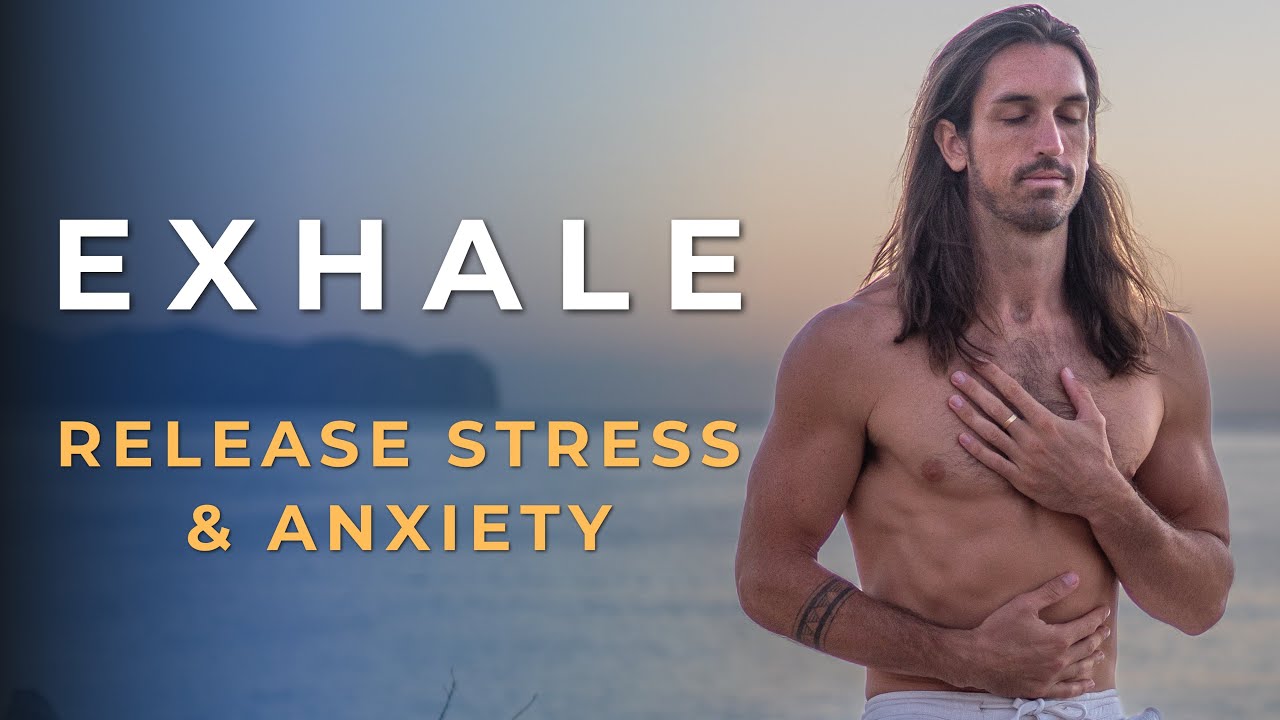
This guided breathwork session by Breathe With Sandy is a structured, three-round practice rooted in the principles of psychedelic breathwork — a modality that combines conscious connected breathing (no pause between inhale and exhale) with extended breath retentions to move awareness out of the thinking mind and into a state of deep inner observation. Each round consists of approximately two and a half minutes of continuous "belly chest out" breathing through the mouth, followed by a full exhale and a 90-second breath retention. The session is designed as an accessible introduction to a longer, more intensive practice that can last up to 90 minutes, and is specifically framed around supporting the body's endogenous production of DMT (dimethyltryptamine) — a naturally occurring compound associated with vivid inner experience.
What Is Psychedelic Breathwork?
Psychedelic breathwork is a practice that draws on conscious connected breathing — a rhythmic, continuous breath pattern with no pause between the inhale and the exhale — combined with deliberate, extended breath holds. Unlike casual breathing exercises, this approach is intentionally designed to alter the body's chemistry and shift the quality of awareness. Sandy describes the full-length version as lasting "up to one and a half hours, with 25 minutes of breathing, a pre and post meditation, activation and integration." The session in this video is a condensed but structurally faithful version of that practice.
The stated goal is to move the practitioner "out of the thinking mind and open up to whatever needs to come up." In a full psychedelic breathwork session, participants may experience ego dissolution, emotional release, spontaneous imagery, or what Sandy describes as "an open heart." This video functions as a gateway: a shorter session that introduces the nervous system to the same mechanics without requiring an hour-plus commitment.
What Is the Connection Between Breathwork and DMT?
DMT (N,N-dimethyltryptamine) is an endogenous psychedelic compound produced naturally in the human body, believed to be synthesized in the lungs and pineal gland among other sites. Researchers and practitioners in the breathwork community, including figures like Stanislav Grof (whose Holotropic Breathwork shares structural similarities), have long noted that certain breathing patterns can induce states that subjectively resemble those reported with exogenous psychedelics. The hypothesis is that hyperventilation-style breathing, followed by breath retention, shifts blood CO₂ and O₂ levels in ways that may support or amplify the body's release of endogenous DMT.
Sandy does not make clinical claims, but frames the session as being "inspired by" and designed to "support the release of DMT" — positioning breathwork as a tool for accessing naturally occurring altered states rather than as a substitute for any substance. The tingling, visual phenomena, and energy sensations that practitioners commonly report during this style of breathwork are consistent with the physiological effects of controlled hypocapnia (lowered CO₂) combined with the focused attention of breath retention.
How Does the "Belly Chest Out" Breathing Technique Work?
The specific breathing style Sandy uses is called "belly chest out." On the inhale, the practitioner first expands the belly, then lifts and opens the chest — a two-stage diaphragmatic and thoracic breath. The exhale is passive: Sandy instructs practitioners to "just let it come out naturally." Crucially, there must be no pause between the inhale and exhale. This continuous loop of breath is what creates the conscious connected quality — the breath becomes a wave rather than a series of discrete events.
Breathing is done in and out through the mouth, though Sandy notes nose-in, mouth-out is also acceptable. The unbroken rhythm, sustained over two-plus minutes per round, is what builds the physiological conditions (altered blood gas ratios, activated nervous system, increased prana or life-force energy according to yogic frameworks) that make the breath holds so impactful.
What Happens During the Breath Retention?
At the end of each round of breathing, Sandy cues practitioners to take a final full inhale, then hold. He instructs: "Squeeze everything — squeeze your pelvic floor, squeeze your abdominals, send the energy up your spine, up your prana tube. Feel the energy. Place your attention between your two eyes." This engagement of the root lock (mula bandha in yogic terminology) and the direction of attention to the third eye point (ajna chakra) is not incidental — it is a deliberate framework for channeling the aroused energy rather than letting it dissipate.
After the held inhale, Sandy cues a full exhale and then a 90-second retention on the empty lungs. This is the phase of deepest stillness. During this window, he invites practitioners to: "Bring your attention back to how you feel, what you see behind your closed eyes. Just observe what is going on within you." It is in this empty-lung retention that many practitioners report the most vivid internal phenomena — visual patterns, emotional waves, or a quality of spacious awareness that is difficult to access through ordinary meditation alone.
How Is the Session Structured Across Three Rounds?
The session follows a clear, repeating architecture:
- Round 1: ~2 minutes 25 seconds of continuous belly-chest-out breathing → full inhale hold with body squeeze and third-eye focus → full exhale → 90-second empty-lung retention with inner observation.
- Round 2: Identical structure. During the retention, Sandy says: "This is the time to just be with yourself as you look within. Observe what you see behind your closed eyes. Feel the inner light that we all have."
- Round 3: The final round. Sandy encourages giving "all you've got" and being "connected with each breath." The closing retention is followed by a return to natural breathing, gentle wiggling of the hands and feet, and an extended integration period.
This three-round format is designed to build progressively. By the third round, the body has already passed through two cycles of activation and release, meaning the third breath hold tends to be the most potent for many practitioners.
Why Does Sandy Ask Practitioners to Set an Intention Before Starting?
Before the first round begins, Sandy pauses and asks: "Why did you show up today? What is your intention? What do you want to get out of this breath?" He explicitly invites practitioners to pause the video and take time with this question. This is not a ritual formality — intention-setting in breathwork serves a functional purpose. It orients the unconscious toward a specific question or need, making it more likely that what arises during altered states of breath (imagery, emotions, insights) will be relevant and usable.
In longer psychedelic breathwork sessions, this pre-meditation phase is a formal part of the structure (what Sandy calls "activation"). Here, even the brief prompt serves to shift the practitioner from passive viewer to active participant with a stake in what unfolds.
What Should You Expect to Feel During This Practice?
Sandy explicitly prepares practitioners for physical sensations: "You might experience some different sensations, maybe some tingling here and there, but just know that you're okay." Tingling — particularly in the hands, face, and around the lips — is a well-documented physiological response to the CO₂ shifts caused by extended rhythmic breathing. Some practitioners also report warmth, light-headedness, emotional surges, spontaneous imagery, or a feeling of expansion in the chest.
Sandy consistently reassures: "If you ever want to stop, just return to your normal breath." This is important safety framing. The practice is intense by design, but the off-ramp is always available. The session is meant to be done lying down or seated in an upright posture, in a safe and comfortable space where the practitioner can remain still after the rounds conclude.
What Is the Role of Integration After the Session?
Sandy ends the session not with an immediate return to activity, but with a dedicated integration window. He says: "I encourage you to remain where you are and enjoy what you're feeling. Reflect on your journey, because this is the time where insights might come, emotion might get released. So just remain where you are and allow whatever it is to happen."
Integration — the process of metabolizing and making meaning of what arose during the session — is considered as important as the breathwork itself in psychedelic-adjacent modalities. In a full psychedelic breathwork session, this is a structured post-meditation. Here, it is informal but explicitly valued: Sandy invites practitioners to sit with the aftermath rather than rush past it.
Where to Go from Here
This 19-minute session is explicitly described as a condensed introduction. Sandy's full psychedelic breathwork sessions on Patreon extend to 90 minutes and include a formal pre-meditation activation, 25 minutes of connected breathing, and a post-session integration meditation. For practitioners who find that this three-round structure opens something meaningful, the longer format offers a more complete immersion in the same principles.
Those interested in the broader tradition can also explore Holotropic Breathwork (developed by Stanislav and Christina Grof), Wim Hof Method breathing, and pranayama practices such as Kapalabhati and Bhastrika, all of which share structural elements with what Sandy teaches here. For any practitioner with cardiovascular conditions, epilepsy, pregnancy, or a history of psychosis, consultation with a qualified practitioner before attempting extended breathwork is strongly advised.