Transcript
[0:01] [music]
[0:07] [music]
[0:20] and perfect our love.
[0:25] Early [singing]
[0:27] with
[0:29] 100,000
[0:31] million [singing] kas
[0:35] to see and listen to
[0:39] and accept.
[0:41] I
[0:43] taste the truth of the
[0:47] words.
[1:14] Good morning.
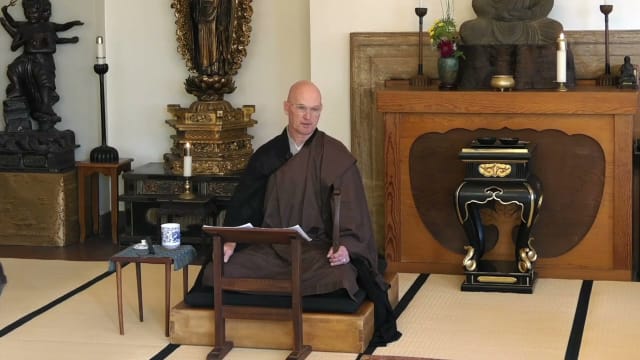
[1:16] Welcome to Beginner's Mind Temple.
[1:20] To introduce myself, my name is Shaosan
[1:23] Victoria Austin. I'm a priest here at
[1:26] San Francisco Zen Center and um
[1:30] completely indebted
[1:32] to um the people upon whose shoulders I
[1:35] stand and whose hands I hold.
[1:39] Uh so uh I'd like to thank some of the
[1:42] people who are now gone. Of course,
[1:43] Suzuki Roshi and uh my teacher Sojun Mel
[1:48] Whitesman.
[1:50] And then also I'd like to thank
[1:54] um the Abbott and the Tanto. So Abbott
[1:58] David and Tanto Tim, thank you for
[2:00] inviting me to speak on this Halloween
[2:05] day.
[2:07] So, I'd like to start with um an
[2:11] important song that I learned in
[2:14] childhood. And I think everybody might
[2:17] know a different version of the song,
[2:19] but parents and grandparents
[2:23] and people who are um young, please feel
[2:27] free to join me. This is a New York
[2:29] variation.
[2:33] Ready?
[2:36] Never laugh when a hearse goes by
[2:39] because you may be the next to die. They
[2:43] wrap you up in a bloody sheet and bury
[2:47] you [singing] under six feet deep. All
[2:50] goes well for a couple of weeks, but
[2:53] then your coffin begins to leak. The
[2:56] worms crawl out. The worms crawl I'm
[2:58] sorry. The worms crawl in. The worms
[3:01] crawl out. The worms play peanuckle on
[3:05] your snout.
[3:07] [laughter] Your stomach turns a slimy
[3:10] green and pus comes out like shaving
[3:13] cream. You lap it up with a piece of
[3:16] bread and that's what you eat when you
[3:20] are dead.
[3:22] [laughter]
[3:26] >> [laughter]
[3:29] >> So, um I think this is important because
[3:32] you know, sorry, I really do because um
[3:38] you know, children rehearse these
[3:40] things, these issues that everyone's
[3:43] scared of in a very straightforward
[3:45] fashion
[3:46] and uh one that invites us to join. So,
[3:50] how many of you know Neil Gim's book and
[3:53] the movie Coraline?
[3:55] >> You know it. Isn't it one of the
[3:57] scariest for people who know it? One of
[3:59] the scariest movies and books ever.
[4:03] So, um, in Coraline, uh, there's a an
[4:07] intrepid girl named Coraline.
[4:12] I'm going to tell you because you might
[4:13] not have heard this. This is an
[4:15] important u fear-based story.
[4:19] So, um
[4:23] she's very very um
[4:26] she's very uh
[4:30] uh brave kid and she loves exploring.
[4:35] She loves finding out new things, the
[4:38] house and the grounds. And one day it
[4:40] rains and she feels stuck.
[4:44] And
[4:46] while wandering around the house, she
[4:48] opens a little mysterious door that
[4:50] she's never seen before. And she is
[4:54] transported into a realm that's the
[4:56] exact mirror opposite of her own house
[4:59] and her own mom.
[5:02] And the parents in the house and the
[5:04] animals in the house all have button
[5:06] eyes. It's really scary, actually. So
[5:09] they they all act like automatons
[5:13] and you can tell that they don't really
[5:15] love her.
[5:17] Okay. So that's a
[5:19] um I I won't tell you the end because I
[5:21] don't want to I don't want to spoil it
[5:23] for you. [laughter]
[5:25] But um again this is uh the just like
[5:28] the song is explores our fear of death
[5:33] and decomposition.
[5:35] Uh this book and this movie explore
[5:40] uh the idea of unusual states of mind
[5:43] and unusual states of relationship that
[5:46] are scary for children and for
[5:49] grown-ups. And today Halloween is the
[5:52] perfect day to uh study these scary
[5:56] things.
[5:57] And um I don't know if you know but
[6:00] Halloween used to be a serious holiday.
[6:03] A really serious holiday. It was a
[6:04] religious holiday,
[6:06] All Hallows Eve,
[6:10] in which um a multitude of hungry ghosts
[6:15] and spirits would come out and we would
[6:19] face our darkest fears before
[6:23] um inviting in the saints
[6:26] um to help. And of course, this was not
[6:28] my home tradition, but there are people
[6:31] here for whom it was their home
[6:33] tradition. And so please correct me if
[6:35] I'm wrong. Okay.
[6:38] And I want to say that last night we had
[6:40] an absolutely
[6:42] spot-on terrific seiki ceremony that
[6:45] [clears throat] does much the same
[6:47] thing. So in uh seiki means uh it it's
[6:51] it's a ceremony in which let's see it
[6:54] was started but when um I believe it was
[6:57] Modgalana
[6:59] um had a dream. Come on in, Valerie.
[7:03] Valerie. Um, there's chairs on the other
[7:06] side in the courtyard and you could
[7:07] bring one in. Yeah. Okay.
[7:10] [clears throat] So, um,
[7:13] so
[7:14] um saw had a vision of um his mom who
[7:20] had died being trapped in the flames of
[7:23] hell
[7:25] and realized that her spirit couldn't um
[7:29] dissolve. her karma couldn't be over uh
[7:32] because she uh even after death her
[7:36] yearnings, her desires, her difficulties
[7:38] were so strong that they had taken on a
[7:41] life of their own beyond her life. And
[7:44] so that's the story behind this
[7:46] ceremony. And in the ceremony, you can
[7:48] see we're still set up for it. The altar
[7:51] is back there by the five Buddha family
[7:54] um banner. And uh in the ceremony uh uh
[8:00] Abbott David came and uh called the
[8:03] hungry spirit with mudras and mantras to
[8:06] come and be satisfied. And actually
[8:09] there's a food offering with a leaf
[8:11] where you kind of mush it up. And it's
[8:14] usually stuff like host like dingdongs
[8:16] and ho and M&M's uh for the hungry
[8:20] ghosts. So the a Buddha is covered
[8:22] because uh the uh hungry ghosts would be
[8:26] scared by the conventional forms of um
[8:30] respect.
[8:32] And then after that um we call on the
[8:35] Buddhas and ancestors as um supportive
[8:40] spirits and supportive spirits um you
[8:44] know fear uh the basic raw emotion of
[8:48] fear cries out for support. So we call
[8:51] on the different names of Buddha and the
[8:54] awakening beings to for support in the
[8:56] ceremony to help turn this backwards
[9:00] realm, this topsyturvy realm that we've
[9:02] set up into a sacred space where all
[9:06] beings uh desires unfulfilled
[9:10] and um
[9:12] undernourished can be held and
[9:16] satisfied.
[9:18] And then um we call on the families of
[9:22] Buddha. And these um banners that are
[9:26] all around um
[9:30] are uh some of the major um Buddhas that
[9:34] can support people in fear. So they're
[9:37] Buddhas of courage. They're Buddhas of
[9:39] acceptance and so on. And then
[9:44] and then the hungry ghosts are fed on a
[9:47] physical level
[9:49] and they have the support of the Buddhas
[9:51] and ancestors throughout time and the
[9:55] everlasting aspect of the various
[9:57] Buddhas who can help them right now and
[10:00] the next thing that we do is ordain
[10:03] them.
[10:05] So, I don't know if you know that in um
[10:08] Dogen, Dogen is the founder of our
[10:10] school in Japan, he went over to China
[10:13] to learn about Zen and he brought it
[10:15] back to Japan and it grew in Japan in
[10:18] various ways and finally came to us in
[10:21] the United States.
[10:23] But, um
[10:26] yeah. Um
[10:28] okay, I'm sorry. Sorry, I don't want to
[10:30] I don't want to really go go to Dogen
[10:32] right now. So, I'll I'll backtrack a
[10:35] little bit,
[10:37] but uh Oh, yeah. No, maybe I will. So,
[10:40] um because Tim's in the room, so I want
[10:43] to talk about this robe. U Tim is in
[10:46] charge of our sewing. And you see people
[10:49] around wearing the big robe, which is
[10:51] called the Oacasa, and the small robe,
[10:53] which is called the Rakusu, which just
[10:55] means small robe. And this robe
[11:00] um we uh chant about it every morning.
[11:04] Um great robe of liberation
[11:07] field far beyond form and emptiness
[11:11] wearing the tatagata. The one who comes
[11:14] thus is teaching
[11:16] saving or freeing all beings. So we wear
[11:20] the teaching.
[11:22] We wear the teaching. We wrap ourselves
[11:24] in the teaching. uh and it transforms
[11:27] our experience from a field of suffering
[11:29] to a field of blessing. So this is a
[11:32] support that's present in this room and
[11:35] can be present around our bodies and
[11:37] minds. And there are people who received
[11:39] the precepts just last week who received
[11:42] these vows and received the robe and
[11:45] receive this kind of support in their
[11:47] life. It's very helpful to have the
[11:49] support of people who have been on the
[11:52] path. uh people who exemplify the path,
[11:56] um friends who can hold your hand while
[11:59] you try to be on the path, witnesses who
[12:03] can help. It's really, really helpful.
[12:06] But what Dogen said was even if someone
[12:10] puts on the robe as a joke,
[12:14] it predicts their future awakening.
[12:18] So even if the hungry ghosts are only
[12:22] ordained kind of involuntarily,
[12:25] it protects them throughout the future.
[12:28] Modgalana could protect his mom by doing
[12:31] this ceremony on her behalf. And we can
[12:35] protect our states of fear. Come on in.
[12:40] Have a seat anywhere.
[12:43] Um do do you want a cushion or a chair?
[12:47] you're good because there's plenty of
[12:49] extra cushions around. So, um
[12:54] there it it's it's um
[12:59] as I said, fear requires support just
[13:03] like anger requires boundaries.
[13:06] Anger requires um boundaries and
[13:09] respect. And you know, you have to feed
[13:13] that angry spirit with
[13:16] uh a sense of being safely and
[13:20] uh almost luxuriously held.
[13:23] Fear requires support,
[13:26] a support that um that feels safe.
[13:30] And so all of those Buddhas and
[13:32] ancestors names and food and people
[13:35] chanting and weird sounds and costumes
[13:38] and stuff that we do in the ceremony
[13:41] that we had last night give the hungry
[13:43] spirits the idea that they can be fed
[13:46] and that they can turn towards the path.
[13:48] Maybe not now but in the future.
[13:52] So this weekend, um Dave and I are going
[13:55] to be teaching about um love and power
[13:59] responding to fear. So that's why I'm
[14:02] talking about fear and more about that
[14:04] later.
[14:06] Um I want to talk about uh some of the
[14:10] traditional ways that we meet fear in
[14:13] our practice and some of the kind of
[14:17] power ups that I think we need in the
[14:20] 21st century and particularly going into
[14:22] elections week.
[14:25] So um [clears throat] elections week
[14:27] many people are afraid on every side of
[14:30] the political spectrum of what might
[14:32] happen if the other side wins. And uh
[14:38] the other side you can read in the media
[14:41] has often been portrayed as demons or u
[14:46] threatening figures that will ruin
[14:48] everything.
[14:49] Doesn't matter who you are or what you
[14:51] believe. the other side has been uh
[14:55] amped up to be bad and scary.
[14:59] And so there's a lot of fear going
[15:01] around it. What happens if this? What
[15:04] happens if that?
[15:07] And uh so and it's not just the
[15:09] election. There's wars,
[15:12] there's methane,
[15:14] there's um there's uh increasing
[15:17] temperatures and there's data centers
[15:21] and and all sorts of things that people
[15:24] are concerned about today. So, um what
[15:27] kind of supports do we need today?
[15:31] And I want to point out that um you know
[15:34] uh fear was often handled in the early
[15:37] teaching by kind of rehearsing it the
[15:39] way that kids rehearse it in the hearse
[15:43] in the hearse song or in the in Coraline
[15:46] in movies like Coraline where you go
[15:48] into a cemetery and one of the big fears
[15:51] is death and you sit there and look at
[15:53] someone who's just died, someone who's
[15:56] in the process of being buried u someone
[15:59] who has uh been buried for a while or
[16:02] has been dead for a while. You look at
[16:04] that and you sit there with acceptance
[16:07] and it's the vows and the practices that
[16:10] support you to do that and that is a
[16:13] wonderful practice
[16:16] and I want to say that I think we need
[16:19] stronger medicine right now to feel safe
[16:22] that it can't just be monastics living
[16:25] in kind of super supported environments
[16:28] like Tasahara
[16:30] where thousands hundreds of thousands
[16:33] thousands and maybe even millions of
[16:35] people are supporting the practice to go
[16:38] on for these three months in a monastery
[16:40] like Tasahara. There's donors through
[16:43] the ages. There's everyone who's
[16:44] received Zazen instruction or practiced
[16:47] or everything. It's so supported.
[16:50] But people often in this day and age
[16:53] feel alone even though the internet AI
[16:57] connect us more than ever. It's it
[17:00] doesn't it's not it doesn't guarantee
[17:02] that there'll be a connection that
[17:04] satisfies us in the heart as you were
[17:07] saying this morning in the leaving
[17:09] ceremony. What do we um what do we hold
[17:13] in our heart and how do we nourish that
[17:15] part of ourselves to make that dimension
[17:18] of our life make sense where we need it
[17:20] the most.
[17:22] So, I want to point out a totally
[17:25] different um
[17:27] totally different part of Dogen's
[17:29] teachings that um
[17:34] helps
[17:36] in times like this.
[17:39] Um
[17:42] where um
[17:44] and that it's more on the order of uh
[17:48] what we say in the heart sutra.
[17:50] Um that uh when we understand that form
[17:54] is emptiness, emptiness is form, that
[17:57] which is form is emptiness, that which
[17:59] is emptiness, form. When we understand
[18:01] that everything is a flashing
[18:04] uh in the midst of a great light and
[18:07] that it has a beginning, a middle and an
[18:09] end and has a change as possible and
[18:13] none of it is identified with a fixed
[18:15] self and um all of it is limited. When
[18:20] we understand that no hindrances can
[18:23] bother us and without the hindrances, no
[18:26] fears can exist.
[18:29] If we're not obstructed, if our
[18:31] experience or perception is inclusive,
[18:34] fear can't arise in the same way because
[18:37] we're supported by everything.
[18:40] And so I want to point out a completely
[18:42] different set of teachings besides
[18:45] um gravestone graveyard meditations and
[18:49] the like that can support our feeling of
[18:52] safety in the midst of fear. So one of
[18:56] those is called uh saha suta the bonds
[18:58] of fellowship.
[19:00] So um to establish fellowship in the
[19:02] body you might want to stop listening to
[19:04] me for a second and just adjust yourself
[19:07] on your buttock bones. uh reestablish
[19:10] the comfort of your legs and of your
[19:12] back uh so that you can hear me and I
[19:16] can speak to you without um you feeling
[19:21] uh without you being uh without doubt
[19:24] coming up due to physical pain. So we
[19:27] keep ourselves refreshed to be able to
[19:30] concentrate and hearing is actually a
[19:33] creative process that's different from
[19:35] listening. So that's why we do that when
[19:38] we involve the whole body and mind in
[19:40] reflective hearing
[19:43] then also fear can't dominate us in the
[19:47] same way and that's where this uh sutras
[19:50] like the sangaha suta come in. So I'll
[19:53] just read it to you. It's it's actually
[19:56] a basis of some teaching that uh is uh
[20:00] was rewritten many many years later by
[20:04] by Dogen Zenji. So this is the sutra.
[20:09] There are four grounds for the bonds of
[20:11] fellowship. Which four?
[20:15] Generosity, kind words,
[20:18] beneficial help, consistency.
[20:22] These are the foregrounds for the bonds
[20:24] of fellowship. Fellowship meaning
[20:27] togetherness, intimacy that allows us to
[20:30] feel safely held.
[20:35] So the poem is generosity,
[20:39] kind words,
[20:42] beneficial help,
[20:45] consistency in the face of events,
[20:50] aligned with what's appropriate in each
[20:52] case. In each case,
[20:56] these bonds of fellowship
[20:59] are in the world like the lynch pin in a
[21:01] moving cart.
[21:04] If these bonds of fellowship were
[21:06] lacking, a mother would not receive the
[21:08] honor and respect owed by her child.
[21:12] Nor would a father receive what the
[21:14] child owes him.
[21:16] But because the wise show regard for
[21:19] these bonds of fellowship, they achieve
[21:21] greatness and are praised.
[21:24] So simple, giving,
[21:28] kind
[21:30] words and actions
[21:32] and a mind that continues in the face of
[21:36] ups and downs.
[21:38] And um we've been studying patience and
[21:41] if we want to understand how to manifest
[21:44] patience in ways that aren't about the
[21:47] feeling of forbearance but about the
[21:50] activity of forbearance. This is where
[21:52] we'll go.
[21:54] We'll learn how to speak about our
[21:57] issues or problems in friendly or
[21:59] neutral ways.
[22:02] >> [clears throat]
[22:02] >> Um, we'll learn how to act kindly to
[22:06] ourselves and others when faced with
[22:08] them.
[22:10] And we'll learn how to act in accord
[22:14] with other human beings and with beings
[22:17] in every realm.
[22:20] And that gives us the uh physical,
[22:26] perceptual,
[22:28] intellectual and emotional support
[22:32] to have the physical
[22:35] uh organic or energetic,
[22:39] intellectual and spiritual oomph to
[22:44] persist
[22:45] and forgive in the face of fear and
[22:48] pain.
[22:51] So um the five fears we've already
[22:54] covered some of them through examples.
[22:57] The five fears that the Buddha taught
[22:59] are death
[23:02] harung
[23:05] illness
[23:07] similar
[23:09] unusual states of mind. Coraline
[23:14] loss of livelihood or reputation. And I
[23:17] think we can all relate to that.
[23:20] Modern times are teaching that. And um
[23:25] fear of embarrassing oneself in public.
[23:30] [laughter]
[23:33] See, am I speaking the dharma or am I
[23:36] talking trash? You know, is this helpful
[23:39] or is it not helpful?
[23:41] What do people think of me?
[23:44] you know, uh those could run somebody
[23:47] who's in front of the room. Um
[23:50] fortunately,
[23:52] um that's not the practice to allow
[23:55] oneself to be run by that. And it
[23:57] doesn't get cured by
[24:00] uh dominating that feeling or turning it
[24:03] into some something else. It gets cured
[24:06] by having a more inclusive spirit that
[24:11] kind of obiates that fear. it just is
[24:14] not that relevant to what's actually
[24:16] going on here, which is that we're
[24:18] bringing up the dharma. We're bringing
[24:20] up a a path that can actually help us
[24:23] with our suffering anywhere it arises,
[24:27] whether it arises from our basic
[24:29] attractions and aversions or whether
[24:32] it's further down the line of thinking
[24:34] or acting. Um,
[24:37] we're we're all helping each other just
[24:39] by being here on a Saturday morning. and
[24:43] bringing up the dharma,
[24:45] bringing up the topic.
[24:48] So, there's so much more I could say
[24:50] about this
[24:52] um
[24:54] you know, there's there's a lot um in
[24:58] this
[25:00] um in these um sutras and but I want to
[25:06] I want to read a few things and just
[25:09] comment on them if I could. So, I just
[25:11] read you the the five fears and the um
[25:17] the idea that intimacy can help with
[25:19] those.
[25:21] And I want to fast forward
[25:24] um you know almost a thousand years to
[25:27] Dogen Zenji to just read how he put it
[25:32] that uh same material from the Sahus
[25:34] Suta. And so you can see what happened
[25:38] um as Buddhism made its way through uh
[25:42] India, China to Japan.
[25:45] So this is uh this is written in the
[25:48] 1200s
[25:49] and it's called the boa shisho the
[25:53] bodhicattvas or awakening beings four
[25:55] methods of guidance.
[25:58] I'll just um
[26:01] read like one sentence from each
[26:03] paragraph of this.
[26:07] So Dogen begins and this this um
[26:10] translation is by uh Kazdanahashi
[26:13] uh and Lou Richmond. Uh Lou Richmond was
[26:16] a student of Suzuki Roshi's and um he
[26:20] received Dharma transmission from Ed
[26:22] Satisan who was Abbott here um until a
[26:26] few years ago and um Lou is an amazing
[26:31] musician
[26:32] and u a kind person who writes about
[26:36] work practice about aging as spiritual
[26:40] practices. So I highly recommend his
[26:42] writings if you want to read something
[26:45] in the modern age that's really good and
[26:48] helpful.
[26:50] So um the bodhic sattva's four methods
[26:53] of guidance are giving, kind speech,
[26:58] beneficial action and identity action.
[27:03] Sounds pretty similar, doesn't it?
[27:06] Giving, kind speech, beneficial action,
[27:09] identity action. Giving means non-
[27:12] greed. Non-greed means not coveting, not
[27:16] currying favor.
[27:18] Even if you govern four continents,
[27:21] always convey the correct teaching with
[27:23] non-greed.
[27:27] Um, so that's giving
[27:30] kind speech.
[27:33] Oh well the end of that section is mind
[27:37] is beyond measure.
[27:39] Gifts are beyond measure.
[27:43] Moreover in giving mind transforms gift.
[27:47] Gift transforms mind.
[27:51] Okay. So um giving means that you
[27:54] establish friendliness with someone
[27:57] which means you can tolerate more from
[27:59] them. And so giving and patience are
[28:02] strongly related.
[28:05] Kind speech means that when you see
[28:07] sensient beings, you arouse a mind of
[28:10] compassion and offer words of loving
[28:12] care.
[28:14] It is contrary to cruel or violent
[28:16] speech.
[28:19] In the secular world, there is the
[28:20] custom of asking after someone's health.
[28:24] In Buddhism, there is the phrase,
[28:25] "Please treasure yourself."
[28:28] And the respectful address to seniors,
[28:30] might I ask how you are.
[28:34] Okay. And then he says, "It is kind
[28:37] speech to speak to sentient beings as
[28:39] you would to a baby." And I think what
[28:41] he means by as speaking to a baby is you
[28:44] know how when they put that newborn into
[28:46] your hands, this thing happens.
[28:56] Right.
[28:58] And and and something comes up. It's
[29:00] like, I'll do anything, baby.
[29:03] I'll do. What do you need? I'll do. And
[29:06] then pretty soon that goes by the
[29:08] wayside because the baby goes
[29:11] and you kind of go, "Ah, no. What? What
[29:13] do they need? Oh no. Oh no. I'm killing
[29:15] them." you know,
[29:16] [clears throat and laughter]
[29:18] at least maybe that doesn't happen for
[29:21] you, but but I'm not a mother. So, you
[29:25] know, especially when I'm holding
[29:27] somebody else's baby, there's always
[29:29] that fear that I'm ruining the baby,
[29:31] right? And then quickly that gives way
[29:34] to being a little more accurate about
[29:36] what I perceive. But for that flash of a
[29:39] second, there's that doubt and fear,
[29:41] right? Oh, no. Here's this absolutely
[29:43] pure being and the way I'm holding them
[29:46] and then immediately my hands gentle
[29:49] and my hand can hear the baby's being
[29:55] right as soon as uh as soon as I drop
[29:57] the fear right so I think that's what
[30:00] Dogen means
[30:04] so um the it he also says
[30:08] um be willing to practice it for this
[30:12] entire entire life. Do not give up.
[30:15] World after world, life after life.
[30:20] And then he says um he ends this
[30:24] paragraph by saying kind speech arises
[30:27] from kind mind. Kind mind from the seed
[30:30] of compassion. Ponder the fact that kind
[30:33] speech is not just praising others
[30:35] merit.
[30:37] It has the power to turn the destiny of
[30:40] the nation.
[30:44] Okay. It has the power to turn the
[30:47] destiny of the nation.
[30:51] And then third beneficial action
[30:53] skillfully to benefit all classes of
[30:56] sensient beings.
[30:58] that is
[31:00] to care about their distant and close
[31:04] future and to help them with skillful
[31:08] means.
[31:11] So it means
[31:14] benefit self and others alike. Benefit
[31:17] friend and enemy equally. If you have
[31:20] this mind, even beneficial action for
[31:22] the sake of grasses, trees, wind and
[31:25] water is spontaneous and unremitting.
[31:29] Dogen says elsewhere, like a hammer
[31:31] striking emptiness.
[31:33] This being so, make a wholehearted
[31:36] effort to help.
[31:39] And then the fourth one, identity
[31:41] action, is a little weirder to try to
[31:43] understand a little more um like what
[31:47] identity action? What's that? So, um I
[31:50] just want to point out something from
[31:52] recent history. Um Chuck, who's sitting
[31:55] in the back row there, could you raise
[31:57] your hand, Chuck? Chuck was in the
[31:59] diggers. And the diggers was a group of
[32:03] people that against uh local law
[32:06] distributed free food and resources to
[32:09] people just because they were human.
[32:14] That's identity action.
[32:17] That's an example of identity action
[32:19] from our history.
[32:21] Also, um, uh, Ellen making safe, making
[32:27] basics kits for kids in schools
[32:32] is an example of identity action.
[32:38] Okay. Um,
[32:41] uh,
[32:42] there are so many people I could mention
[32:44] who are doing identity action, but I
[32:46] don't want to, um, I [clears throat]
[32:48] don't want to, uh, like out anybody,
[32:52] um, who isn't already in the public eye,
[32:55] so I won't, but know that you can look
[32:59] at the person next to you and they have
[33:02] done something that is an example of
[33:04] identity action. What is it?
[33:08] What can you see in them? Uh that goes
[33:13] with your deepest wish.
[33:17] So it means non-ifference.
[33:19] It's non-ifference from self,
[33:21] non-ifference from others.
[33:26] It means right at the action part of it
[33:29] means the form, the deport, the dignity,
[33:32] the manner.
[33:33] We cause ourselves to be in identity
[33:36] with others and them to be an identity
[33:39] with us. The relationship of self and
[33:42] others varies limitlessly with
[33:44] circumstances.
[33:46] So um that's why we have to look um
[33:50] diligently and really look for this
[33:55] you know dance dancing with someone
[33:58] that's an example of identity action.
[34:02] So then it says
[34:04] each of these four methods of guidance
[34:06] includes all four.
[34:08] So they're all holographic.
[34:12] So that's how this um
[34:17] these um practices that the Buddha
[34:20] taught played out a thousand years later
[34:23] and how they can play out now. and we
[34:26] have to we're the agents of um how it
[34:30] plays out now. So the um pre-ordained
[34:33] people I think are responsible to be
[34:36] visible in the uniform
[34:40] uh with the department that's been
[34:42] taught so it can manifest in this
[34:44] generation
[34:45] so it can continue to another generation
[34:49] and lay people I think have the
[34:52] responsibility uh for
[34:55] um your life your talents your
[34:58] relationships your jobs, your
[35:01] connections, but also to make sure that
[35:04] priest practice doesn't go orai and
[35:07] become narrow and dower.
[35:10] Okay. So, um priests can help make make
[35:15] it so that it in practice it's not like
[35:18] oh anything goes uh just because I'm
[35:21] doing anything it is practice. No, it's
[35:23] a gateway to practice. lay people can um
[35:27] help uh priests understand that you know
[35:31] looking this way is not the only way to
[35:34] practice and that uh we're all necessary
[35:37] for the path all of us together and all
[35:40] of us differently
[35:42] um with a united heart and a united
[35:46] mind.
[35:47] Um and uh doing these four um actions,
[35:53] giving kind words, beneficial help and
[35:56] tranquil constant mind in every
[35:59] circumstance
[36:01] are how our kind of gut equipment, our
[36:06] equipment for patience and forbearance
[36:09] arises in the midst of fear. After all,
[36:13] fear is negativity projected into the
[36:17] future.
[36:19] Something that will be beyond our
[36:20] control, beyond our power to um take
[36:25] care of.
[36:29] But these bigger actions that we can do
[36:33] for and with each other make our
[36:37] experience big enough to hold whatever
[36:39] might come and to hold it in friendly
[36:41] ways. So I want to end with a story from
[36:46] um today's paper. This was in the
[36:49] morning section of
[36:51] uh the uh New York Times this morning.
[36:56] And I just want to read this story.
[36:58] Okay, a little bit of the story now that
[37:00] we're on scary kids stuff. It's okay if
[37:03] I do. So, it's called Stage Fright and
[37:06] it's by Melissa Kersh.
[37:11] My landlord's spooky season sidewalk
[37:13] tableau this year features three
[37:15] skeletons carrying an open casket inside
[37:18] of which is yet another skeleton as well
[37:20] as a disembodied hand.
[37:23] One morning last week, I emerged from
[37:26] the building to see two women with
[37:27] infants and strollers parked out front.
[37:31] It's not unusual around Halloween to see
[37:34] families taking pictures of the
[37:36] spectacle, but I found it amusing that
[37:38] these people had stopped to show it to
[37:40] their babies.
[37:42] What would these tiny humans make of a
[37:44] surprisingly lifelike rotten tooth crone
[37:47] beckoning them from the hedge? Would
[37:50] they recognize Halloween's creepy cast
[37:52] of characters as frightening? Perhaps
[37:55] they were too young to even register
[37:57] what they were seeing? Perhaps the world
[38:00] in their eyes was still a sh series of
[38:02] shapes, light and color, dot dot dot.
[38:05] The things that spook us as children
[38:08] leave their mark. We grow into adults
[38:10] who must disentangle real threats from
[38:13] perceived ones and often discover that a
[38:16] present- day fear took root when we were
[38:18] too young to know better. Dot dot dot.
[38:23] In a recent Times article, the writer
[38:26] Allesandre Shada record that as a child
[38:29] she lived next door to the Goosebumps
[38:31] author RL Stein.
[38:34] She read his horror stories for kids.
[38:36] She convinced herself that Stein's house
[38:38] was haunted.
[38:41] 20 years later, Shada met Stein, who
[38:44] told her about his career and how he
[38:46] came to inhabit the home from whose
[38:48] chimney she once was certain she saw
[38:50] ghosts floating.
[38:52] She learned that Stein and his wife, who
[38:55] met when they were editing magazines at
[38:57] Scholastic in the 1960s, had lived there
[39:00] on a quiet culde-sac in Sag Harbor on
[39:04] the eastern end of Long Island for a
[39:06] quarter century. The source of her
[39:08] childhood anxiety turned out to be, as
[39:11] she put it, a friendly octagenarian
[39:14] who goes by Bob.
[39:19] Our childhood fears resist
[39:22] rationalization.
[39:23] We can turn on the light and see that
[39:25] the boogeyman is just a pile of clothes.
[39:28] But we sleep with one eye open
[39:30] nonetheless.
[39:32] As adults, we have the tools to
[39:34] distinguish between real and imagined
[39:36] peril. But we don't always use them. The
[39:40] scary album is replaced by the amorphous
[39:42] worry.
[39:44] Dot dot dot.
[39:46] We picture the worstc case scenario. We
[39:50] still see monsters where there's just
[39:52] dirty laundry.
[39:54] No matter how old we get, we still need
[39:57] to remind ourselves that what is unknown
[39:59] or mysterious to us isn't necessarily
[40:02] dangerous.
[40:05] Halloween is a laboratory for
[40:07] experimenting with this. All around us,
[40:10] bedshet ghosts haunt the neighbors oak
[40:13] tree. Spiders as big as hatchbacks climb
[40:16] up the sides of tenementss.
[40:18] And children, the one most likely to
[40:21] shrink from this pageant of frights,
[40:24] walk through it delightedly,
[40:26] meeting witches and vampires and
[40:29] learning to distinguish costume from
[40:33] reality.
[40:36] Thank you very much. May your candies be
[40:39] all individually wrapped.
[40:44] And may um you be happy and well,
[40:49] joyous,
[40:50] free from suffering, the causes of
[40:52] suffering
[40:54] and free from fear.
[40:56] And thank you very much for your
[40:58] attention.
[41:00] And um those who are coming this
[41:03] afternoon um later you can announce
[41:06] perhaps something about what we're
[41:08] doing. and
[41:11] um people who are in the practice period
[41:13] thank you for inspiring this talk.
[41:16] So
[41:18] let's
[41:22] >> may
[41:27] extend to everything
[41:30] and place
[41:33] with the true merit of Buddha's way
[41:41] beless
[41:45] I vow [singing] to save them.
[41:49] Delusions are inexhaustible.