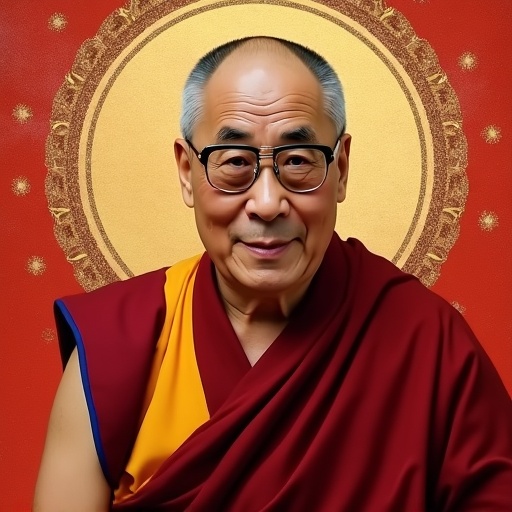
In a teaching recorded on June 25, 2016, and later posted under the title "The True Meaning of Non-Violence," the Dalai Lama makes a claim that cuts against most everyday intuitions about harm: violence is not defined by the object in someone's hand or by how sharp a sentence sounds. It is defined by the mind that moves the hand and shapes the sentence. By his account, a weapon is only an instrument, and an angry or fearful person is the one who reaches for it. Non-violence, in turn, is not the absence of hard words or stern faces. It is the presence of a particular motive, and the first of those motives he names is compassion. The clip runs under two minutes, but it lays out a complete logic: locate violence in the mind, test actions by their motivation, and build peace by cultivating compassion rather than policing behavior alone.
The teaching opens with a flat assertion: "Violence never take place out of compassion." The statement is simple, but it carries a diagnosis. The Dalai Lama places the origin of violence in three states: anger, jealousy, and fear. He does not describe violence as something that happens because of bad tools or bad circumstances. He describes a person "full of anger, fear," who then reaches for the instrument that is available.
This is the first move in what becomes a larger argument. If the weapon is the thing we blame, we aim our efforts at guns, knives, and other objects. If the root is an inner state, we aim at the person. He draws the conclusion directly: "the peaceful world must come through inner peace." The sequence he sketches runs from the inside out. Inner agitation comes first, and outer violence follows when the agitated person finds a means.
Readers familiar with Buddhist teaching will recognize the emphasis. Across the Dalai Lama's public teachings, anger, jealousy, and fear recur as the afflicted states that disturb a person from within. What is distinctive in this short clip is how plainly he uses them as a definition of violence, not just as a description of unhappiness.
The central claim is precise. He says that the "final demarcation" between violence and non-violence "is not external expression, but mental level." That is a demanding standard, because it means outward behavior cannot settle the question on its own. Two people can say the same words, make the same gesture, or take the same action, and one of them may be acting violently while the other is not.
To make the test concrete, he lists the motivations that make an action violent: "anger, hatred, jealousy, and want to cheat other people, and want to exploit other people, take advantage other people." When an action rises from any of these, he says, "any action essentially violence." The list is worth reading slowly. Several items are not loud or physical at all. Wanting to cheat, to exploit, or to take advantage can be carried out with a smile, a contract, or a polite conversation. By placing those motives in the same category as anger, the teaching suggests that quiet, courteous harm is still harm, and that the absence of visible aggression is not evidence of non-violence.
The logic also works in reverse, which is where the teaching becomes most arresting.
The Dalai Lama answers this with an image most listeners will know from their own lives. He describes a "sensible teacher" or a "parent," someone who "sometimes take little bit sort of harsh word, or sometimes uh negative sort of angry face." The teacher is not acting out of hatred. The parent is not trying to exploit the child. The motive, he says, is "out of sense of concern of student or children's well-being," and "actually that's non-violence."
Then comes the sentence that organizes the whole clip:
"Real demarcation of violence and non-violence is not depend on action, but depend on motivation."
— the Dalai Lama, in a teaching recorded June 25, 2016
The point is easy to misread, so it is worth stating carefully. He is not saying that harshness is good, or that a stern tone is always appropriate. He is saying that the moral category of an act depends on what drives it. A reproach offered from genuine care belongs to a different category than a kind-sounding remark offered to manipulate. The outward form of a word can be sharp and still be non-violent. The outward form can be sweet and still be violent. Any reading that treats his point as permission for cruelty misses that he has specified the motive as concern for another's well-being, and that concern is a demanding test.
The clip ends with a practical conclusion that is more an instruction than an observation: "the promotion of non-violence, we have to go the promotion of compassion." If violence is rooted in anger, jealousy, and fear, and non-violence is rooted in concern for others, then the work of building peace is not primarily a matter of banning objects or regulating speech. It is a matter of cultivating the motive itself.
This reframes a familiar debate. Efforts to reduce violence often focus on what people do: what they are allowed to carry, what they are allowed to say, which behaviors get punished. Those efforts matter, but the teaching implies they are incomplete if the motives underneath go unchanged. A person who has learned to avoid visible aggression while still acting from exploitation has not, in this framework, become non-violent. The deeper task is to address the mind that is full of anger or fear, because that mind is where the outer actions start.
It is worth noting how much this places on inner work. Compassion here is not a sentiment that appears on its own. It is something promoted, cultivated, and returned to, in the same way a musician returns to scales. The Dalai Lama's language is about promotion, meaning active effort, rather than a passive hope that good feelings will arrive.
The teaching does not give a checklist, but its structure suggests some questions a reader can bring to an ordinary moment. These are applications of his categories, not claims he made in the clip:
- When I say something firm, is it coming from concern for the other person's well-being, or from a wish to win, punish, or be proven right?
- When I act kindly, am I also hoping to gain something at someone else's expense, to take advantage of their trust, or to steer them without their knowledge?
- Is there anger, jealousy, or fear underneath the action, even if the action looks calm?
- If the other person could see my motive plainly, would I be comfortable with it?
These questions are hard because they require honesty about the inside, not only the outside. That is precisely the difficulty the Dalai Lama's framing creates. It moves the work of non-violence from managing behavior to examining intention, and intention is harder to audit than conduct.
A two-minute clip cannot cover everything, and it is honest to say what it does not address. It does not explain how a person can reliably tell their own motives from the stories they tell themselves, a problem that any sincere practitioner will eventually face. It does not give guidance for cases where the motive of another person is unclear, or where a harsh word from a teacher or parent is genuinely harmful despite good intentions. The teaching states a principle; applying it in messy situations requires further reflection and, for many people, further study.
What the clip does offer is unusually clear. It removes the comfort of judging by appearances in either direction. It says that violence can hide behind courtesy and that compassion can sound like criticism. And it places the responsibility for peace in the mind of each person, starting with the three states he names: anger, jealousy, and fear.
If this teaching has you thinking about your own motives, the most useful next step is slow reflection rather than more reading. Take one interaction from the past week and run it through the categories the Dalai Lama uses: was the motive concern for another's well-being, or was it one of the states he lists? Notice where the answer surprises you. For a fuller hearing of his voice and context, the complete recording is available on the Dalai Lama's YouTube channel, where this clip appears under the title "The True Meaning of Non-Violence." Two minutes is enough to plant the question; the practice of answering it honestly is the work that follows.


