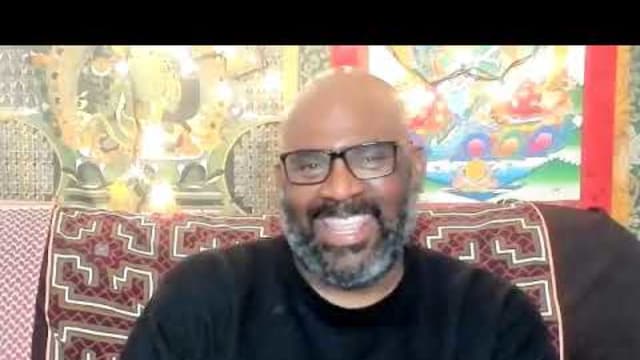
A questioner asks a Theravada monk to explain a line he has used before: that the view of sensuality is one in which a person regards their own body as a basis for pleasure. The monk pauses, and the room laughs at his answer. "How much time do you have?" The exchange, published as a short Hillside Hermitage teaching under the title "Why Physical Desire Is Not Merely Physical," runs barely eight and a half minutes. Yet it contains one of the more precise accounts of sensual craving you are likely to hear: the body is not where desire begins. The citta, the mind in its intentional, reaching aspect, has already taken the body up as an instrument of pleasure, and the physical sensations that follow are its doing. Once you see that, the entire strategy of restraint shifts from managing the flesh to working with the mind that is holding it.
Most people experience a food craving, a flash of sexual want, or a surge of ill will as a physical event. The stomach responds, the mouth waters, the chest tightens, and the sense of self arrives a moment later as the one being affected. The monk starts from that ordinary experience and asks the listener to notice what came first. His example is simple. You are not hungry. You have not been thinking about eating. Then your eyes land on something good to eat.
"You see, say, some nice food. So, you were not hungry before. You didn't think of eating before. You didn't think of the taste before. And then your eyes caught something available. And suddenly you have a physical desire to have it."
— Ajahn Nyanamoli, Hillside Hermitage teaching, 1:26
The sequence is the teaching. The sight is the trigger, but the wanting, and the body's readiness to want, arrive together. The monk extends the same pattern to other domains. Sexual desire works this way, and so does ill will: a person feels a physical urge to express anger, whether in words or in "repetitive thinking or something." In each case, he says, the physical part "has arisen on account of this," and that physical part is exactly what the citta is doing.
The word citta is not the same as the English "heart" or simply "mind." In the monk's usage it names the active, directed mind that reaches toward objects and holds on to them. The claim that a body can be "taken up" by the citta is central here. The body does not spontaneously decide to pursue pleasure; the citta grasps it as a basis for enjoyment, and the grasping shows up as salivation, arousal, tension, and the pull toward a particular sensation.
The monk makes the point with unusual directness. The salivation is not the result of a thought such as "let me begin salivating." It simply happens, and he explains why: "Because the whole thing belongs to the animal. Because the whole thing is the animal." The animal here is his image for the untamed, reactive side of the mind, the part that leaps toward what it wants. The body's response to taste or touch is not separate from that leap. It is the leap, in physical form.
This is the reframing at the heart of the talk. Ordinary self-understanding places the physical reaction inside the body and treats the mind as a spectator, or at most as a separate party that occasionally inflames the body. The monk reverses that picture. He wants the listener to regard the physical arousal "as the actual living citta doing it," and to recognize that "any form of arousal towards sense objects" is the citta present in the body right then.
The answer he gives is about attention and restraint. The citta is hard to see while it is busy. A mind that is constantly pursuing sights, sounds, tastes, and touches has no gap in which to notice what it is doing. "Mind needs to have been dried out of actually engaging with sense objects," he says, and then adds a qualification that is worth taking seriously: "depends the one a person for how long." There is no fixed timetable. The drier the citta becomes of being allowed to return to sensuality, the more clearly the physical reaction shows itself as the citta's own activity.
Without that clarity, the reaction is felt as a personal event. The monk describes the usual sequence: "people don't see the citta enough, so the physical part is felt like… this is me being affected by this." From there the next step is predictable. You feel the pull, you conclude that something has been done to you, and you start building barriers. "Now I have to put the gates on it and block it and stuff," he says. He does not dismiss that impulse. He says it is "inevitably how you're going to start." But it is a beginning, not the destination.
He also distinguishes conceptual understanding from direct seeing. A person may already hold the idea that the citta is involved, in the way a sotapanna, a stream-enterer in the Pali tradition, is described as having the view. But the idea is not enough. The monk says such a person "still might feel like this body is kind of, you know, in between," as though the citta were over there and the body were the thing that gets satisfied. The difference between that idea and seeing is what separates the stream-enterer from the non-returner (anāgāmī) in his account. The aim is not to hold a correct theory of desire but to see every small instance of the body being taken up, "tactilely through the mouth, mentally, eyes, and so on," as the active citta at work.
This is the most practically useful section of the talk, and it runs against a common habit. When desire becomes physically intense, the instinct is to relax the body: breathe, stretch, do some yoga, lower the heart rate. The monk acknowledges that the body will indeed calm down, but he locates the real problem elsewhere. "You can't just calm down the body cuz you haven't picked it up. Chitta picked it up." When the questioner restates the point ("you're trying to calm down this thing that the chitta is using"), the monk agrees and says it is "where you should be calming down the chitta. Rather than the body to relax."
The principle is subtle but important. If the body is the instrument, then working on the instrument while the player keeps reaching for it is a losing exercise. The physical tension will return as soon as the citta reaches again. Calming the body may bring temporary relief, but it leaves the reaching intact.
Nor does he ask the practitioner to suppress the physicality by force. "It's not like I must get rid of that physicality," he says. The point is to see it accurately, as the citta's doing, "live so to speak there and then." The seeing itself changes the situation. It is, in his phrase, "already a way of containing it all on a whole new level."
If the citta holds the body as a basis for pleasure, then the way out is not to remove the desire but to change what the citta is working with. The monk's answer is to "provide the perceptions of dangers and so on within that same context." He explains the logic plainly: "Because if chitta let's go of it, it cannot be held. It cannot persist longer. It cannot remain there waiting until it disappears."
"So chitta wants this, okay. We don't change that. We recognize it to the extent that it is. We just add a broader background to it, to add more information to what you actually want. We don't ignore the implications of desires."
— Ajahn Nyanamoli, Hillside Hermitage teaching, 6:47 (paraphrased segment; quoted from the transcript)
This is a notable stance. The practice does not pretend the desire is absent, and it does not argue with the citta's wanting in the abstract. It accepts the wanting as it is and widens the frame around it, so that the consequences of the pursuit enter the picture. The citta still wants the food or the touch, but it no longer wants it in a vacuum.
The conversation turns to an example the questioner offers from everyday life. Watching people climb skyscrapers or mountains without ropes, they find their feet beginning to sweat, which seems to happen automatically, as if "the body's ready there." The monk's reply is precise: "the body is ready there with chitta, not with you. So, you witnessing somebody climbing is basically you providing perceptions for the chitta. And the chitta starts to have sweaty feet."
The example shows how far the teaching reaches. The citta does not need an object you are pursuing. It can take up the body from a perception alone, a sight or a story, and bring the physical response with it. This is why the training, as the monk frames it, operates at the level of recognition. A monk, he suggests, may notice that there is no lust present in a given moment, yet still know that if he starts looking in a certain direction, "there's a good chance this animal will wake up and start taking up the body and pushing me towards providing it with pleasure."
"So that's why the training is on the level of recognizing that."
— Ajahn Nyanamoli, Hillside Hermitage teaching, 8:04 (approximate, as the monk paraphrases the training)
The final chapter of the talk, marked "Sense Restraint and Preventing Sensual Desire," gathers these threads. Restraint in this account is not a wall built around the senses. It is the ability to notice the early movement of the citta toward a sense object, before the physical craving has fully arisen and before the self has been drawn into it as the one affected. When you can see that the body has already been taken up, you can add the broader context of danger and consequence, rather than fighting the sensation after it has become overwhelming.
Read this way, the teaching is less a rulebook than a method of attention. It asks that you watch where the mind reaches, notice the body's readiness as a sign of that reaching, and respond to the citta rather than to the flesh alone.
Because the talk is brief and condensed, its full force depends on returning to it slowly. Watch the video with a pause after each example, and try the monk's own test on a small, ordinary craving: a snack you did not think you wanted until you saw it. Ask whether the physical pull arrived with a sense of "this is happening to me," or whether you can notice the citta reaching first. Then notice what changes when you bring a wider picture of consequence to the same wanting.
For a fuller treatment of these ideas, the Hillside Hermitage archive at archive.hillsidehermitage.org holds the monks' teachings, and books by Ajahn Nyanamoli are available through hillsidehermitage.org/books. The channel's description also invites support for the monks' work through hillsidehermitage.org/support-us.