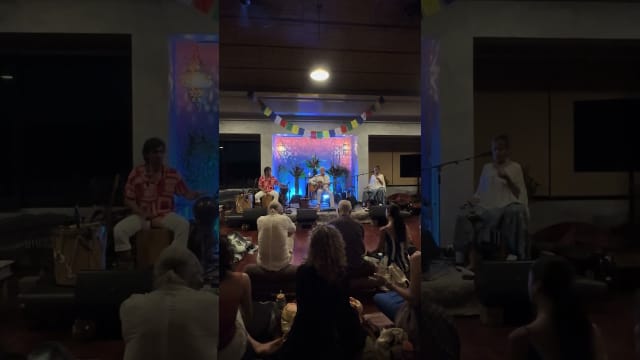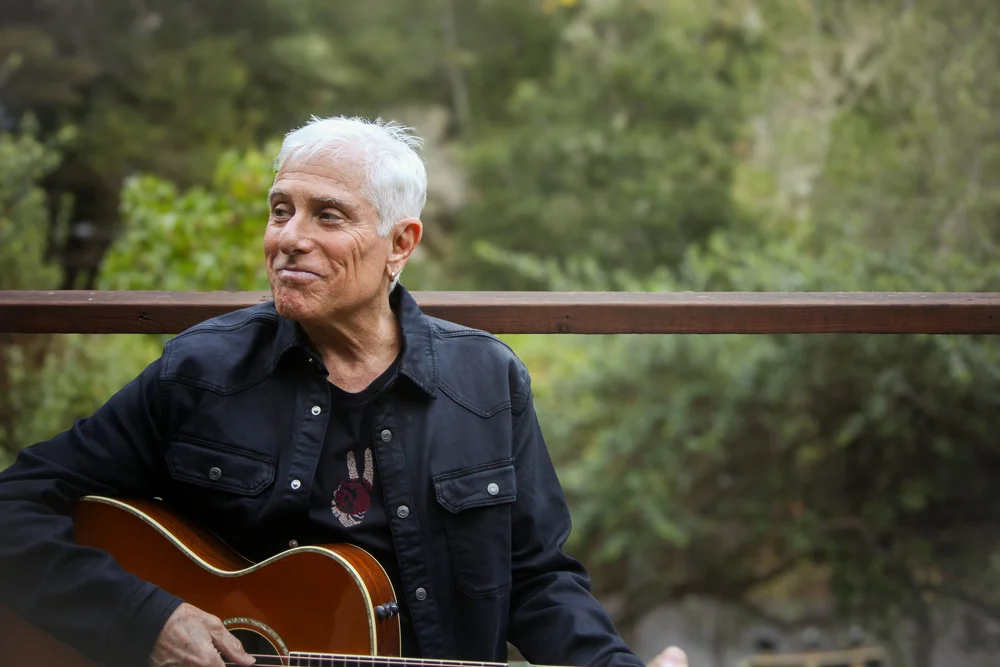
Four minutes in, the camera is outdoors, and a speaker says she feels privileged to be "in this pure land." She is describing a place she calls a blue zone, a region where people live longer, and she is describing the week that is about to unfold there: Kirtan Camp, a summer immersion in devotional singing led by Jai Uttal and guest teachers, set for July 24 to July 31, 2027, at Blue Spirit in Costa Rica. The clip, a short promotional video from Uttal's channel, is slight on detail. It does not walk through a schedule or explain a lineage. What it does is make a case for the retreat's central idea, that kirtan is a communal practice, and that the people who gather to sing matter as much as the songs.
Kirtan is call-and-response devotional singing, a form in which a leader sings a name or phrase and a room full of people sing it back. The retreat's description places it inside the wider traditions of kirtan and bhakti yoga, and it lays out two groups it has in mind. The first is yoga teachers who want to bring chanting into their classes. The second is people who simply want to immerse themselves in devotion without a professional reason. The description's promise is modest and specific: over one week, the teachers will share "some of the many tools" used in their bhakti practices, and the hope is that everyone leaves with the experience and knowledge to "sing and share our hearts with others."
The speakers in the clip return often to the same word, which is togetherness. One voice says it plainly (video, 2:10):
"The most precious part of Kirtan Camp is this being together with one another, learning from one another, loving one another, communing with one another."
That emphasis tells you how to approach the camp. This is not a concert with an audience on one side and a stage on the other. The format is built around participation, which means the people who come are part of the music, not spectators to it.
The clip frames the location as part of the experience. A speaker explains that the "blue zone" is an area, here and in a few other places in the world, where people live longer "because it's a place for health" (video, 0:25). The retreat's own description sets the scene in similar terms: a tropical jungle that keeps blooming, and "the sweet, warm waters of the nurturing, ever changing ocean." Another speaker, asked to describe the week, names the sensory side of it (video, 2:45): the ocean is "so clear, so warm," and the experience is "an awakening of your senses and your heart and your mind."
There is a logic to pairing devotional singing with that kind of setting. Kirtan asks people to open their voices and their emotions in front of others, and a place that feels restorative makes that openness easier. One speaker puts it simply (video, 3:25): "Nature inspires you. Within this embrace of nature is so, so nourishing for the heart."
Bhakti is the Sanskrit word usually rendered as devotion or love, and it is the path the retreat takes its name from. The description calls it an "ancient practice" and describes its emotional territory as "the deep rivers of emotion that flow within all of our hearts." In that framing, kirtan is one of the main vehicles for bhakti: singing becomes a way of reaching toward something larger than oneself, and of feeling that reach shared by the group.
Uttal's own words, from the retreat description, make the point most directly:
"Kirtan is the calling, the crying, the reaching across infinite space — digging into the heart's deepest well to touch and be touched by the Divine Presence."
— Jai Uttal, quoted in the retreat description
Note the word "crying" in that line. Kirtan is not presented as a pleasant warm-up for yoga. It is presented as emotionally direct, and the invitation is to let the voice go where the heart goes.
The clip ends on a chant. Around the four-minute mark, the voices move into "Jaya Rama, Jaya Rama," repeated over and over, and the rhythm carries the room. Jaya is commonly translated as victory or glory, and Rama is the name of a figure revered across Hindu devotional tradition. Phrases like this are typically sung in repetition, so the meaning settles in gradually rather than being explained up front. In kirtan, the repetition is the practice: you sing the same line long enough that the mind quiets and the voice does the work.
That is the experience the clip is trying to convey, more than any single fact about the retreat. A camp like this succeeds or fails on whether a stranger who came alone can, by the third or fourth round of a phrase, be singing with a room.
Based on the retreat description, the week combines several strands. Mornings include daily Yoga and Dance sessions led by Nubia Teixeira, one of the guest teachers, and Bhakti Yoga sessions with Visvambhar Sheth, the other. Kirtan singing runs through the days, and the camp leaves room for ocean time, shared meals and the company of other participants. The description promises "good company" and "delicious food," which in a retreat of this kind are not garnish; they are part of how a group becomes a group.
The details that the clip does not cover are worth noting. It does not give a price, a daily timetable, or the full list of teachers and their credentials. Anyone considering the camp should read the full retreat page, which is the authoritative source for those specifics.
If the clip made you want to sing with a room of people in a warm, green place, the next step is the full retreat listing at Blue Spirit's site for the July 24–31, 2027 session. Read the description's account of the camp's tools and its guidance for yoga teachers, then decide whether you are coming to learn chanting for your classes or to sink into bhakti for its own sake. Either way, you will be singing with others, and the clip's most repeated message is that the others are the point. To go deeper, listen to a full kirtan recording before you arrive, so the call-and-response pattern is already familiar when you find yourself answering it in the ocean breeze.