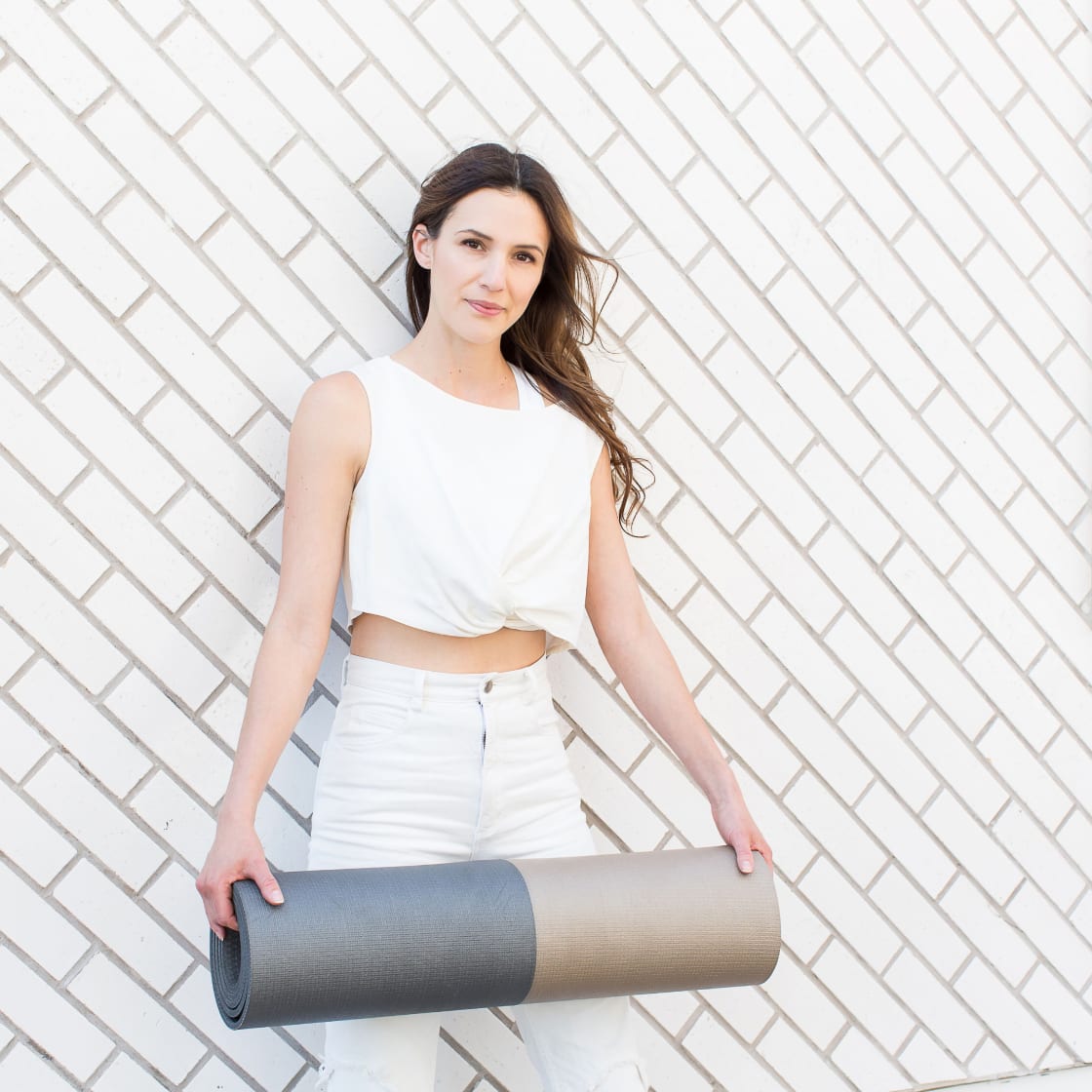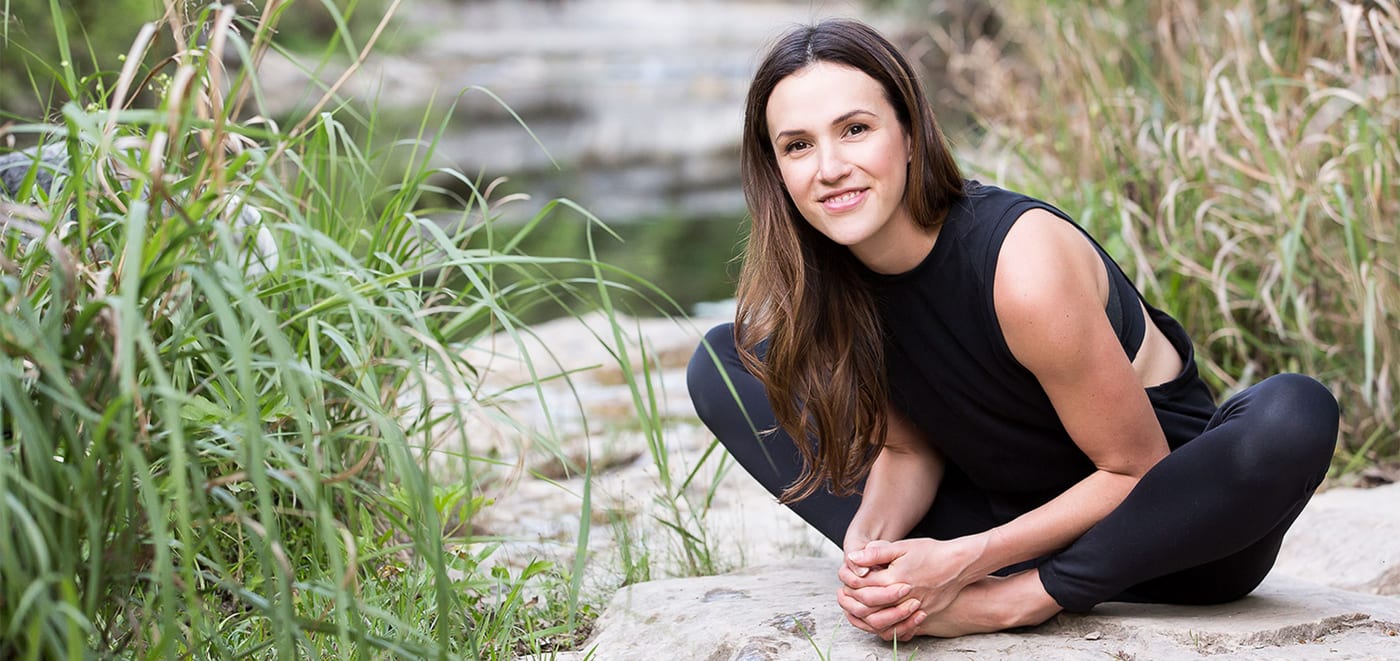

Adriene Mishler is a yoga teacher, actor, writer, activist and entrepreneur from Austin, Texas. Her channel, Yoga With Adriene, has more than 12 million subscribers, and Google named it the most searched workout of 2015. Scale is the first fact about her, but it is not the most useful one for understanding what she teaches. The more interesting question is how she teaches, and what that choice costs and gains.
A class with Mishler is closer to a conversation than to a drill. She speaks in plain language, explains cues without leaning on Sanskrit or technical jargon, and offers modifications constantly. Nothing is presented as the one correct version of a pose. Rest and skipping are treated as legitimate choices rather than lapses.
Her theater background shows in the structure. Classes have pacing and a narrative arc, with moments of humor and occasional tenderness, and she pays close attention to her own voice and presence. That attention is what produces intimacy through a screen. The result is usually not a sense of spiritual transcendence. Students tend to come away calmer and more connected to their bodies, which is a modest promise, honestly made.
The format is mostly digital. The core is free on YouTube, including the "Yoga For Beginners" and "Foundations of Yoga" series, which are designed as entry points. She also hosts an annual free at-home retreat on the channel, which is the nearest thing to extended immersion for most of her audience. A subscription app, Find What Feels Good, adds further content. She co-owns Practice Yoga Austin, where she teaches occasionally, but in-person teaching is not the main channel of her work.
The organizing idea is access. Tools for mental, emotional and physical health, in her framing, should not be gated by cost, body type or experience. That commitment is the mission, not a side effect of it.
Around it sit several linked themes:
- Self-care and self-compassion, taught through practice rather than abstraction.
- Embodied awareness, meaning trust in one's own sensation over external standards.
- The nervous system, with breath work and movement presented as regulation tools, not only fitness or spirituality.
- Inclusivity, with attention to different bodies, ages, abilities and circumstances.
- Playfulness, the idea that one need not become solemn or ascetic to be serious about practice.
Her stated line, "Yoga is really the art of waking up," gives these themes their direction, and "Find What Feels Good" is the working rule.
She is not a teacher of doctrine, so the questions are practical and personal. What does this actually feel like in my body right now? Am I doing this because it serves me or because I think I should be performing it correctly? Where does the habit of judging myself show up on the mat? These are inward-facing questions, and they cut against the perfectionism common in wellness culture. "Find What Feels Good" is easy to read as a slogan, but as a teaching it asks for ongoing self-inquiry, and some students will find that harder than following instructions.
Humor is central. It defuses the solemnity many people bring to yoga, and it makes authenticity feel permissible. Storytelling and metaphor make philosophy tangible, in keeping with the bio's description of her blending traditional yoga and breath technique with developmental movement, storytelling, neuroscience and mindfulness. The bio also credits her with a deep reverence for yoga philosophy and its origins, though in practice that reverence is delivered lightly, folded into conversational teaching rather than lecture.
Silence plays a smaller role than it would in a retreat or meditation-centered tradition. She does teach meditation and breath work, but the dominant texture is a guiding voice. Scripture is not a prominent feature of her delivery as presented here.
It lands hardest for beginners, for people intimidated by yoga culture, and for those who want a home practice without cost or equipment. It also suits people who have been put off by perfectionism and want permission to listen to themselves. Some longtime practitioners come to it precisely because it strips away gatekeeping.
It is less likely to satisfy several other groups:
- Students seeking strict adherence to one traditional lineage or a deeply rooted philosophical system, since the blend of neuroscience and Western psychological framing may read to them as compromise.
- Practitioners with deep grounding in a specific tradition, who may find the eclecticism surface-level.
- Those looking for physical rigor, precise alignment work or advanced challenge.
- Anyone who needs a one-to-one teacher relationship, which a video channel cannot supply however warm it is.
Her accessibility is the source of her reach and also the limit of her depth for advanced students. For those seeking a particular philosophical grounding, supplementary study elsewhere will be necessary.
The bio places her in no single lineage and names no guru or teacher. It states that she was certified in Austin and has trained with master teachers across the United States for 20 years, without naming them. What it does say is that she combines traditional yoga and breath technique with developmental movement, storytelling, neuroscience and mindfulness for modern life. This is a deliberate fusion rather than adherence to one school, and that is the most accurate way to place her.
Her wider work reinforces the same orientation toward the public rather than the cloister. She sits on the boards of Fusebox Live, an international hybrid arts festival, and Medicinal Media, a non-profit. Her background in television, voiceover, film and dance also informs her teaching.
Mishler's strength is making a practice feel livable. She is a skilled communicator whose craft, drawn from theater, is real, and whose commitment to free access is consistent. Her limits are those of the form she has chosen: breadth over depth, warmth over austerity, a screen instead of a room. Judged on what she sets out to do, she does it with discipline. Students who want something different will need to look elsewhere, and she does not claim otherwise.