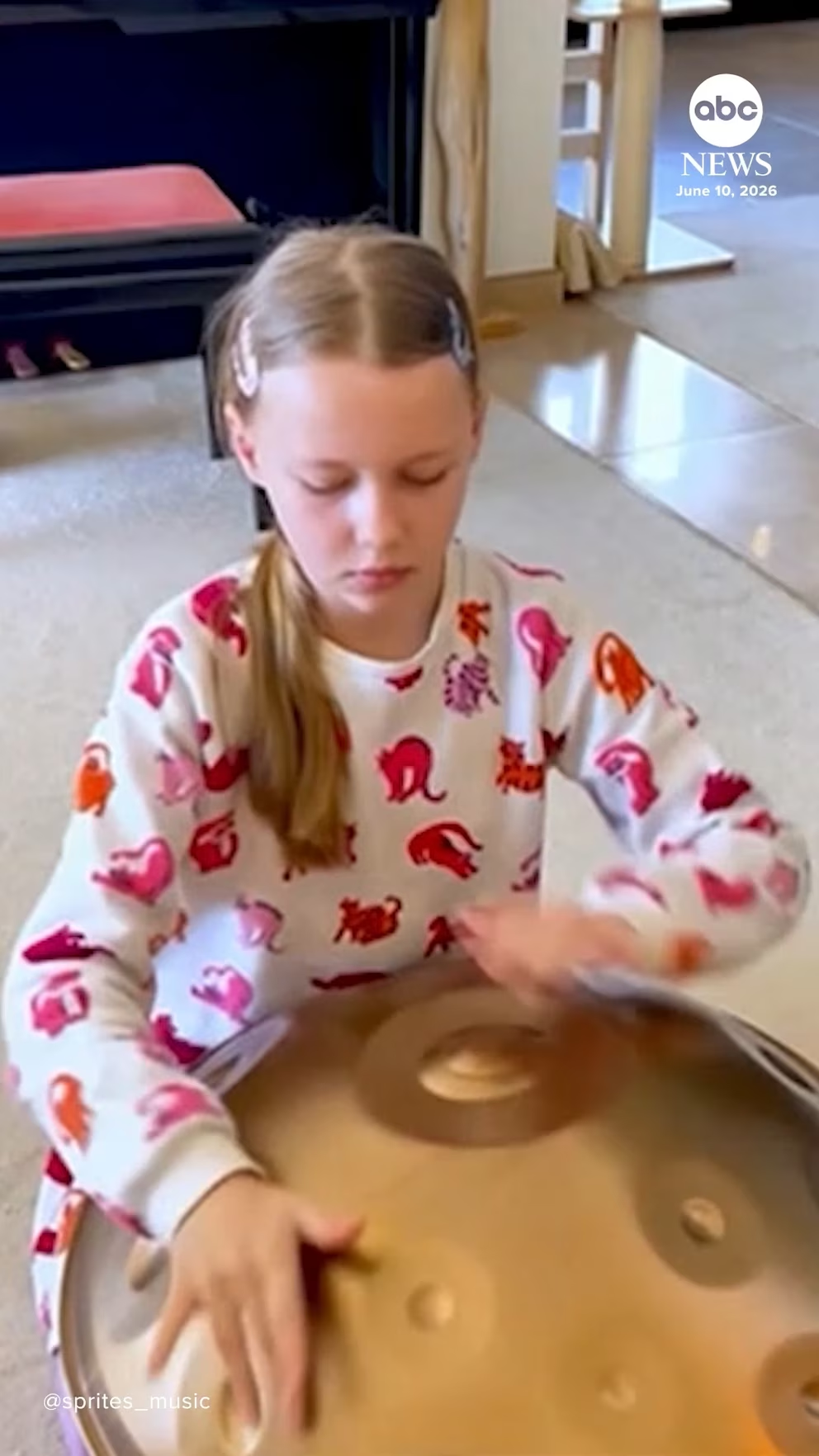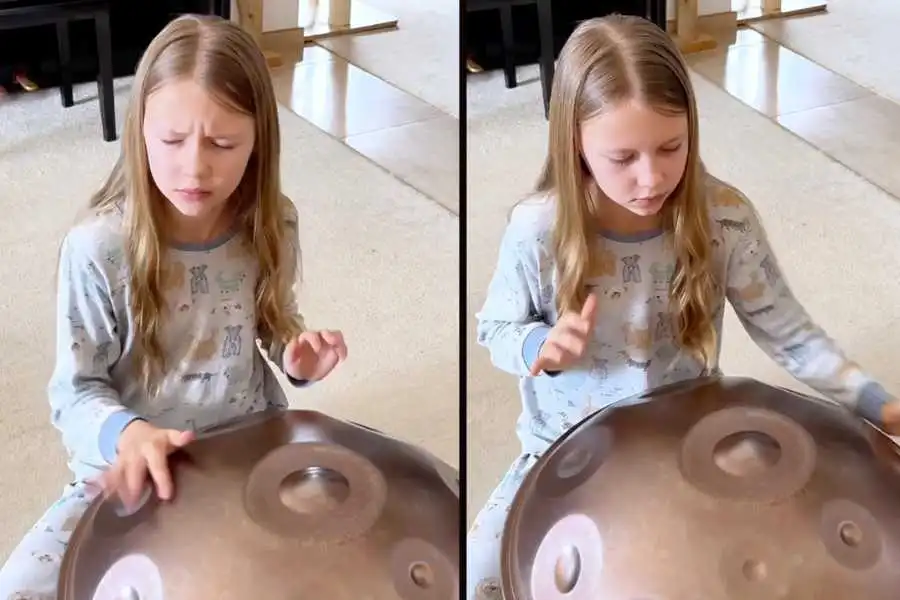

When an eleven-year-old sits down with a handpan—a steel percussion instrument that looks like a UFO and sounds like water droplets on bronze—the expected result is choppy exploration, tentative strikes, rhythm without structure. Sprites defies that expectation. Her debut track "Oceangrown" reveals a player who understands that the handpan's power lies not in speed or complexity, but in the space between notes, the duration of each resonant decay, the patience required to let metal sing.
The handpan produces a layered metallic shimmer—part gamelan, part steel drum, part Tibetan singing bowl. Each strike yields a fundamental tone plus sympathetic overtones that bloom and fade like ripples on water. Sprites works within this natural reverb, playing slow, deliberate patterns that emphasize the instrument's sustain. Her tempos hover in meditative territory: unhurried, cyclical, built on repeating motifs that shift incrementally rather than dramatically.
There's no voice here, no electronic augmentation in the traditional sense—just the direct sound of fingers on nitrided steel. The texture is clean, intimate, almost uncomfortably close. You hear the pad of skin meeting metal, the slight variation in attack from strike to strike, the natural imperfections that prove a human being is actually playing this thing. Production-wise, the sound is studio-quality but not over-processed, likely a reflection of her father Christian Büttner's (TheFatRat) involvement in recording and release infrastructure. The reverb feels natural, the stereo field allows the overtones to breathe, and the overall mix prioritizes warmth over clinical precision.
The handpan emerged from the Swiss Hang in the early 2000s, making it younger than most players currently exploring it. It exists in a peculiar lineage—too new for ancient tradition, too rooted in acoustic physics to belong fully to electronic music. The instrument found its audience in ambient music circles, yoga studios, street performance scenes, and among producers seeking organic textures to layer into downtempo tracks.
Sprites arrives at a moment when the handpan has moved past novelty into legitimacy. Players like Manu Delago, Daniel Waples, and Kabeção have established vocabularies for the instrument, developing techniques that range from percussive minimalism to melodic storytelling. The broader context includes the ambient world music movement—artists blending acoustic instrumentation with contemplative structures, creating soundscapes that function as both performance and sonic ritual without committing to any specific religious tradition.
This places Sprites in conversation with acts like Estas Tonne (guitar), Estas Tonne, or the more production-heavy world of artists like Bonobo and Ólafur Arnalds, who integrate acoustic instruments into electronic frameworks. But she's working without the electronic scaffolding, which makes her closer to solo handpan practitioners focused on the instrument's intrinsic voice.
What distinguishes Sprites at this early stage is restraint. Many young players—and plenty of older ones—treat the handpan as an opportunity to showcase dexterity, filling every measure with notes. Sprites does the opposite. She allows silence to carry structural weight. Her phrasing breathes. She seems to understand intuitively that the handpan's overtones need time to develop, that rushing to the next note cuts off the previous one's full harmonic life.
This isn't yet a fully developed artistic voice—she's been playing for less than a year—but it's a foundation that suggests musical intelligence beyond technical mimicry. Whether this develops into a distinctive compositional approach or remains a phase in broader musical education is still unfolding.
If you're approaching Sprites for the first time, recalibrate your expectations. This isn't background music for productivity playlists, though it might function that way. It's not virtuosic showmanship. It won't build to dramatic crescendos or introduce surprise elements.
What it offers is sonic consistency with micro-variations—think minimalist composition meets meditative practice. The surprise, if there is one, is that an eleven-year-old is playing with the patience of someone decades older. Listeners familiar with Terry Riley, Steve Reich, or La Monte Young's early work will recognize the aesthetic, even if the instrumentation differs. Those coming from yoga or sound healing contexts will find familiar territory without the explicitly spiritual framing.
Expect intimacy. Expect repetition that's intentional, not lazy. Expect the sense that you're hearing someone think through their hands.
"Conscious music" as a category struggles under vagueness, but if we're defining it as sound intended to shift awareness or create contemplative space, Sprites fits comfortably. She's part of a post-New Age generation that assumes global sonic vocabularies without the cultural appropriation baggage of earlier movements. The handpan itself—European in origin, inspired by Caribbean steel drums and Indonesian gamelan—sidesteps specific sacred lineages while still producing sounds that feel ritualistic.
She's too young to have collaborators shaping her work in the traditional sense, though her father's production infrastructure and audience base provide significant scaffolding. The real question is whether she'll continue developing as a solo handpan artist or whether this instrument becomes one element in a broader musical practice. For now, she represents the handpan's youngest wave—proof that the instrument's meditative pull transcends age and experience.