
Prashanti Paz was born in Patagonia, Argentina, and spent her childhood in São Paulo, Brazil. She grew up in an interfaith household: her father was Jewish and her mother Christian, and both traditions were honored and joyfully celebrated at home. Just as importantly, she was encouraged to find her own path. That early permission to seek, rather than inherit, a single religious identity runs through nearly everything she has made since.
Her first professional ambitions lay in film. She attended film school in Buenos Aires and later specialised in screenwriting in New York. It was a craft built on structure, image and the economy of storytelling, and some of that discipline can still be heard in the spare, deliberate way she shapes a recording.
In 1997, her first job in film was as a production assistant on Seven Years in Tibet. The production was shot in a remote part of the Andes, and it placed her in daily contact with Tibetan monks, Rinpoches and scholars. It was there, on a film set standing in for another mountain range, that she first met Buddhism.
The encounter might have remained a memorable chapter of a young filmmaker's career. In 1999, however, her mother died suddenly, and the loss became the second hinge in her story. She began formal studies in Buddhist scriptures, sadhanas, mantras and meditation, working with teachers including H.H. the Dalai Lama, Kyabje Kalu Rinpoche and Gyetrul Jigme Rinpoche. According to her own sources, she has trained for more than two decades. Her foundation is explicitly Buddhist, rooted in the Tibetan tradition, even though her singing travels well beyond it.
For years she kept a screenwriting career alongside this inner work. In 2016, she turned away from it to devote herself fully to chanting.
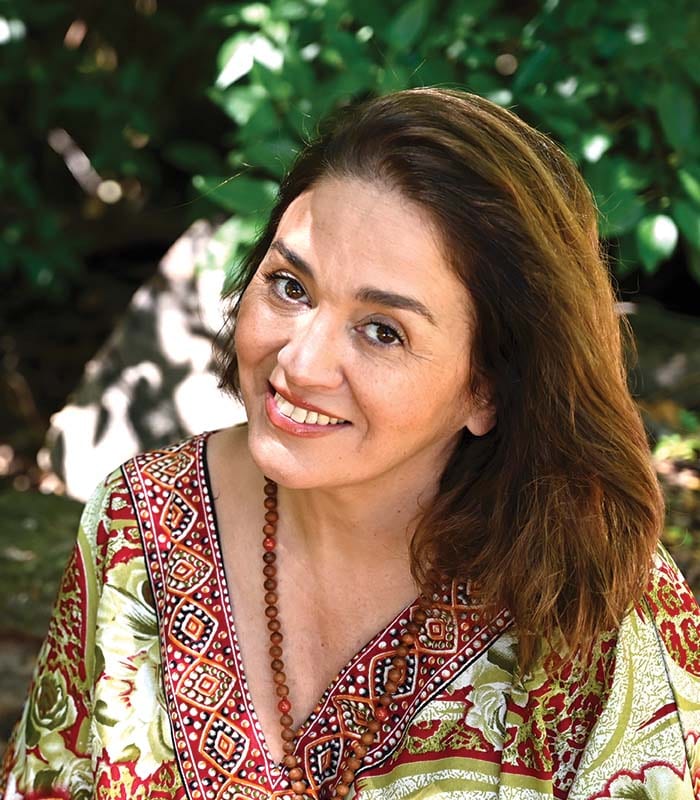
Prashanti Paz is a devotional singer, musician, writer and meditation teacher, now based in The Hague, the Netherlands. Her contribution lies in the way she approaches mantra: as an ancient practice to be honored, but sung with a contemporary sensibility. Her repertoire draws on Hinduism, Buddhism, Sikhism and the shamanic traditions, and she moves among them as someone whose understanding comes from study and practice rather than from sampling.
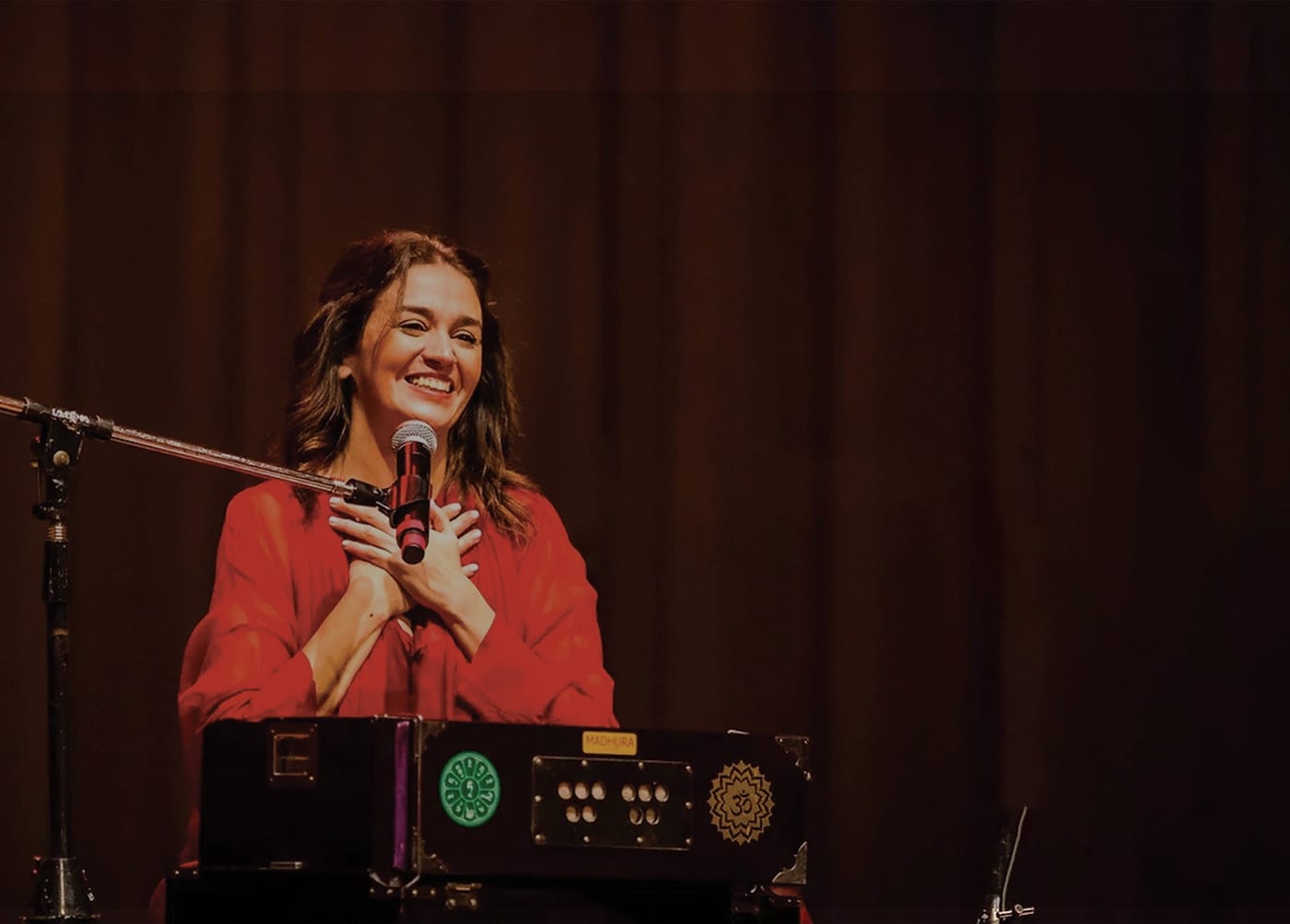
Her voice is often described as luminous and soothing. By her own sources, the sound is an alto, clear and unhurried, with careful attention to Sanskrit pronunciation. The arrangements are deliberately sparse: harmonium is central, with light strings on some tracks and room left for silence between phrases. This sets her apart from the communal, call-and-response energy usually associated with kirtan, a label Spotify often applies to her. Her recordings lean toward the introspective, closer to solo practice than to a group sing-along.
Krishna Das, one of the best-known figures in Western kirtan, has said of her: "I love Prashanti Paz's voice!"
Her albums form the core of her catalog:
- Inner Light (2017): Her debut, and the most natural place to begin. It introduces her voice and the breadth of her mantra practice.
- Into the Heart (2019): A deepening of the meditative work, released shortly before the pandemic.
- Beyond (2023): Recorded across three continents and produced by Anibal Kerpel with her longtime collaborator Diego Marchionatti. It is the fullest in production while keeping her voice at the center.
Between albums, she has released singles that focus on individual mantras, among them Om Ganapataye and Om Asatoma (2018), Ganesha Sharanam and Mere Ram (2022), Om Tare (2023) and Shakti Gayatri (February 2026). During the pandemic she wrote the heart songs Coming Home and A New Day, the latter featuring Kevin Johansen, along with Lokah Samastah, framed as a prayer for difficult times. These songs are more personal and contemporary in language than the Sanskrit mantras that make up most of her catalog.
Her voice has also reached a wider audience through the soundtrack of the Netflix film From Stress to Happiness, made with Buddhist monk and author Matthieu Ricard.
Her recent work shows an artist who keeps releasing and teaching rather than settling into a single mode. Shakti Gayatri arrived in early 2026, and she continues to offer guided meditations, courses and workshops on Insight Timer. She also writes, and the combination of music, writing and teaching suggests a practice in which each strand informs the others. No major tour dates are publicly listed at present, so her website, YouTube channel and streaming profiles are the most reliable places to follow what comes next.
Her audience is substantial but not massive: more than 43,000 followers on Spotify, built largely through steady releases, teaching and word of mouth in meditation and yoga communities rather than through mainstream press. That is consistent with the work itself, which asks for patient, repeated listening rather than casual background play.
She matters for several reasons. First, she offers a path into mantra for listeners who do not identify with any one tradition, a bridge for Western meditators and yoga practitioners who may never have encountered these chants in their original contexts. Second, her interfaith upbringing and decades of Buddhist study give her cross-tradition range an unusual grounding. Third, her restraint is itself a statement. In a field that can lean toward spectacle, her recordings favor breath, clarity and silence.
It is also worth being plain about what her work is not. It is not high-energy group ritual, and it is not secular wellness. It assumes some openness to contemplative practice. For those listeners, though, it provides something increasingly rare: a voice that treats mantra as a living discipline, shaped by a life that moved from film sets in the Andes, through loss, to a long apprenticeship in sacred sound.