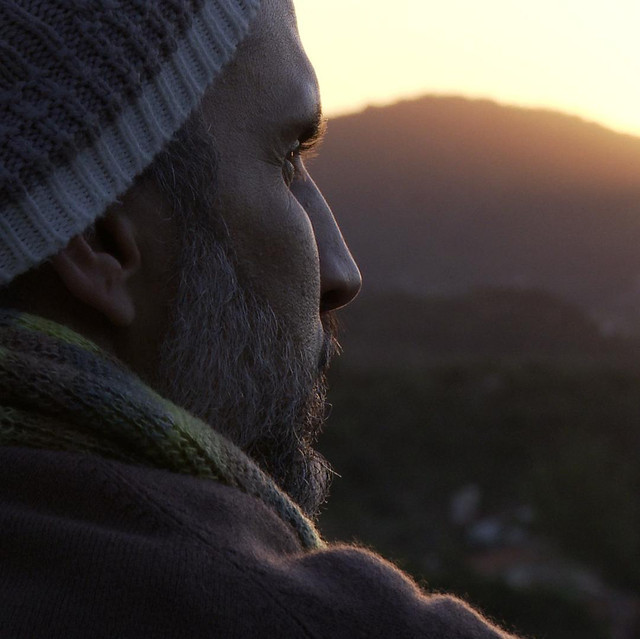

Marco Schultz's music arrives like fog rolling across abandoned warehouses at 4 a.m.—dense, luminous, and moving with its own atmospheric logic. His tracks unfold in the six-to-seven-minute range, built from arpeggiated basslines that pulse like slow breath, synthesizer pads that bloom and recede in filtered waves, and percussion that clicks and hisses with the irregular micro-variations only analog hardware can produce. This is melodic techno stripped of its Instagram-friendly gloss, progressive house that refuses to rush toward the drop, electronic music that privileges texture over spectacle.
What you hear first in a Schultz track is space—not the empty kind, but space filled with layered movement. A Moog Subsequent 37 bassline might anchor the low end with a muscular throb while a Korg Minilogue sequences delicate melodic fragments overhead, each element slightly out of phase with the others in ways that suggest breath rather than grid. The Roland TR-8S provides percussion that feels engineered but never sterile, hi-hats that shimmer with minute timbral shifts, kicks that land with analog weight. There's a cinematic quality to the sound design, not in the sweeping-strings sense but in the way tension accumulates through restraint, through what remains unresolved.
Schultz works squarely within the lineage of German electronic music, but he's drawn a specific inheritance line—not the minimal Berlin school of stripped-down functionality, but the warmer, more melodically adventurous strain that runs from Klaus Schulze's analog epics through the emotional architecture of progressive house's second wave. His Berlin base isn't incidental; it connects him to a city where electronic music still carries the weight of history, where the machines themselves are treated as instruments with character rather than tools for convenience.
Where the Berlin minimal tradition prioritized reduction and hypnotic repetition, and where much contemporary melodic techno opts for preset-driven efficiency, Schultz has committed to an almost ascetic hardware practice. No software synthesizers. No plug-ins mimicking vintage gear. Just the machines themselves—temperamental, warm, requiring hands-on negotiation. This isn't nostalgia; it's a deliberate choice about what kind of imperfection and unpredictability gets baked into the sound.
Schultz's signature contribution to electronic music lies in his public commitment to process. Through studio session videos, he's made visible what usually remains hidden: the slow, iterative work of building tracks from modular synthesis and hardware sequencing. These aren't slick product demonstrations but documents of labor—knob-turning, patch-cable routing, the incremental discovery of what a particular machine wants to offer on a particular day.
This approach generates music with a specific quality of presence. Digital workflows offer infinite recall, perfect reproducibility; analog hardware offers drift, warmth, the ghost in the machine. Schultz's tracks carry the sonic signature of electricity moving through actual circuits, oscillators that drift slightly from their set frequencies, filters that respond with the idiosyncrasies of physical components aging and interacting with temperature and voltage fluctuations.
Come to Marco Schultz's music expecting patience to be rewarded. These aren't tracks that announce themselves in the first thirty seconds. They're constructed as arcs—introductions that establish a rhythmic foundation, gradual additions of melodic and harmonic material, tension that builds through layering rather than obvious builds and drops. The surprises are textural: the moment a filter opens to reveal a pad that's been there all along, the way a bassline suddenly reveals itself as melodic rather than purely rhythmic.
What may surprise listeners familiar with contemporary melodic techno is what's absent: the lush, reverb-drenched, almost trance-like emotionalism that defines much of the genre. Schultz's palette is dryer, more focused, less interested in wash than in architecture. The emotional content emerges through structure and the accumulation of detail rather than through immediate melodic hooks.
Within the broader field of conscious electronic music—that loose coalition of downtempo, ambient, and dance music oriented toward interior experience—Schultz occupies a specific niche. He's not producing beat-less ambient soundscapes for meditation apps, nor is he making peak-hour festival techno decorated with spiritual signifiers. His music sits somewhere between: functional enough for movement (whether that's dancing or walking), complex enough for focused listening, and grounded in a practice—the hardware discipline—that carries its own kind of devotional rigor.
His work speaks to listeners who understand electronic music as a legitimate site for exploring sustained attention, who value the evidence of human decision-making in machine-generated sound, and who find meaning not in transcendence but in the careful articulation of physical materials into emotional architecture.