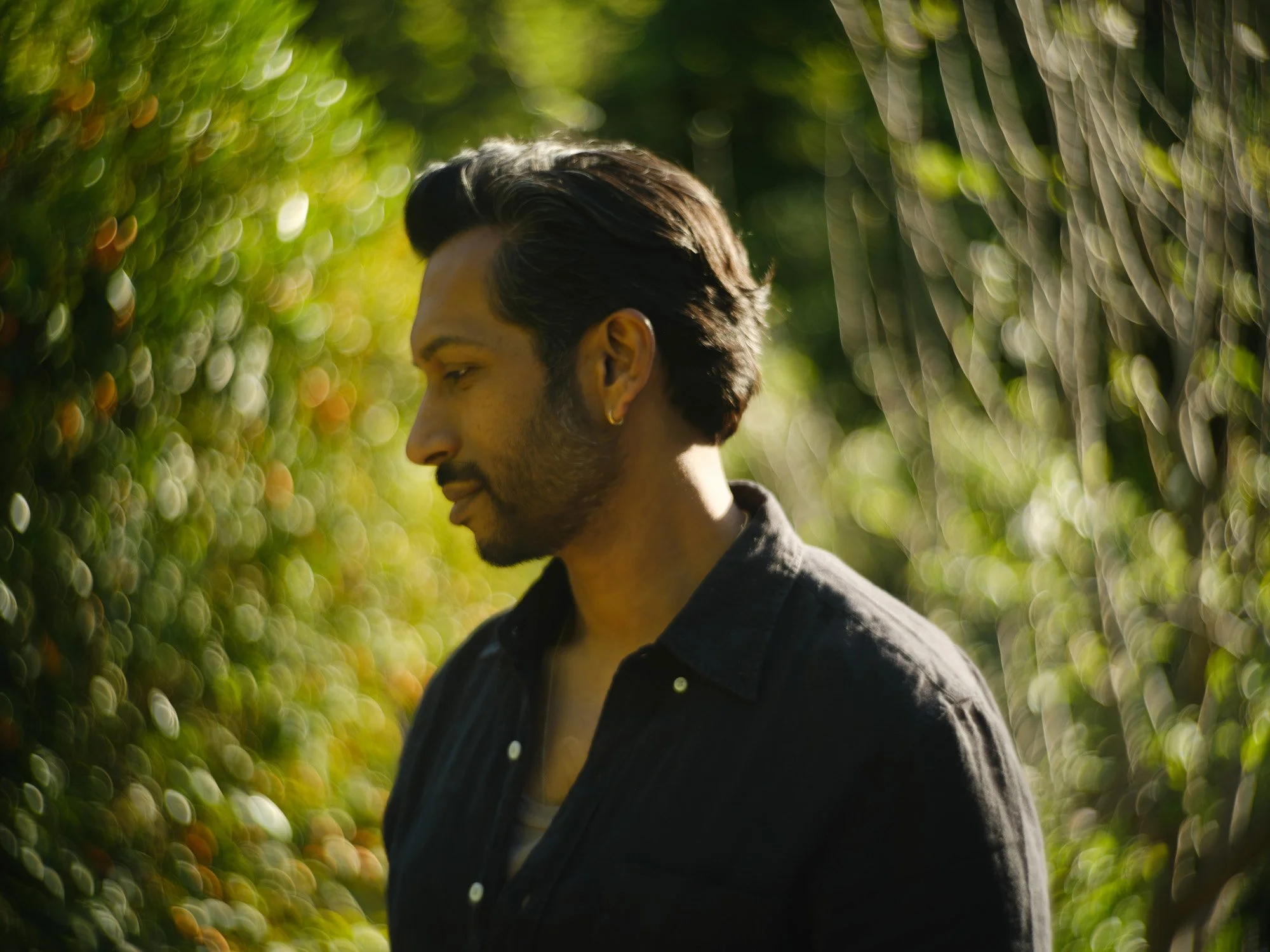

Hrishi's music doesn't announce itself. It arrives like morning fog—gradually, enveloping, already present by the time you notice it. The foundation is drone, that constant tonal ground that characterizes all raga practice, but here it's given unusual prominence. Where traditional concert presentations might foreground virtuosic melodic development, Hrishi extends the drone into a breathing architecture, a sustained pitch over which the raga's characteristic phrases unfold with deliberate slowness. The effect is less performance than atmospheric shift, sound that reorganizes the space around the listener.
The voice, when it enters, carries the ornamentation of classical training—gamaka, the oscillating pitch variations of Carnatic music, and the more gradual meend slides of Hindustani style. But the phrasing refuses the conventional arcs of concert repertoire. Phrases repeat, sometimes with microscopic variations, sometimes identically, creating a recursive quality that pulls attention inward rather than forward. This isn't the narrative development of a bandish or kriti; it's sound as continuous present tense.
Instrumentation remains sparse. Tanpura provides the essential drone, its cyclical strumming creating a shimmering harmonic cloud. Occasional accompaniment from bansuri or harmonium emerges, never to accompany in the Western sense but to thicken the tonal field. The compositional choice here is restraint—allowing single pitches to occupy their full resonant space before introducing the next element. "Therigiradhe," one of Hrishi's documented works, exemplifies this patience, stretching melodic material across extended duration until the raga's emotional quality—its rasa—becomes a physical sensation rather than an aesthetic observation.
Hrishi works within the dual inheritance of Hindustani and Carnatic classical music, but positions themselves at an oblique angle to concert tradition. Both systems rest on the principle that specific ragas correspond to particular times, seasons, and emotional states—Bhairavi for devotion at dawn's end, Darbari Kanada for midnight's gravitas, Kalyani for auspiciousness and strength. This isn't metaphor but practical acoustics: the microtonal relationships within each raga's scale create distinct neurological and emotional responses.
Where Hrishi diverges from lineage is in application. Traditional practice aims toward aesthetic perfection—the flawless exposition of a raga's character within concert parameters. Hrishi treats raga as therapeutic technology, isolating its healing properties from its performative context. The result is music that honors classical principles while refusing classical presentation. This is raga as sound bath, as nervous system recalibration, as sustained tonal meditation.
The shift is significant. Concert ragas build tension and release through rhythmic development, climactic taans, and the eventual resolution into familiar compositions. Hrishi's approach suspends that arc, maintaining the raga in its pure melodic state—the alap extended indefinitely, the exploratory phase becoming the entirety of the experience. It's a radical simplification that paradoxically reveals complexity: the microtonal intervals, the subtle pitch bends, the way a single note contains multitudes when given time to resonate.
Come to Hrishi's work expecting duration. These aren't three-minute compositions with verse-chorus structures. The pieces unfold across spans that require surrendering conventional listening habits. The first few minutes may feel like very little is happening. That's intentional. The invitation is to settle into the drone, to let the continuous pitch become a reference point rather than background.
What may surprise: the emotional specificity that emerges from apparent simplicity. As a raga's characteristic phrases repeat, subtle variations in vocal tone or slight shifts in pitch emphasis create distinct affective textures. The music doesn't reach toward emotion—it establishes an emotional field and allows you to inhabit it. This isn't catharsis through intensity but through sustained presence.
Listeners familiar with Western ambient music will recognize the extended forms, but the tonal architecture differs fundamentally. Where ambient often works through harmonic progression or textural layering, Hrishi's pieces develop through melodic micro-variations within fixed scalar frameworks. The reference points are closer to Pauline Oliveros's Deep Listening practice or La Monte Young's Theatre of Eternal Music—sound as meditation technology—but rooted in centuries-old raga discipline rather than experimental minimalism.
Within the conscious music ecosystem, Hrishi occupies a particular niche: classically grounded sound work that refuses the devotional packaging of much kirtan and mantra music. There's no call-and-response here, no lyrics offering narrative content or spiritual instruction. The work is pre-verbal, operating through tone and interval rather than text and meaning.
This positions Hrishi alongside practitioners like Amelia Cuni, who similarly brings classical Indian vocal training to experimental contexts, or the raga-informed electronic work of Charanjit Singh. But where those artists often hybridize traditions, Hrishi distills—extracting raga's therapeutic essence through subtraction rather than synthesis. The result is sound that serves without selling, heals without promising transcendence, and honors lineage by finding new applications for ancient knowledge.