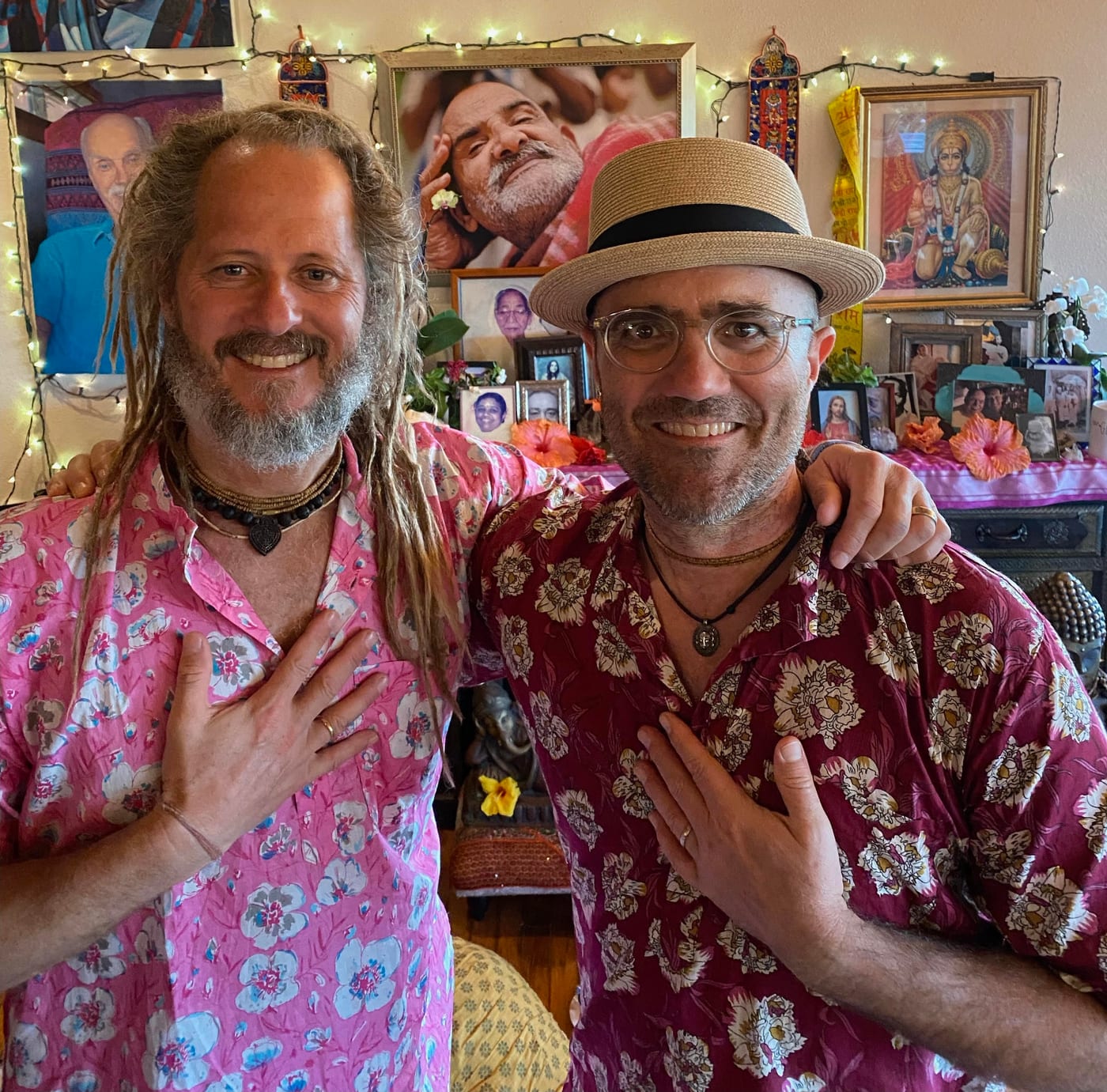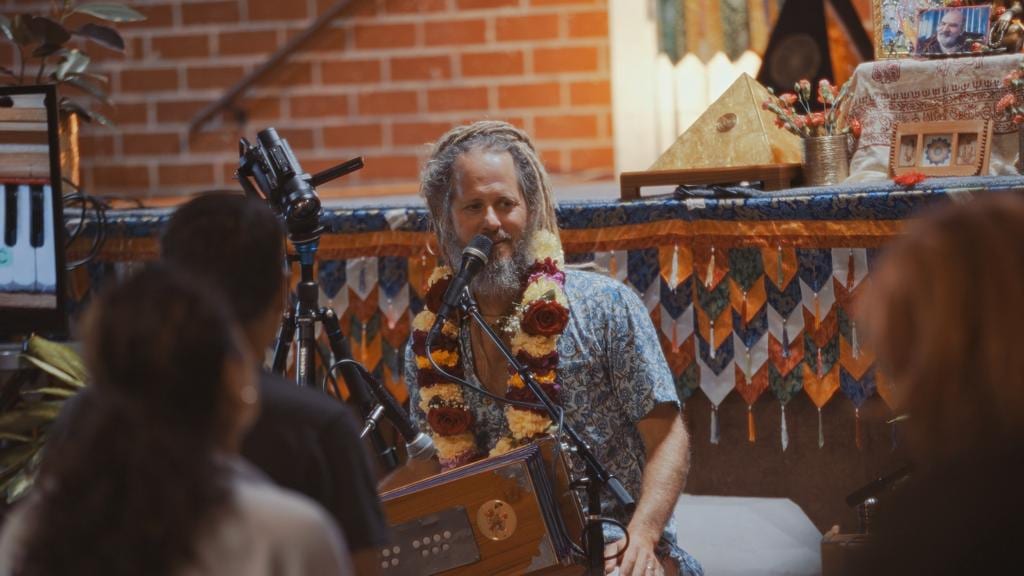

Govind Das is a musician, kirtan leader and spiritual teacher from Pacific Palisades, California, and the director of Bhakti Yoga Shala. His teaching is not easily separated from his instrument. He has played harmonium and led kirtan for more than twenty years, and nearly everything he teaches, from philosophy to yoga to retreat structure, is organized around devotional chanting. What follows is a profile of how that teaching works, what it keeps returning to, and who is likely to find it useful or not.
The core format is kirtan: call-and-response singing in which a short melodic phrase is sung and the room answers. The harmonium holds the line. It is a reedy, breathing instrument, and in his hands it grounds the chant rather than decorating it. The sound is mostly voice, harmonium and group response, so the congregation is part of the instrumentation. Pacing builds gradually through repetition rather than sudden changes.
Around kirtan, the Shala offers yoga, yin and restorative classes, breathwork, trance dance and sound healing, plus an online studio called Portal to the Path of Devotion. The structure treats these as one ecosystem rather than separate products.
The retreats are the fullest expression. Since 2005 he has led groups in India through Rishikesh, Kainchi Dham and Vrindavan. The day begins early with meditation and kirtan, moves into Bhakti Vinyasa yoga, and includes temple visits, vegetarian food and satsang, the gathering in spiritual company. Group conversation carries as much weight as individual practice. This is immersion rather than comfort, and it asks participants to commit to a full daily schedule.
The central theme is bhakti: love, gratitude and devotion as a path of practice. Alongside it runs the teaching of Neem Karoli Baba, whom the Shala follows, that all Gods are one. That idea underwrites the Shala's open-door stance. Hanuman is a major figure, and The Love Everyone Podcast, which he hosts with Rama Chandra Das, takes one line of the Hanuman Chalisa per episode.
A second theme is walking the path in ordinary life, not only on the mat or in the temple. A third is the body as a site of devotion: Bhakti Vinyasa, yin, restorative classes and trance dance are framed as devotional practices rather than fitness. India recurs as a source. He has traveled there since 1999 and describes it as a holy land, "the Mother," from which the great yoga practices and wisdom were born.
The materials available do not record specific questions he poses, and none should be invented here. But the shape of the teaching implies certain inquiries. What does it mean to practice love as a discipline rather than a mood? How does devotion show up away from the cushion? What changes when a phrase is repeated until it stops being a phrase and becomes an orientation? The podcast's line-by-line method suggests a further one: what is a single verse asking of the person reading it? These are inferences from the format, not quotations.
The delivery leans toward restraint and absorption rather than virtuosity or showmanship. Kirtan's purpose is participation, and his approach follows that logic. Repetition is intentional; the same phrase deepens across cycles. Newcomers often find the first listen monotonous, and the form does not apologize for it.
Scripture and chant carry the weight here, with the Hanuman Chalisa the clearest example. His kirtan leading instruction pairs chants learned on the harmonium with the philosophy behind them, so students hear the reasoning rather than only repeating the songs. The approach is more devotional than analytical. The sources do not document his use of humor, silence or storytelling, so those cannot be characterized responsibly.
It suits practitioners who want a teacher with long harmonium experience and direct ties to India rather than a performer chasing a mass audience. His Spotify following is modest, about 12,300 followers, and his reputation rests more on in-person kirtan and the Shala's community than on streaming. It suits people willing to sing badly in public, to repeat, and to accept devotional vocabulary as the point rather than the packaging. The welcome is genuine: no background in Hinduism, Sanskrit or yoga is required, and singing along matters more than knowing the words.
Anyone wanting yoga stripped of religious context will find the Hindu and Neem Karoli Baba framing explicit; the Shala does not hide it. Secular mindfulness seekers will find the bhakti vocabulary a poor fit. Listeners wanting fast tempos, heavy production or a concert with a passive audience will find kirtan participatory and repetitive. Those who prefer academic-style instruction may find the retreat days demanding and the approach insufficiently analytical. Some practitioners from more traditional temple satsang may find a community that also offers yin, restorative and trance dance classes a looser container. And anyone hoping to browse a deep recorded catalogue will be disappointed, since no full discography is listed.
His work sits within the Bhakti tradition, the devotional path of Hinduism that treats love of the divine as the center of practice. The only named teacher is Neem Karoli Baba, whose teachings the Shala follows. No other guru or lineage is stated in the bio, and none is assigned here. His long collaborations, including a friendship and teaching partnership of more than 25 years with Saul David Raye, and the Shala's community messages signed together with Radha, show a teacher working in company rather than alone.
This is a teaching of depth over reach. Its strengths are consistency, a clear devotional center and a practical format that makes philosophy something sung and lived. Its limits are the flip side: it asks for participation, tolerates little irony, and offers little for those who want devotion explained without being practiced. For a newcomer, the sensible start is one short kirtan in a room, not a recording. For anyone wanting the thinking behind it, the podcast is the clearest entry. Current schedules are best confirmed at bhaktiyogashala.com.