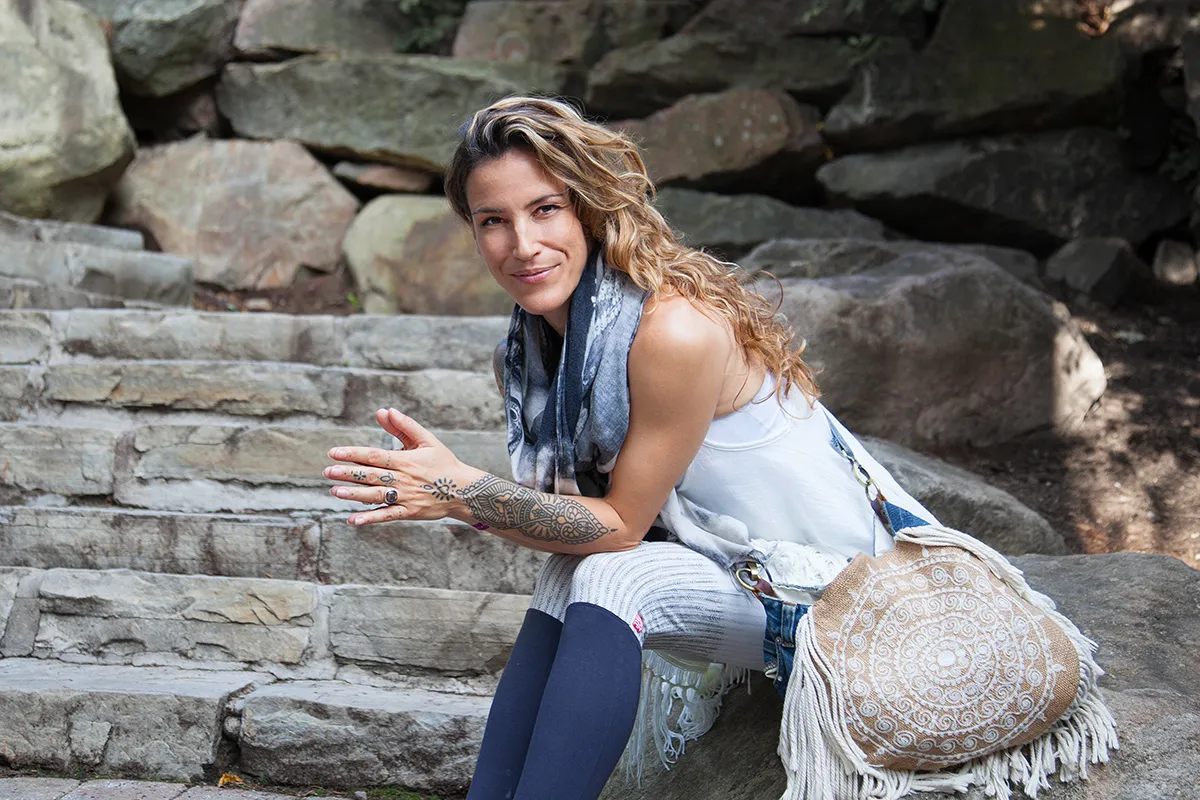

Annie Langlois's journey into breathwork facilitation emerged from her own exploration of somatic modalities and a deepening curiosity about how breath affects the nervous system and emotional regulation. Like many practitioners who eventually become guides in body-centered work, Langlois came to conscious breathing not through academic study alone, but through direct experience—discovering in her own practice how intentional breath patterns could unlock dimensions of self-understanding that intellectual analysis couldn't reach.
Her training in conscious breathing facilitation provided the technical foundation, but it was her recognition of the body's inherent intelligence that shaped her distinctive approach. This realization—that the physical form holds wisdom independent of cognitive processing—became the philosophical cornerstone of what would eventually become Essence du Souffle, her breathwork practice dedicated to unified conscious breathing.
Langlois founded Essence du Souffle as a container for a specific kind of somatic work, one that positions breath not as a tool for mere relaxation but as an active portal into what she calls soul journey work. The practice draws from the lineage of conscious connected breathwork, a body of knowledge that emerged from the holotropic and rebirthing traditions of the 1970s. These traditions understood breath as more than a physiological function—they recognized it as a bridge between conscious awareness and deeper layers of bodily experience.
What distinguishes unified conscious breathing from other modalities like guided meditation or pranayama is its emphasis on sustained, rhythmic breathing patterns. These aren't brief exercises or techniques borrowed from yogic tradition, but extended practices designed to facilitate altered states and embodied insight. Langlois's approach centers on the relationship between breath rhythm, physical sensation, and emotional release, creating conditions where participants can move through physical tension, stored emotion, and habitual thought patterns.
Through Essence du Souffle, Langlois facilitates both group sessions and individual breathwork experiences. Her methodology typically combines circular breathing techniques—a continuous pattern without pauses between inhale and exhale—with body-centered awareness practices. This pairing is intentional: the sustained breath pattern creates a physiological shift, while the somatic awareness allows participants to track what emerges in real time.
The practice operates on a fundamental premise: that the body holds memory, and that conscious breath can unlock pathways to these stored experiences. Rather than working through verbal processing or cognitive reframing, participants engage directly with sensation, allowing the breath to move them through layers of physical and emotional material. It's work that bypasses analysis, trusting instead in what Langlois terms the intelligence of the physical form.
Central to Langlois's work is her positioning of herself as a guide rather than an instructor. This distinction matters. In her framework, transformation isn't taught or directed—it's facilitated. Her role is to create the conditions in which participants can safely access their own embodied wisdom, to hold space while the breath does its work.
This approach reflects a broader understanding of somatic practice: that healing and insight don't come from external authority but from reconnection with one's own body consciousness. Langlois's background in supporting people through embodied transformation informs this stance. She works not by prescribing outcomes but by maintaining presence, allowing each person's process to unfold according to its own logic.
Langlois's work exists within a larger resurgence of interest in breathwork and somatic practices. In an era characterized by cognitive overload and chronic nervous system dysregulation, practices that offer direct experience rather than more information have found receptive audiences. Yet Langlois's approach maintains important distinctions from mainstream wellness trends.
Where commercial breathwork sometimes promises quick fixes or peak experiences, Langlois's practice of soul journey work acknowledges the slower, sometimes difficult terrain of genuine somatic exploration. Her emphasis on body consciousness and the wisdom held in physical form aligns with trauma-informed approaches that recognize the body as a valid site of knowledge, not simply a vessel to be optimized or controlled.
What makes Annie Langlois's contribution significant is not novelty but depth. In founding Essence du Souffle and committing to the specific lineage of conscious connected breathwork, she offers something increasingly rare: a practice rooted in established tradition yet responsive to contemporary need. Her work matters because it provides structured access to somatic experience in a culture that often privileges thinking over feeling, analysis over sensation.
For those who come to her sessions, the value lies not in acquiring new techniques but in being guided back to the intelligence they already possess—the wisdom encoded in breath, held in tissue, waiting to be remembered through the simple, profound act of conscious breathing. In this way, Langlois continues a lineage while making it accessible, translating the transformative potential of breathwork for those seeking pathways beyond the cognitive, into the felt territory of embodied knowing.