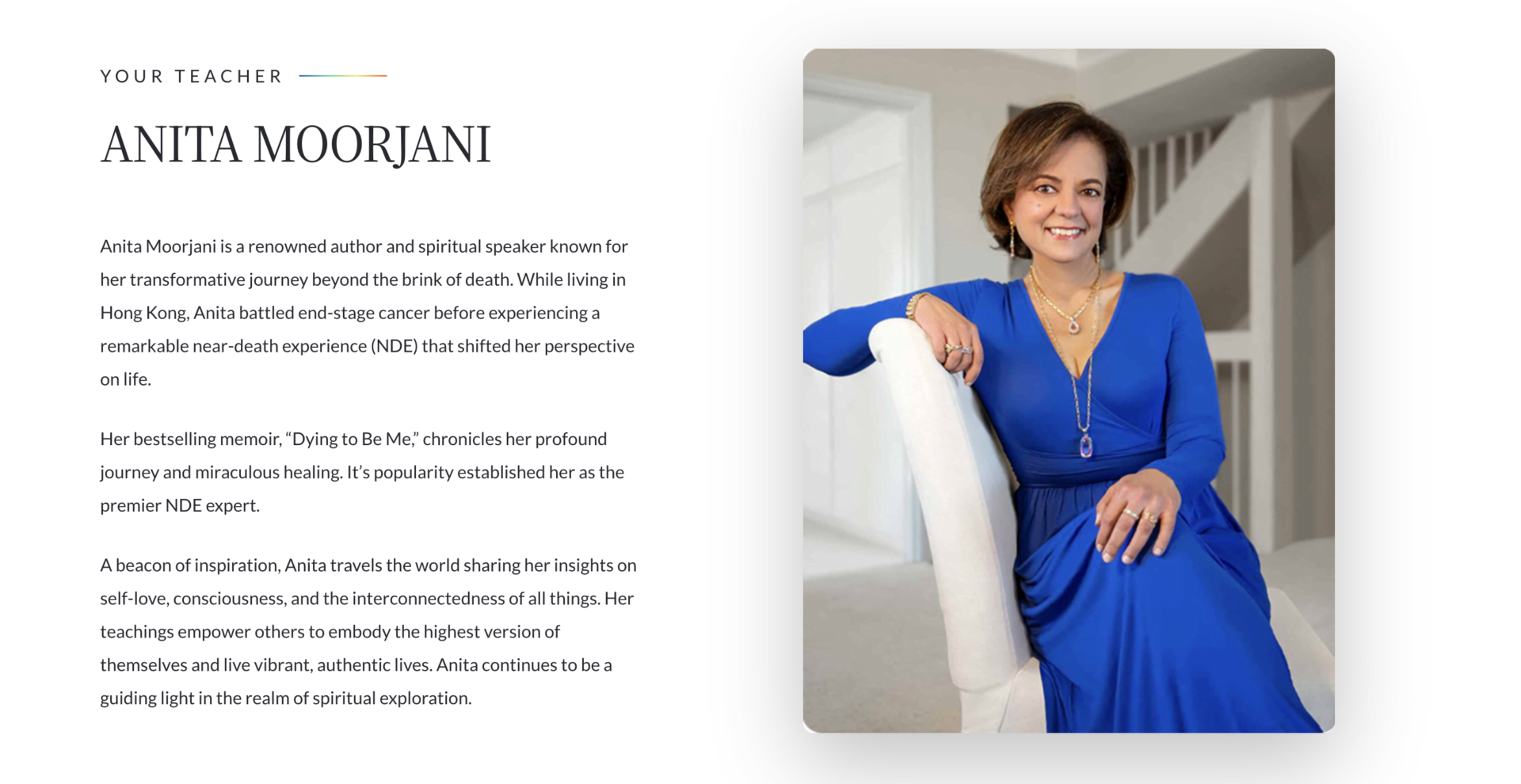

Anita Moorjani teaches from a single, shattering moment. A 2006 near-death experience while dying of lymphoma forms the gravitational center of everything she offers—workshops, talks, retreats all orbit this event. What distinguishes her approach is not the NDE itself, which has precedent in mystical literature, but her insistence that the experience delivered specific, transmissible knowledge about how to live. Her sessions feel less like spiritual instruction than testimony with commentary. She recounts what she claims to have understood while beyond the threshold: that fear is the root pathology, that self-judgment literally manifests as disease, that love is not something to earn but a state to remember. Then she works outward from these axioms, applying them to career paralysis, relationship toxicity, chronic illness.
The shape of her teaching is confessional and looping. She returns to her own story with the consistency of a musician playing a standard—same melody, different improvisations. In a typical talk, she'll describe the coma, the expansive awareness, the spontaneous remission, then pivot to a listener's question about anxiety or purpose or healing. The answer routes back through her core messages: you are already whole, fear constricts, love expands. Retreats extend this structure over days, adding guided meditations and small-group processing, but the architecture remains narrative. She positions herself not as guru but as tour guide who's been to a specific place and can describe the terrain.
Her recurring themes cluster tightly. The toxicity of fear-based living. The particular burden carried by empaths and sensitive people who absorb others' emotions and cultural conditioning. The idea that illness is often a physical manifestation of self-abandonment. The primacy of self-love, not as indulgence but as prerequisite for health and clarity. She speaks frequently about "being yourself" versus performing an acceptable version of yourself, framing authenticity as both spiritual practice and immune support. There's a persistent emphasis on worthiness—she insists that value is intrinsic, not earned, and that this understanding is curative.
The questions she pushes students to sit with are direct: What would you do if you truly loved yourself? Where are you living from fear rather than love? What beliefs are you carrying that don't belong to you? These aren't koans meant to short-circuit conceptual thinking; they're diagnostic prompts. She wants students to inventory their fear-based assumptions and consciously choose differently. The method is more psychological than mystical, even as the source material claims mystical authority.
Moorjani's aesthetic is relational and story-driven. She uses humor—self-deprecating observations about her pre-NDE anxieties, her immigrant family dynamics, her struggle with cultural expectations. There's little silence in her teaching, few pauses for contemplation. She fills space with narrative, explanation, reassurance. Scripture and traditional texts are absent. She doesn't cite sutras or mystics. Her authority is experiential, not scholarly. This gives her work an accessible, almost therapeutic quality. She sounds more like a skilled facilitator at a personal development seminar than a traditional spiritual teacher.
Her delivery lands most powerfully for those navigating identity crises, chronic illness, or the exhaustion of people-pleasing. Empaths and highly sensitive people find in her teaching a validation of their experience and a framework that doesn't pathologize sensitivity. Those recovering from religious trauma or rigidity appreciate her insistence that spirituality is about liberation rather than discipline. People seeking permission to prioritize themselves—especially women conditioned toward self-sacrifice—respond to her unapologetic emphasis on self-love.
But her approach bounces off those seeking rigor, lineage, or practice-based transformation. Students drawn to Zen's austerity or Vedanta's philosophical architecture may find her work thin. Critics note that while her story is dramatic, the teaching derived from it is relatively conventional—self-help psychology dressed in afterlife authority. The lack of engagement with broader mystical traditions can feel isolating rather than liberating. And for those uncomfortable with teachers who center their own narrative, her method may feel closed rather than generative.
Moorjani belongs to a contemporary Western teaching tradition that emphasizes direct experience over transmitted knowledge, therapeutic healing over ascetic discipline. She shares lineage space with teachers like Byron Katie and Eckhart Tolle—figures whose authority derives from personal breakthrough rather than formal study. Her work intersects with the New Thought movement's emphasis on consciousness as causative, though she grounds this in NDE testimony rather than idealism. She's part of a broader cultural moment that privileges authenticity, emotional healing, and the dismantling of fear-based conditioning. Whether this constitutes a teaching tradition or a therapeutic modality remains an open question, but her voice within it is clear, consistent, and, for many, genuinely helpful.