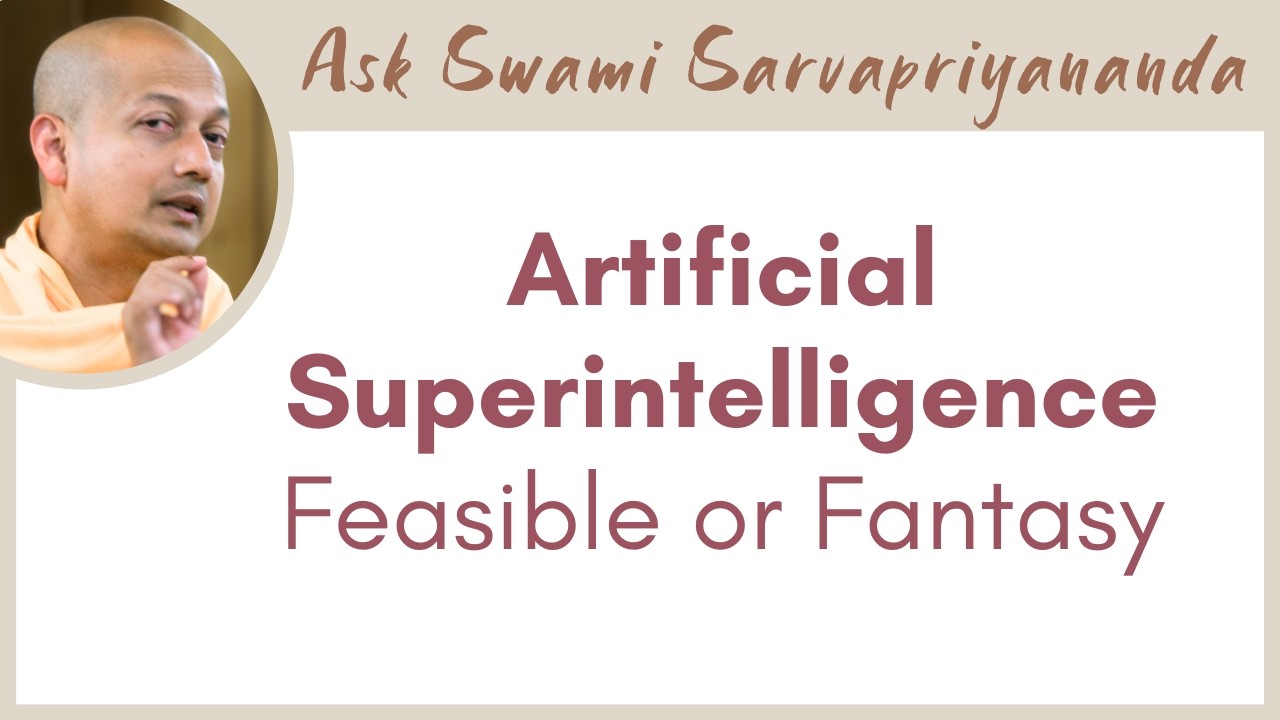
A student of the Vedanta philosopher Swami Sarvapriyananda raises a deceptively simple question: if Buddhism teaches that a "consciousness wave" transfers from life to life—carrying karma and experience across incarnations—doesn't that already presume some form of duality? Doesn't it require an independent self, separate from the body and mind, to do the transferring? The question cuts to the heart of what Buddhism actually teaches, and the answer—delivered with scholarly precision—reveals that Buddhism has never spoken with a single voice.
"It does," Swami Sarvapriyananda acknowledges, honoring the questioner's insight. But then comes the crucial clarification: "Not that all Buddhism is non-dual. Buddhism has multiple schools."
When tracing Buddhism back to its roots, four major schools emerge, each with its own metaphysical architecture. The Sautrantika school, the Vaibhashika school, the Yogacharam Vijnanavada (mind-only) school, and the Madhyamaka Shunyavada (emptiness) school represent fundamentally different answers to the question of what exists and what persists.
Two of these schools—Sautrantika and Vaibhashika—operate openly within a dualistic framework. They accept that multiple realities coexist: there is a self (even if illusory in nature), and there is a world of continuous change, a realm of flux and transformation. In this dualistic view, the problem isn't that a self exists, but that it generates an illusion of permanence. The self experiences itself as a unified "I," yet what it truly is—what actually exists moment to moment—is only movement, only change, only becoming.
The spiritual goal in these schools hinges on a specific image: the extinguishing of fire. Nirvana, in this dualistic Buddhist context, means to put out the flame of that continuous, illusory selfhood—to exhaust the burning that perpetuates itself across lifetimes. The consciousness wave that transfers, the karma that accumulates, the suffering that cycles through births and deaths: all of this is the fire. And the path is to stop it.
Here lies a profound philosophical tension that early Buddhist teachers navigated with extreme caution. If you extinguish the fire lifetime after lifetime, if you systematically put out that burning, what happens when it is finally gone? What remains when suffering is over and freedom is attained?
The classical Buddhist answer is famously elusive: don't ask. This isn't evasion for its own sake. It reflects a deliberate epistemological stance—a conviction that the question itself, when posed in language, already contains error. As Swami Sarvapriyananda notes, "according to Buddhism, they are very particular about precision. You are already making a mistake if you put it in language."
Yet the logical implication haunts the silence. If you are freed, if liberation is attained, then something must remain—some reality, some consciousness, some ground of being. To say nothing remains would contradict the very idea of freedom. But to name what remains is to violate the Buddhist prohibition against conceptual reification. This is not mystical obscurantism; it is philosophical rigor applied to the limits of language and knowledge.
The other two schools—the Mahayana traditions known as the mind-only school and the emptiness school—explicitly claim non-dualism. They use the Sanskrit term Advaya Vada to describe their philosophical position: the doctrine of non-duality.
These schools introduce radically different concepts to describe ultimate reality. The mind-only school speaks of consciousness as the fundamental substrate of experience. The emptiness school emphasizes the absence of inherent, independent existence—not the absence of being itself, but the absence of fixed, unchanging essence. Both traditions, however, point toward what they call Buddha-nature—an underlying reality that is not created, not contingent, not dependent on conditions.
The vocabulary differs markedly: Tathagatagarbha (the Buddha-embryo), Dharmakaya (the body of dharma, the ultimate principle), and other terms carry subtly different implications. Yet they converge on a single insight. "Which comes very close to the Brahman of Advaita Vedanta," Swami Sarvapriyananda observes, "the absolute of non-dual philosophy."
Brahman—in the Vedantic tradition—is the single, non-dual reality underlying all existence. It is not a creator separate from creation, not a being among other beings, but the sole conscious principle in which all apparent multiplicity arises and dissolves. That the non-dualistic schools of Mahayana Buddhism articulate something structurally similar, using different language and different philosophical frameworks, suggests a convergence across traditions on the nature of ultimate reality.
The original question—does the consciousness wave transferred from life to life imply duality?—proves less answerable in abstract than it appears. Within the dualistic Buddhist schools, yes, it does imply duality in a certain sense: there is a self (albeit illusory), and there is karma, and there is change, operating within a multiplicity of real phenomena. The consciousness wave is real, the transfer is real, the problem is real.
Within the non-dualistic schools, the question itself dissolves. The appearance of a consciousness wave, the seeming transfer, the illusion of a separate self—all of this is understood not as evidence of true duality but as the play of Maya, as the appearance within the one non-dual reality. There is not actually a wave transferring; there is the appearance of waves within the ocean, while the ocean alone is real.
This is not mere semantic difference. It represents two fundamentally distinct metaphysical visions of what Buddhism is. One says: accept duality at the conventional level, perfect your understanding of cause and effect, exhaust the fire of becoming. The other says: recognize the non-dual nature of reality beneath all appearance, and freedom is revealed to have always been your nature.
For a student of philosophy or contemplative practice, the implication is clear: Buddhism cannot be read as a monolithic doctrine. To engage seriously with Buddhist thought requires understanding which school is speaking, which layer of teaching is being addressed, which audience and which historical moment are in play. The consciousness wave question, seemingly settled by "Buddhism teaches non-self," actually opens onto centuries of sophisticated debate about the relationship between emptiness and being, between negation and affirmation, between what cannot be said and what must be lived.
Equally, the convergence between non-dualistic Buddhism and Vedantic non-dualism suggests that across traditions, contemplatives who have touched the deepest levels of realization have arrived at strikingly similar truths. The differences lie primarily in maps, in language, in the cultural and philosophical contexts in which those truths are expressed. The territory—the actual lived realization—appears to be singular.