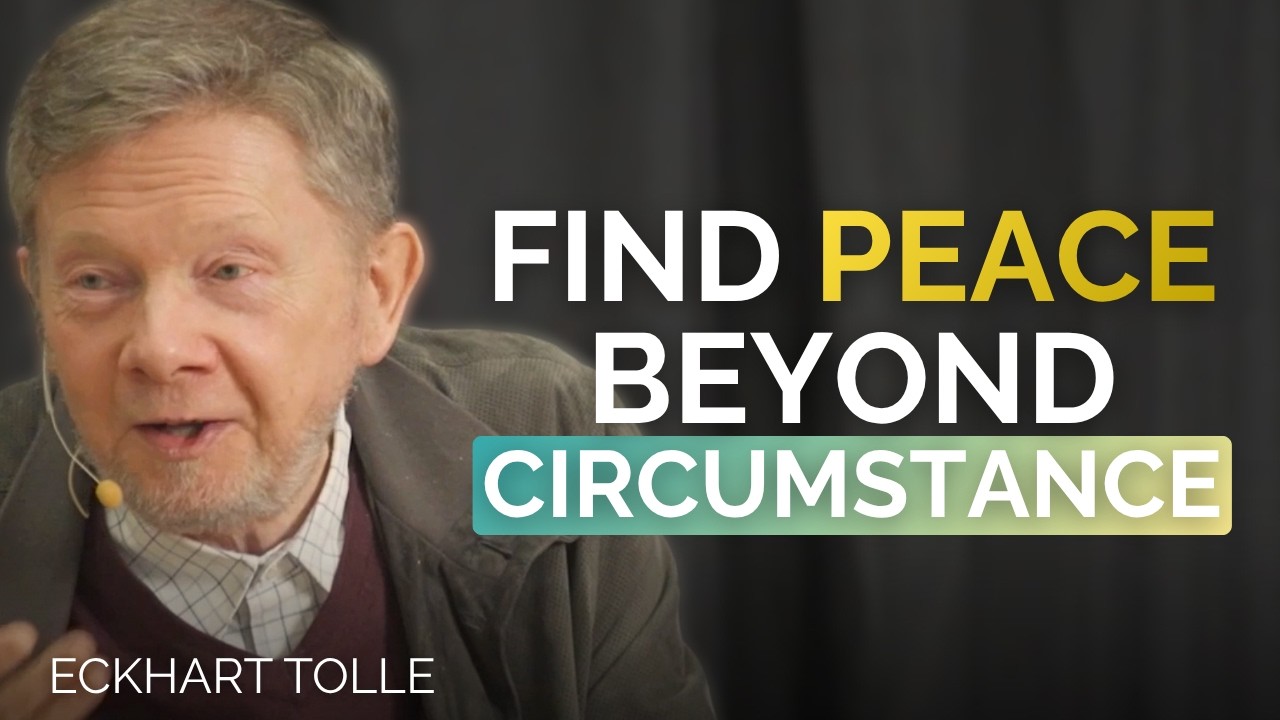
The device in your pocket is not the villain of your scattered attention. It is, rather, an amplifier—one that broadcasts a signal your mind was transmitting long before touchscreens existed. This is the foundation of what Eckhart Tolle lays out in a conversation about presence, addiction, and the architecture of modern consciousness: the phone takes over your life because your mind already had the habit of abandoning the present moment. Technology simply gave that habit better equipment.
What Addiction Really Means
Before examining the phone, Tolle poses a definition of addiction that cuts beneath the surface: it is the point at which you can no longer distinguish between I cannot let go of this and I do not want to. The difference collapses. You stop knowing whether the thing has you, or you have the thing.
This ambiguity matters because it shows that addiction is not simply about external objects. It is about the relationship between you and the thing—and that relationship becomes invisible from the inside. The smoker, the drinker, the person who cannot set down their phone: each experiences their compulsion as personal choice, even as that "choice" repeats beyond their will. "I often say thinking is the greatest addiction," Tolle observes. Incessant, compulsive thinking has the same quality: it loops, it pulls you away from what is happening now, and it is nearly impossible to switch off.
Phones as Extensions of Mind, Not Causes
Here is where the argument becomes subtle. Tolle does not argue that phones are malevolent technology or that awakening requires throwing them away. Instead, he argues that phones are extensions of the mind, in much the same way that a hammer is an extension of the hand. The hammer does not create the impulse to build; it amplifies it. Similarly, the phone does not create the impulse to leave the present moment. Your mind was already pulling you out of the now—through worry, memory, fantasy, rumination—long before there was a glowing screen to facilitate the escape.
"Your mind was already taking you out," he says. "But now that these devices are here, they are an extension of the mind, and they have an addictive quality in the same way that incessant compulsive thinking is addictive."
The technology amplifies what was already there. It gives the mind a tool that never sleeps, that rewards distraction with novelty every microsecond, that makes the compulsion feel less like compulsion and more like connection. When the phone takes over your life, it means the mind has taken over your life again—with upgraded machinery.
The Hive Mind and Collective Momentum
But Tolle introduces a dimension that did not exist for earlier generations, and it is perhaps the most disorienting aspect of modern consciousness: on top of your personal mind, there is now a collective one. He calls it the hive mind, and it has its own momentum.
Millions of people react to a single event within minutes. They use the same words. They experience their reaction as personal, unique, theirs—and yet it is moving in lockstep with millions of others. The tweets, the Facebook posts, the retweets and shares: they are the hive mind made visible. You are thinking with a crowd and experiencing it as individual thought.
"This hive mind has its own momentum," he says. "This hive mind is in the tweets, the Facebook postings, the reactions of millions of people reacting to one event, and you're doing the same."
This is not a metaphor. It is a real phenomenon: the distribution of consciousness across networks so dense that the line between your thought and a shared thought dissolves. The algorithm knows this. It learns which thought-patterns will propagate, which outrage will spread, which opinion will achieve viral velocity. The hive mind is not a thinking entity—it is a pattern, a force field of momentum that individual minds both join and reinforce.
Discipline as the Only Counter
Tolle's remedy is not romantic. He does not suggest meditation retreats or a return to pre-digital life. He suggests discipline. Small, practical discipline with the device itself, so that the mind does not get completely overtaken by it.
This is because the problem is not the phone. The problem is the mind running the show through a device that never sleeps. Without a little discipline, you become the hive mind's instrument. Your thoughts and reactions amplify the collective pattern, which in turn shapes what thoughts are available to you next. It is a feedback loop that feels like freedom—infinite choices, infinite content, infinite connection—but functions as a cage.
The hive mind exists whether you acknowledge it or not. "You need to know that," Tolle says, "so that you can at least have a little bit of discipline, so that your mind doesn't get completely taken over by the devices."
Knowing the pattern is the first step toward stepping outside it. Not away from technology—but outside the compulsion that technology has amplified and made visible.
Where to Go from Here
If you recognize yourself in this description—if you have felt the pull of notifications, the difficulty of setting the phone down even when you want to, the strange experience of thinking thoughts that feel personal but sound like a thousand other voices—the work is not to reject the device. It is to bring presence back into everyday life, the place where most of your actual living happens. Notice when the mind pulls you out of the now. Notice when you are thinking alone, and when you are thinking with the hive. Then, with a little discipline, make a choice: not whether to pick up the phone, but whether your mind—personal or collective—gets to run the whole show.