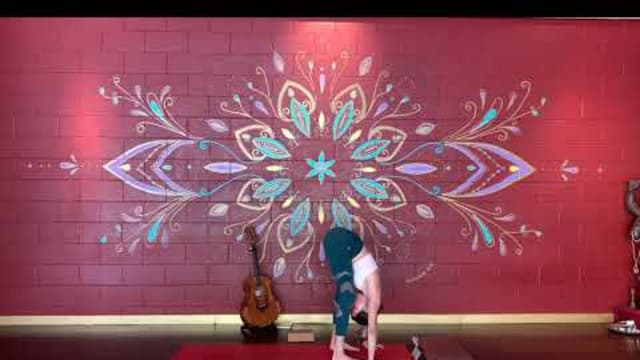
Charlie Follows' 25-minute daily yoga flow is a single, unhurried session built to be repeated on an ordinary day, not saved for a special one. It opens on the floor in child's pose, moves through wrist warm-ups and cat-cow, pedals into plank and downward dog, and then works through a long run of vinyasa transitions: low lunge twists, chaturanga, high lunges, warrior variations, lizard lunge, a standing fold, and a wide-legged squat called Skandasana before it settles into lying-down rest. Follows is a registered yoga teacher with more than 500 hours of training in vinyasa and functional anatomy, and the video shows that training in the choices she makes: which joints get attention first, which options she offers at each step, and how the breath is used as the metronome for the whole practice. What follows breaks down how the flow is built and why it holds together.
The class begins where most home practices do, on the mat, knees folded, forehead heading toward the floor. "So, you can keep your knees together or open them apart if you prefer," Follows says, and then she gives you five breaths to arrive. It is a small thing, but it sets the terms for everything after it. The first five breaths are not a warm-up in the athletic sense. They are a deliberate pause, and Follows frames the whole routine around that idea: take time to tune in to your body, to your breath, and to the practice.
Because the hands carry you through most of what comes next. From tabletop, Follows asks students to begin "moving in a circular direction to warm up the wrists," traveling through all four corners of the mat, first forward and back, then clockwise and counterclockwise. Anyone who has held a plank or a downward dog knows that wrists are the joints most likely to complain when they are asked to bear weight without preparation, and this short circuit does that work in under a minute.
Then comes cat-cow, linked tightly to the breath. "Now, on your inhale, arch your back, look forward. On your exhale, round your spine, look down. Move in time with your breath." The instruction is simple, but the function is significant. The spine is put through flexion and extension in a controlled rhythm, and the practice quietly teaches the habit it will rely on all session: movement starts with the breath, not the other way round. Follows adds a permission that matters for a daily practice: "Going as fast or as slow as you like." On the days when the body is stiff, the pace can drop. On the days when it is loose, it can rise.
Follows then uses the final inhale of cat-cow to lengthen the chest and back body with a longer pause, a pattern she repeats throughout the video. The contrast between the open chest and the rounded back gives the spine its first real range of motion before the body comes up into the weight-bearing work of plank.
Vinyasa, in its everyday sense, means linking one shape to the next with the breath as the connective tissue, and this video is built that way from start to finish. From cat-cow, Follows moves into plank by extending the legs and "pedal[ing] out the legs," with the option to lower one knee for support. She is specific about the form that matters in the transition: "try to keep the shoulders over the wrists. The spine is neutral. You're bracing your core here." That bracing is what makes the plank a working position rather than a collapse.
From plank the flow slides back into downward dog, where the feet alternate heel by heel, and then walks forward to a ragdoll position. The knees are bent, the upper body hangs over the legs, and the neck is relaxed with the chin tucked. Follows instructs a gentle side-to-side sway, holding the opposite elbow. It is one of the few moments where the video deliberately asks you to let weight go, and it works as a reset before the body is asked to build heat again.
The heat-building begins with low lunge twists. "Bring your fingertips down to the mat, inhale and lift your chest. Exhale, step the left foot back to low lunge." From there the arms open into a T-shape with each exhale, and the chest turns with the twist. Follows repeats the sequence several times, sometimes with the breath at the lead, sometimes with the pause at the top of the twist. The repetition is the point. A single twist stretches; a run of them starts to mobilize.
Then the flow shifts into a sequence that recurs through the class: chaturanga, a choice between cobra or upward-facing dog, and a return to downward dog. Chaturanga is described with care, "lower through chaturanga, moving as slowly as you can," and the back-bend choice is left open. Follows gives a clear cue for the transition itself: "Inhale, take cobra or upward-facing dog. Exhale, downward-facing." It is the spine's version of a breath cycle, and it appears on both sides of the body throughout.
"Choose the option that allows you to prioritize your breath."
That line is worth stopping on. It appears in the middle of the standing sequence, and it summarizes the teaching philosophy of the whole video: the form is a means to a steady breath, not an end in itself.
The standing work is where the practice spreads across the body's planes. From downward dog, Follows steps or hops the right foot through to a high lunge, reaches the arms up, and finds balance by fixing the gaze on one spot. The next move opens the hips and chest at once: exhale to open the back foot into warrior two, relax the shoulders, and focus on the front middle finger. Then the palm flips and the body leans back into a reverse warrior, which works the front of the body in a different direction from anything before it. Extended side angle follows, where the forearm can rest on the thigh or the hand can reach down to the inside of the foot. Follows gives the choice directly: pick the option that lets you "take a deep breath in and turn your chest open."
Lizard lunge comes next, with both hands on the inside of the front foot and the back foot turned forward. The knee can stay up or come down. The stretch is specific, and Follows names it: "You're looking to feel that stretch in the front of the left thigh," then the same on the other side. Working each side in turn, the flow keeps the balance even rather than letting one leg do all the work.
Once both sides are complete, the practice returns to the top of the mat and rounds the spine up to standing, turns to the side, and moves into a straddle. The forward fold is described with attention to the feet: distribute your weight "between the toes and the heels for balance," and let the hands come down to support you. A little bend in the knees is offered as acceptable. From the fold, the body lifts halfway, twists, and works through a long Skandasana near the end of the standing section, a wide-legged squat that takes the hands away when balance allows. The option structure is consistent. There is always a way to make the shape easier without losing the thread of the breath.
The description calls the class suitable for all levels, and the transcript supports that claim through its repeated options. Knees can come down in plank. The back toes can stay on the mat or tuck and lift the knee in the lunge pauses. Arms can rest on the thigh or reach to the floor. In the standing fold, the knees can stay bent. Each choice is framed the same way: keep the breath moving and the spine neutral, and choose the version that allows both. That is the real accessibility of the video. It does not reduce the practice to something gentle. It gives you permission to find the level at which the same shapes can be breathed through.
For a beginner, the value is in the pace and the cues. For a more experienced student, the value is in the options that add depth: the extended side angle with the hand on the mat, the Skandasana with hands lifted, the back-bend choice after chaturanga. The same sequence serves both, which is what a daily routine needs.
The final stretch of the video slows down. Follows invites you to lie down and extend the legs, and the instruction shifts from doing to noticing: relax the upper body, let the breath even out, and come back to the body. Near the close, she offers a question that sums up the intention of the whole class. Can you just be here without having to do anything? The answer is not a technique. It is a reminder that the twenty-five minutes were meant to be a pause as much as a workout.
The video ends with a brief farewell: "I hope that you enjoyed today's" session, with the closing word about energy. The routine is brief enough to repeat daily and thorough enough to touch every major area of the body. That combination is the reason it works as a daily practice, and why a teacher who spent years in studios and now teaches online built it this way.
If you try this flow, start with the opening five breaths and the wrist circles, and do not rush the first cat-cow. Let the breath set the pace, choose the option that keeps you steady, and treat the closing rest as part of the practice rather than an afterthought. If you want more from Charlie Follows, her programs are listed on her channel's site at charliefollows.com/programs, and her teaching is also shared on Instagram, Facebook, and TikTok. For a complete daily routine, pair this flow with a few minutes of seated breathwork on rest days, and return to the same sequence until the transitions feel like your own.